What Size Inverter to Run A Refrigerator
There's nothing quite like the dream of keeping your food cold and your beverages chilled, even when you're miles away from the nearest power pole. But the reality hits when you start looking at off-grid solar systems, and suddenly, you're faced with a dizzying array of numbers, terms, and specifications. One of the biggest head-scratchers for many folks is figuring out what size inverter you actually need to reliably run a refrigerator without constantly worrying about power outages or damaging your appliance. This guide is here to cut through the confusion and walk you through the precise steps to size an inverter specifically for your refrigerator, ensuring your off-grid setup keeps things cool and calm.
Understanding Your Refrigerator's Power Needs
Before you can pick out the perfect inverter, you absolutely have to get a handle on what your refrigerator demands in terms of electricity. It's not just a simple "plug and play" situation when you're off-grid; every watt counts, and understanding your appliance's hunger for power is the first and most crucial step in building a reliable system.
Decoding Watts, Amps, and Voltage
When you dive into the world of off-grid solar, you'll encounter a few terms that can seem like a foreign language: watts, amps, and volts. Let's break them down in simple terms.
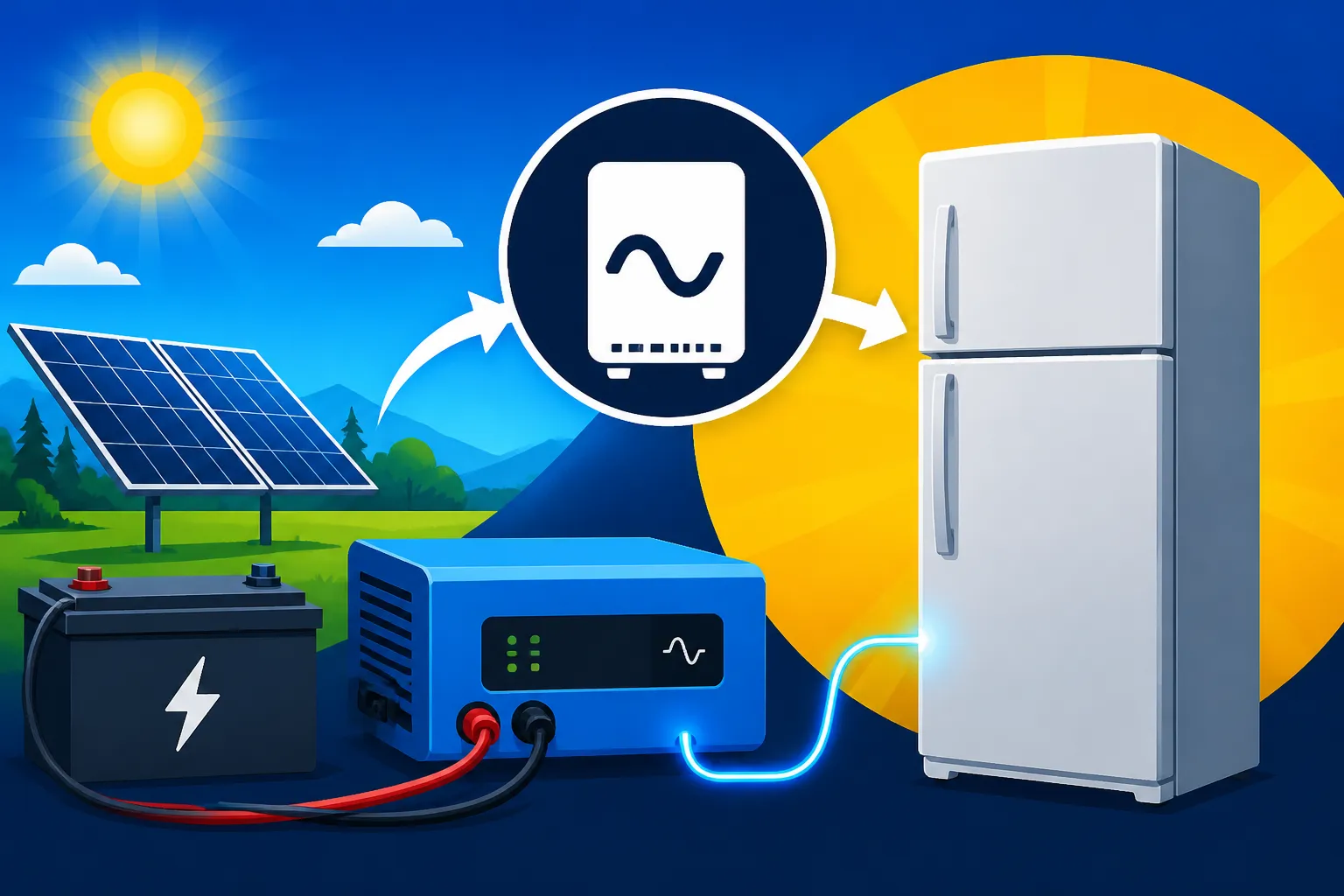
- Volts (V): Think of voltage as the "pressure" of electricity, pushing it through a circuit. Most standard household appliances in North America run on 120V AC (alternating current), while your off-grid battery bank typically stores power at lower DC (direct current) voltages like 12V, 24V, or 48V. Your inverter's job is to convert that DC battery power into usable AC power for your fridge.
- Amps (A): Amperage is the "flow" or volume of electricity. It tells you how much current an appliance draws. A higher amp draw means more electricity is flowing.
- Watts (W): This is the measure of actual power consumption, the amount of work the electricity is doing. Watts are calculated by multiplying volts by amps (Watts = Volts x Amps). When you're trying to figure out how much power your refrigerator uses, watts are your primary concern. This is what your solar panels need to generate and your batteries need to store. Understanding these fundamental units is key to effectively performing an Off-Grid Solar Load Calculation Explained.
For your refrigerator, you'll typically see wattage listed. This is the continuous power it needs to operate once it's up and running. However, refrigerators have a secret power surge that most people overlook, and that's where the real sizing challenge comes in.
Starting Watts vs. Running Watts The Surge
This is perhaps the most critical distinction when sizing an inverter for a refrigerator. If you only look at the "running watts" listed on your fridge, you're in for a rude awakening.
- Running Watts (or Continuous Watts): This is the power your refrigerator consumes once its compressor is actively running and maintaining temperature. It's the steady-state power draw. For a typical residential refrigerator, this might be anywhere from 100 to 300 watts.
- Starting Watts (or Surge Watts): This is the burst of power your refrigerator needs for a brief moment (a fraction of a second to a few seconds) when its compressor first kicks on. Compressors require significantly more power to overcome inertia and start moving, often 3 to 10 times their running wattage. This initial surge can be substantial—a fridge that runs at 150 watts might momentarily demand 800 to 1500 watts or even more to start up. If your inverter can't handle this surge, it will trip or simply fail to start the fridge, no matter how much battery power you have. This concept is so important that we often have dedicated discussions on How to Handle Starting Watts vs Running Watts in off-grid systems.
Many off-grid hopefuls make the mistake of choosing an inverter based solely on running watts, only to find their refrigerator refuses to start. This phenomenon isn't just limited to refrigerators; it applies to any appliance with a motor, like well pumps, air conditioners, or power tools.
How to Find Your Refrigerator's Specific Consumption
So, how do you get these crucial numbers for your specific refrigerator? There are a few reliable methods.
- Check the Appliance Label: Most appliances, especially energy-efficient ones, will have a yellow EnergyGuide label or a sticker on the back or inside the door that lists the annual kilowatt-hour (kWh) consumption. While useful for long-term energy budgeting, this doesn't directly tell you instantaneous running or starting watts. However, you might find a smaller sticker near the compressor or on the back that lists voltage, amperage, and sometimes wattage. If it lists amps, you can calculate the wattage: Watts = Amps x Volts (e.g., 5 Amps x 120 Volts = 600 Watts). This figure is usually the maximum running wattage.
- Consult the Manual: Your refrigerator's owner's manual or specification sheet is an excellent resource. It often provides detailed power consumption figures, including running watts and sometimes even a hint about surge current. If you don't have the physical manual, a quick search online with your refrigerator's make and model number will usually lead you to a digital version.
- Use a Kill-A-Watt Meter: This is the most accurate and recommended method. A Kill-A-Watt meter is an inexpensive device that plugs into a standard wall outlet, and then you plug your appliance into it. It will precisely measure the real-time power consumption, including instantaneous watts, peak watts (surge), voltage, amperage, and kilowatt-hours over time. To get an accurate starting wattage, you'll want to plug it in, cycle the fridge off and on, and watch the peak wattage reading. Do this a few times to get a consistent peak. You can find these meters readily available on platforms like Amazon. This kind of real-world measurement is invaluable when you're trying to How to Estimate Appliance Power Draw accurately for your off-grid setup.
Let's say your Kill-A-Watt meter shows your refrigerator consistently runs at about 180 watts, but when the compressor kicks on, it briefly spikes to 1200 watts. These are the numbers you'll need for your inverter sizing.
Key Factors in Inverter Sizing for Refrigerators
Once you understand your refrigerator's power demands, you can start looking at inverters. It's not just about a single number; several specifications dictate an inverter's suitability for powering a motor-driven appliance like a fridge.
Continuous Power Output
The continuous power output of an inverter is its bread and butter. This rating tells you how much wattage the inverter can supply constantly, day in and day out, without overheating or failing. For your refrigerator, this continuous output must be at least equal to, and preferably a bit higher than, your refrigerator's running watts.
For example, if your refrigerator runs at 180 watts, an inverter with a 200-watt continuous rating might technically work, but it's cutting it too close. You'll want some headroom. A 300-watt or 500-watt continuous inverter would provide a much more comfortable margin. Remember, an inverter's efficiency can drop when it's constantly running at its maximum capacity, leading to more heat and potentially shorter lifespan. Giving it some breathing room is always a good idea. When planning your whole system, getting this right for all your appliances is part of knowing How Many Watts of Solar You Need.
Surge Capacity is Critical
As we discussed, the surge capacity is the temporary, higher wattage an inverter can provide for a very short duration, typically a few seconds. For refrigerators, this is the most critical specification. Your inverter's surge rating must be able to handle your refrigerator's starting watts.
If your fridge surges to 1200 watts at startup, your inverter needs a surge rating of at least 1200 watts. Many inverters have a continuous rating and a separate, higher surge rating that's often 2x or even 3x its continuous rating. So, a 1000-watt continuous inverter might have a 2000-watt surge capacity, making it perfect for a fridge that runs at 200 watts but surges to 1500 watts.
It's also important to consider the waveform of the inverter.
- Pure Sine Wave Inverters: These produce a clean, smooth AC waveform that is identical to the power you get from the utility grid. They are essential for sensitive electronics, motor-driven appliances like refrigerators, and anything with a clock or digital display. Using a pure sine wave inverter ensures your refrigerator's compressor runs efficiently, quietly, and prolongs its lifespan. Most modern refrigerators require pure sine wave power.
- Modified Sine Wave Inverters: These are cheaper but produce a "choppy" approximation of an AC waveform. While they might work for simple resistive loads (like incandescent lights or heating elements), they are generally not suitable for refrigerators. They can cause motors to run hotter, less efficiently, make a buzzing noise, and potentially damage sensitive electronics or even the compressor itself over time. For more on this, you can explore the differences in Pure Sine Wave vs Modified Sine Wave Inverters.
Always choose a pure sine wave inverter for a refrigerator. Reputable brands like Renogy offer a range of pure sine wave inverters that are popular in the off-grid community for their reliability and performance.
System Voltage Compatibility
Inverters are designed to work with specific DC input voltages from your battery bank. Common off-grid system voltages are 12V, 24V, and 48V.
- 12V Systems: Often used for smaller setups like RVs or small cabins, and usually paired with smaller inverters (up to 2000 watts).
- 24V Systems: A good middle-ground for medium-sized systems, allowing for smaller wire gauges than 12V for the same power, and supporting larger inverters (up to 4000 watts).
- 48V Systems: Preferred for larger off-grid homes and substantial power needs, as they are the most efficient and allow for the smallest wire sizes, supporting very large inverters (5000 watts and up).
The inverter you choose must match your battery bank's voltage. If you have a 12V battery bank, you need a 12V inverter. If you're designing a new system from scratch, choosing a higher voltage (like 24V or 48V) can be more efficient, especially if you plan to have a larger inverter for other appliances later. This is a key consideration when designing an off-grid solar system.
Step-by-Step Guide to Sizing Your Inverter
Now that we've covered the basics, let's walk through the practical steps to determine the right inverter size for your refrigerator. This methodical approach will prevent headaches down the road.
Calculate Your Refrigerator's Running Wattage
Start by identifying the continuous power your refrigerator needs. As mentioned earlier, use the appliance label, manual, or, ideally, a Kill-A-Watt meter. Let's work with an example:
Example:
- Your refrigerator's sticker shows 1.5 Amps at 120 Volts.
- Running Watts = 1.5 A * 120 V = 180 Watts.
- Or, your Kill-A-Watt meter directly reads a steady 180 Watts when the compressor is running.
This 180W is the baseline continuous power your inverter needs to supply.
Determine the Peak Starting Wattage
Next, you need to find that all-important surge wattage.
- Using a Kill-A-Watt Meter: This is the most accurate. Plug it in, let the fridge run, then unplug it for a minute and plug it back in, observing the highest spike on the meter. Repeat a few times.
- Example (continued): Your Kill-A-Watt meter shows a peak startup surge of 1200 Watts.
- Estimating (if you don't have a meter): If you can't measure it, you'll need to estimate. A common rule of thumb for older or less efficient refrigerators is to multiply the running wattage by 5 to 10. For newer, more efficient fridges, it might be 3 to 5 times. This is where things can get a bit risky if you undersize.
- Example (estimation): If your running wattage is 180W and you assume a 7x surge multiplier (to be safe), estimated starting wattage = 180 W * 7 = 1260 Watts.
Always err on the side of caution when estimating. It's better to slightly oversize your inverter than to undersize it and have your fridge fail to start. This is a critical part of How to Size an Off-Grid Inverter.
Select an Inverter with Adequate Continuous and Surge Ratings
With your running and starting wattages in hand, you can confidently choose an inverter.
- Continuous Rating: The inverter's continuous power rating must be greater than your refrigerator's running wattage. For our example, a 180W running fridge needs an inverter with a continuous rating of at least 200-250W.
- Surge Rating: The inverter's surge power rating must be greater than your refrigerator's peak starting wattage. For our example, a 1200W starting surge needs an inverter with a surge rating of at least 1200-1300W.
You'll quickly find that inverters are typically rated by their continuous output. For instance, a 1000W continuous inverter will usually have a surge rating somewhere between 1500W and 3000W for a few seconds.
Let's look at our example:
- Running Watts: 180W
- Starting Watts: 1200W
You'd be looking for an inverter that can continuously deliver at least 200-250W and surge to at least 1200W.
A 1000-watt pure sine wave inverter (like a popular model from Renogy or a similar brand found on Amazon) often has a surge capacity of 2000 watts. This would be an excellent fit for our example refrigerator, providing ample headroom for both continuous operation and startup surge. It's often better to go slightly larger than the bare minimum to account for efficiency losses and ensure longevity.
Here's a quick comparison table for typical refrigerator types and suggested inverter sizes:
| Refrigerator Type | Average Running Watts (Approx.) | Estimated Starting Watts (Approx.) | Minimum Recommended Continuous Inverter Size | Minimum Recommended Surge Inverter Size | Suggested Inverter Size (Continuous) |
|---|---|---|---|---|---|
| Mini Fridge (1-4 cu ft) | 40-80W | 200-500W | 150W | 500W | 300W |
| Compact (4-10 cu ft) | 70-150W | 350-1000W | 250W | 1000W | 500W |
| Standard (15-20 cu ft) | 100-200W | 500-1500W | 300W | 1500W | 1000W |
| Large/Side-by-Side | 150-300W | 750-2500W | 500W | 2500W | 1500-2000W |
| Energy-Efficient Models | 60-120W | 300-800W | 200W | 800W | 750W |
Note: These are estimates. Always check your specific appliance's ratings or use a Kill-A-Watt meter.
Adding a Buffer for Future Needs or Other Appliances
While this guide focuses specifically on your refrigerator, it's wise to consider your overall power needs. Are you planning to run a microwave, a coffee maker, or charge laptops at the same time? Even if not immediately, off-grid systems often grow over time.
It's almost always a good idea to oversize your inverter by about 20-30% beyond what your current calculated peak load (refrigerator surge + other concurrent running loads) requires. This provides a buffer for:
- Inverter Efficiency Losses: All inverters lose some power as heat during conversion.
- Aging Components: As batteries or other components age, their performance might slightly decrease.
- Unforeseen Loads: That occasional power tool, blender, or extra light.
- Simultaneous Operation: What if the fridge kicks on just as someone starts charging a laptop?
- Future Expansion: You might decide to add more appliances later.
So, if your refrigerator needs a 1000W continuous inverter, consider a 1200W or 1500W model instead, if your budget allows. This provides peace of mind and flexibility for your off-grid lifestyle. For a deeper dive into choosing the right component, you might find our guide on Best Off-Grid Solar Inverters helpful, or even a specific comparison like Best Inverter for Off-Grid Solar. Don't forget to factor in the Cost of an Off-Grid Solar Inverter into your overall budget!
Common Mistakes and Advanced Considerations
Even with the best intentions, it's easy to fall into common traps when sizing an inverter for a refrigerator. Being aware of these pitfalls can save you time, money, and frustration.
Ignoring the Importance of Pure Sine Wave Inverters
As touched upon earlier, this cannot be stressed enough: always use a pure sine wave inverter for a refrigerator. While a modified sine wave inverter might seem like a budget-friendly option, especially for smaller systems, it's a false economy when it comes to motor-driven appliances.
Modified sine wave power can cause the motor in your refrigerator's compressor to run hotter and vibrate excessively. This leads to reduced efficiency, increased energy consumption, a shorter lifespan for the compressor, and potential damage to the refrigerator's control board or other sensitive electronics. You might notice a loud humming sound, and your food might not stay as cold because the compressor isn't working optimally. It's just not worth the risk for such a critical appliance. Invest in a quality pure sine wave inverter from the start; it's one of the best investments you can make for your off-grid system's reliability and appliance longevity.
Underestimating Surge Requirements
This is another common pitfall. People often get focused on the "continuous" wattage and forget about the brief but intense startup surge. Imagine you have a 500-watt inverter, which is more than enough for your fridge's 180-watt running draw. You plug it in, and… nothing happens, or the inverter simply trips a fault code and shuts down. The problem isn't the inverter's continuous capacity; it's its inability to handle that 1200-watt surge for even a fraction of a second.
Always, always verify the surge rating and ensure it exceeds your refrigerator's maximum starting wattage. If you're unsure, go with a larger inverter. A common practice for off-grid system designers is to target an inverter that has a surge capacity at least 2-3 times greater than the refrigerator's running wattage, and then confirm that this surge capacity also covers the actual measured or estimated starting wattage. This cautious approach ensures that your inverter will handle the initial jolt and reliably power your fridge every time. Proper inverter sizing is an integral part of understanding Off-Grid Solar System Sizing Guide as a whole.
Accounting for Environmental Factors
While not directly related to sizing the inverter for the refrigerator itself, environmental factors can impact the inverter's performance, which in turn affects its ability to power your fridge.
- Temperature: Inverters generate heat as they convert DC to AC power. High ambient temperatures can reduce an inverter's efficiency and even trigger thermal shutdowns if it gets too hot. Ensure your inverter is installed in a well-ventilated area, away from direct sunlight or enclosed spaces where heat can build up. Many inverters are rated for continuous operation at specific temperatures, and their performance might "derate" (reduce output) in hotter conditions.
- Altitude: For very high altitudes, the air is thinner, which can reduce an inverter's cooling efficiency. While this is less common for typical residential setups, it's a factor in extreme environments.
- Wire Length and Gauge: The wiring between your batteries and the inverter is crucial. If the wires are too long or too thin (small gauge), there will be significant voltage drop, meaning less power reaches the inverter. This can make the inverter work harder, reduce its efficiency, and potentially prevent your refrigerator from starting properly. Always size your battery cables correctly to minimize voltage drop, following electrical code and manufacturer recommendations. This is part of the broader topic of How to Wire an Off-Grid Solar System safely and efficiently.
Taking these environmental and installation considerations into account ensures that your perfectly sized inverter can actually perform as expected when powering your critical appliances like a refrigerator.
Disclaimer
Please note that the information provided in this guide is for educational and informational purposes only. While we strive to offer accurate and up-to-date advice, off-grid solar system design and installation can be complex and may require professional expertise. Always consult with a qualified electrician or solar professional before making significant decisions about your off-grid power system. Local regulations, codes, and specific product specifications can vary, and it is your responsibility to ensure compliance and safety.