How Much to Oversize Your Solar Array
One of the most disheartening experiences when you're living off-grid is watching your battery bank drain faster than expected, especially when the sun isn't cooperating. That sinking feeling of realizing you might not have enough power for another few cloudy days can really throw a wrench in your independence. This guide is here to help you understand why strategically oversizing your off-grid solar array isn't just a luxury, but a smart, proactive move to ensure reliable, continuous power, even when nature has other plans.
Why Oversizing Your Off-Grid Solar Array is More Than Just a Good Idea
It's easy to look at the nameplate wattage on a solar panel and assume that's what you'll get, day in and day out. But the truth of off-grid living is far more nuanced. The reality is, what your panels can produce under ideal conditions is rarely what they do produce in the real world. That's why building a bit of extra capacity into your system from the start is absolutely crucial for peace of mind and consistent power.
Battling Unpredictable Weather and Seasonal Changes
Anyone who's lived off-grid for more than a few weeks knows that the sun isn't always shining bright and strong. Weather patterns can be incredibly fickle, and relying solely on perfect conditions is a recipe for disappointment and dead batteries. Oversizing your array helps you mitigate these unpredictable challenges.
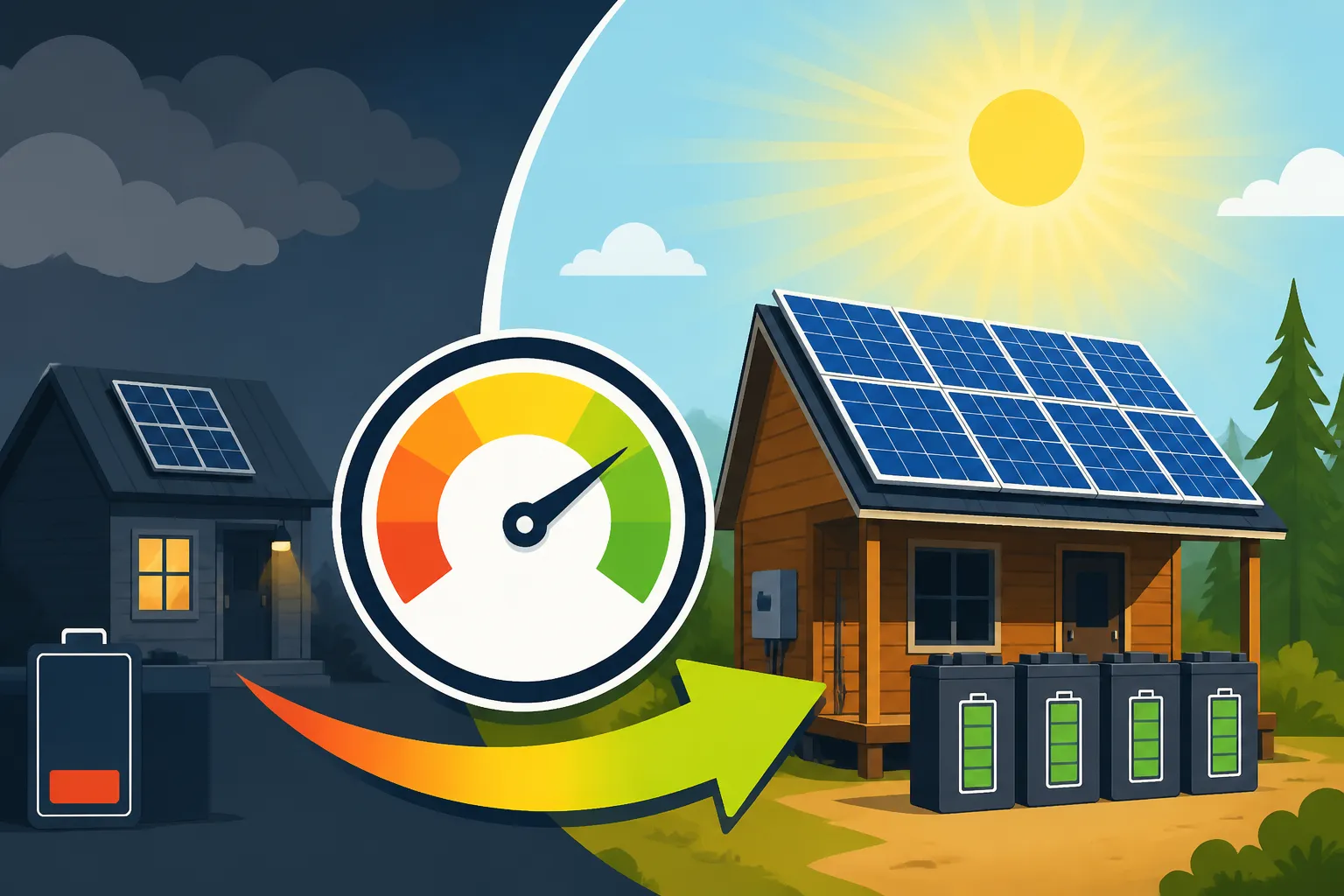
Imagine you're in a place like the Pacific Northwest, where "sun breaks" are more common than full sunny days, especially outside of summer. A standard-sized array, perfectly calculated for peak sun, would leave you in the dark frequently. Or consider the stark difference between summer and winter sun hours. In winter, not only are the days shorter, but the sun's angle is lower, and often, there's more cloud cover or even snow on your panels. Your panels might be rated for 400 watts, but on a dreary December day, they might only be pulling in 50-100 watts. An oversized array acts as a buffer, allowing you to capture more energy during those limited sunny periods, ensuring you still hit your daily energy targets even when conditions are less than ideal. It's about building resilience into your power supply.
Accounting for System Inefficiencies and Degradation
The journey of electricity from your solar panels to your appliances is not 100% efficient. At every step along the way, some energy is lost, usually as heat. These are small losses individually, but they add up across the entire system. You've got losses in the wiring itself, especially if cables are too thin or runs are too long, causing voltage drop. Then there are losses within the charge controller, converting the raw power from the panels into a usable form for your batteries. Your inverter, which changes DC power from your batteries into AC power for most household appliances, also has its own efficiency ratings, typically ranging from 85% to 95%.
Beyond these operational inefficiencies, solar panels themselves degrade over time. Most manufacturers guarantee a certain performance level, often 80-85% of their original output, after 20-25 years. While that sounds like a long time, the degradation starts from day one. In the first year alone, you might see a 2-3% drop, followed by about 0.5% each subsequent year. If you're designing a system meant to last for decades, ignoring this gradual decline means you'll eventually find your "perfectly sized" system falling short. By adding an extra 15-25% to your array from the outset, you're not just covering immediate losses, you're also building in a cushion for this natural aging process, ensuring your system continues to meet your needs for years to come.
Future-Proofing for Expanding Energy Needs
Let's be honest, our energy needs often grow over time. What starts as a simple cabin setup with a few lights and a mini-fridge can quickly evolve. Maybe you decide to add a water pump, a Starlink internet dish, a more powerful freezer, or even a small workshop with power tools. Perhaps you have guests more often, or your family grows. Each new appliance or change in lifestyle adds to your daily energy consumption.
Trying to squeeze more power out of an undersized system means constant energy conservation, running on fumes, or having to undertake a costly, complex expansion project down the line. When you originally designed your system, you probably agonized over every Watt-hour. But by oversizing a bit, you give yourself breathing room. You can embrace new technologies, install that washing machine you've been dreaming of, or simply run your appliances without constant worry. It's much simpler and often more cost-effective to install a few extra panels and a slightly larger charge controller during the initial build than to re-engineer and add components later, which can involve new wiring, mounting, and system rebalancing. Thinking ahead about how your off-grid life might evolve can save you a lot of headaches and expense.
How to Calculate the Right Amount of Oversizing for Your System
Calculating the right amount of oversizing isn't about throwing extra panels at the problem randomly. It's a calculated decision based on a solid understanding of your actual energy demands, environmental conditions, and system components. Getting this right is foundational to a reliable off-grid setup.
Understanding Your Base Load and Critical Loads
Before you even think about oversizing, you absolutely must have a crystal-clear picture of your daily energy consumption. This starts with a thorough How to Calculate Daily Energy Usage or Off-Grid Solar Load Calculation Explained. Go through every single appliance and device you plan to power, noting its wattage and how many hours per day you expect to use it. This will give you your baseline daily Watt-hour (Wh) requirement. For example, if your refrigerator uses 100 watts and runs for 8 hours a day, that's 800 Wh. A 10-watt LED light on for 5 hours is 50 Wh. Add these all up for your total daily consumption.
It's also smart to differentiate between "base loads" – the essentials you need running constantly (like a fridge, internet router, essential lighting) – and "critical loads" – things you can't live without, even if they aren't always on (like a well pump or CPAP machine). Then there are "convenience loads" (like a microwave or TV) that you might be willing to cut back on during lean times. Your oversizing strategy should heavily prioritize ensuring your base and critical loads are always met, no matter what. Don't guestimate here; actual measurement with a kill-a-watt meter can reveal surprising usage patterns.
Applying Loss Factors and Days of Autonomy
Once you have your total daily Watt-hour needs, it's time to factor in the real-world losses we discussed. A good rule of thumb is to assume a combined system efficiency of around 75-85%. This means if your panels generate 1000 Wh, only 750-850 Wh will actually make it to your appliances after all the conversions and transfers. So, if you need 5,000 Wh per day, you'll actually need your panels to generate closer to 5,000 Wh / 0.80 = 6,250 Wh from the array itself.
Next comes the concept of "days of autonomy." This refers to how many days your battery bank can power your home without any input from the sun. While this primarily dictates How to Size an Off-Grid Battery Bank, it also informs your solar array sizing. If you want to be able to ride out three consecutive cloudy days, you'll need enough panels to not only meet your daily consumption but also to fully recharge that significantly depleted battery bank once the sun returns, and do so quickly before the next stretch of bad weather. How to Account for Cloudy Days is a huge factor here. Many off-gridders aim for 2-5 days of autonomy, depending on their location and risk tolerance. If you live in an area with frequent, multi-day cloud cover, you might want to increase your array size to help "catch up" faster after a deficit, or simply to ensure you're generating some power even on very dim days.
Considering Regional Solar Insolation (Peak Sun Hours)
This is perhaps the most critical factor in sizing your array, and where oversizing really makes sense. Solar insolation, often measured in "Peak Sun Hours" (PSH), isn't about how many hours the sun is visible, but rather how many hours per day your panels receive the equivalent of full, direct sunlight (1000 watts per square meter). Peak Sun Hours Explained thoroughly covers this, but the key takeaway is that PSH varies wildly by location, season, and even specific panel orientation.
For instance, Phoenix, Arizona, might get 6-7 PSH in winter, while Seattle, Washington, might only get 1-2 PSH during the same period. If your baseline calculation is based on average PSH for your area, you'll still be short during the worst months. To truly ensure year-round power, you should size your solar array based on the lowest PSH month you anticipate needing full power. This means if your off-grid cabin in northern Michigan needs consistent power in December (which might only offer 2-3 PSH), you'll need significantly more panels than if you were just sizing for summer use with 5-6 PSH.
Here's a simplified look at how PSH can impact your sizing, demonstrating why oversizing relative to average PSH is essential:
| Location Example | Season | Average Peak Sun Hours (PSH) | Panels Needed (for 5000 Wh daily, 80% system efficiency) |
|---|---|---|---|
| Phoenix, AZ | Summer | 7 | (6250 Wh / 7 PSH) / 1000W = 0.89 kW (approx. 2x450W panels) |
| Phoenix, AZ | Winter | 5 | (6250 Wh / 5 PSH) / 1000W = 1.25 kW (approx. 3x450W panels) |
| Seattle, WA | Summer | 5 | (6250 Wh / 5 PSH) / 1000W = 1.25 kW (approx. 3x450W panels) |
| Seattle, WA | Winter | 2 | (6250 Wh / 2 PSH) / 1000W = 3.12 kW (approx. 7x450W panels) |
Note: Panel wattage is for illustrative purposes. Actual number depends on individual panel wattage.
As you can see, the difference is stark. If you sized your Seattle system based on summer (3 panels), you'd be severely underpowered in winter. To truly have reliable year-round power, you'd effectively need to "oversize" your array for the summer by almost double (7 panels).
Practical Strategies for Implementing an Oversized Array
Once you understand why oversizing is important and how to calculate it, the next step is putting it into practice. This isn't just about slapping more panels on your roof; it involves strategic choices about your components and how you approach your build.
Choosing the Right Components for Expansion
One of the smartest ways to enable an oversized array, whether you install all the panels initially or plan to add them later, is by selecting system components with extra capacity from the start. Your charge controller, for example, is the brain that manages the power flow from your panels to your batteries. It has a maximum input voltage and current rating. If you plan to eventually expand your solar array, it's a great idea to buy a charge controller that can handle, say, 25-50% more wattage than your initial panel installation. This way, when you decide to add those extra panels, you won't need to replace the charge controller – a significant cost saving. Brands like Renogy and Victron Energy offer robust charge controllers that often have higher ceilings for PV input, making them excellent choices for scalable systems. Look into options like their MPPT controllers, which are highly efficient and often have good headroom for future expansion. A slightly larger investment upfront in components like your charge controller and inverter can save you a bundle and a headache down the road. Remember, learning How to Size a Charge Controller correctly is paramount.
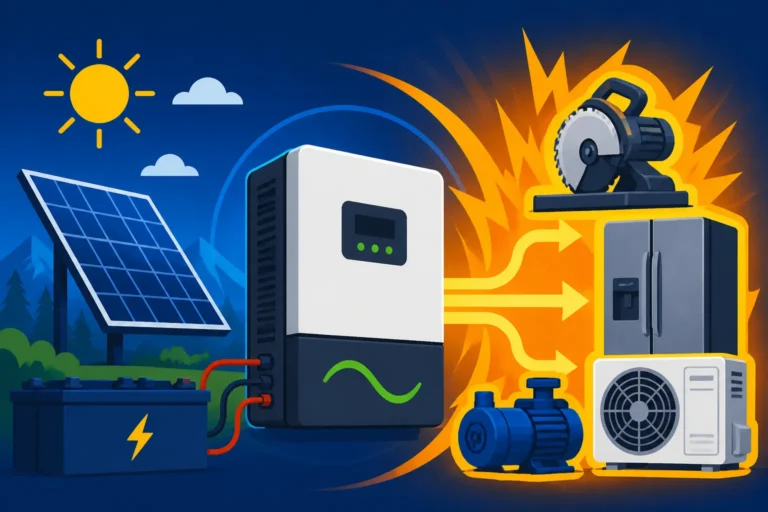
Similarly, your inverter needs to be able to handle the peak AC loads you anticipate, plus any potential future additions. If you know you might eventually add an AC mini-split or a larger power tool, choosing an inverter with a higher continuous output and surge capacity now can prevent you from needing to upgrade it later. This doesn't mean buying a massive 15kW inverter if you only need 3kW, but perhaps opting for a 4kW or 5kW model instead of a bare-minimum 3kW unit. If you're wondering How to Size an Off-Grid Inverter, always consider both your continuous and surge power needs.
Phased Expansion versus Building Big from the Start
Your budget and immediate needs will often dictate whether you build a fully oversized system from day one or plan for a phased expansion. Both approaches have their merits.
Building Big from the Start:
- Pros: Immediate maximum power generation, fully prepared for worst-case weather, often more efficient installation (one trip, one wiring job).
- Cons: Higher upfront cost, requires a larger initial investment in all components (panels, charge controller, batteries).
Phased Expansion:
- Pros: Spreads out the cost over time, allows you to learn your actual energy usage before committing to a final system size, less initial financial burden. This is covered in more detail in How to Phase an Off-Grid Solar Build to Spread Cost.
- Cons: Requires careful planning to ensure components are compatible and scalable, may involve multiple installation phases (and thus, more labor or trips), you'll operate with less resilience in the interim.
If you opt for phased expansion, make sure you're wiring your initial array in a way that allows easy addition of more panels later – for example, leaving space on your roof or ground mount, and ensuring your combiner box and wiring are rated for the future maximum current and voltage, not just the current minimum. It’s far easier to pull one set of correctly sized wires initially than to re-run everything later.
Monitoring and Adjusting Your System Over Time
Installing an oversized array isn't a "set it and forget it" operation. To truly leverage its benefits and ensure long-term reliability, you need to actively monitor your system's performance. A good battery monitor is essential for tracking your state of charge, incoming solar wattage, and outgoing loads. Many modern charge controllers and inverters, especially from brands like Victron, come with comprehensive monitoring apps that provide real-time data and historical logs. These tools allow you to see exactly how much power your oversized array is generating, how quickly it's recharging your batteries, and if you have surplus energy.
By regularly checking your system, you can:
- Verify performance: Are your panels producing as expected, even on cloudy days?
- Identify bottlenecks: Is your charge controller or inverter being overwhelmed?
- Optimize usage: If you see a consistent surplus of power during certain times, maybe you can schedule higher-draw activities (like doing laundry or running a well pump) during those peak production hours.
- Plan future upgrades: Your monitoring data can inform future decisions. If you're consistently running a significant surplus, maybe you don't need to add as many panels as originally planned. Conversely, if your oversized array is still barely keeping up during extended bad weather, it might indicate that your "oversize" factor wasn't quite enough for your specific conditions, or that your load calculations were too low. Many essential monitoring tools and even complete kits can be found on Amazon, making it easy to get started.
Common Oversizing Pitfalls to Avoid
While oversizing your solar array is generally a wise move for off-grid living, it's not without its potential drawbacks if not approached thoughtfully. You don't want to inadvertently create new problems or spend money unnecessarily.
Overspending on Unnecessary Capacity
The goal of oversizing is resilience, not extravagance. There's a fine line between adequately preparing for contingencies and simply throwing money at an unnecessarily large system. Every extra panel, larger charge controller, and thicker cable adds to your upfront How Much Does an Off-Grid Solar System Cost. If you dramatically oversize beyond what your worst-case scenarios and future plans truly warrant, you might be tying up capital that could be better spent elsewhere, perhaps on a more efficient appliance, better insulation for your home, or even a robust backup generator.
A common mistake is oversizing based on an unrealistic expectation of running all appliances all the time, even heavy loads like air conditioning or electric water heaters, without any thought to conservation. In an off-grid setup, energy conservation should always be your first line of defense. By carefully doing your load analysis and distinguishing between absolute necessities and luxuries, you can find the sweet spot for oversizing that gives you peace of mind without breaking the bank. Remember that even with an oversized array, there will be times when you need to be mindful of your consumption.
Neglecting Battery Bank Sizing
An oversized solar array is fantastic for generating power, but if your battery bank isn't capable of storing that extra energy, much of it will simply go to waste. Your batteries are the true heart of your off-grid system, providing power when the sun isn't shining. If you have a massive array producing 5,000 watts an hour, but your batteries can only accept 2,000 watts of charge at that moment, the remaining 3,000 watts are effectively lost.
Think of it this way: you can have the fastest car in the world, but if your fuel tank is tiny, you still can't go very far. Your battery bank needs to be sized not only to meet your daily energy demands during periods of no sun (your days of autonomy) but also to efficiently absorb the energy produced by your oversized solar array. Neglecting How to Size an Off-Grid Battery Bank in proportion to your array means you're missing out on the full benefits of your investment in larger panels. A well-balanced system ensures that the power your panels generate can actually be stored and utilized.
Inadequate Component Matching
When you oversize your solar array, you're increasing the amount of power flowing through your system. This has implications for every other component. Your charge controller, as mentioned, must be able to handle the increased voltage and amperage from your larger panel array. If you add too many panels or panels with too high a voltage to a controller that can't handle it, you risk damaging the controller or, at best, seeing significantly reduced efficiency as the controller limits input.
Similarly, all your wiring – from the panels to the charge controller, from the charge controller to the batteries, and from the batteries to the inverter – must be appropriately sized for the maximum current that could flow. Undersized wires can overheat, become a fire hazard, and lead to significant voltage drop, which translates to wasted power. Fuses and breakers also need to be rated for the increased current to provide adequate protection. It's a classic Common Off-Grid Sizing Mistakes to focus solely on panels and batteries without ensuring that all the intermediary components can safely and efficiently handle the increased power flow. Always consult wiring diagrams and component specifications to ensure everything is matched correctly and safely.
Disclaimer
The information provided in this guide is for general informational purposes only and does not constitute professional advice. Off-grid solar system design and installation can be complex and involve electrical hazards. Always consult with qualified professionals and adhere to all local codes, regulations, and safety guidelines when planning or installing your off-grid solar system.