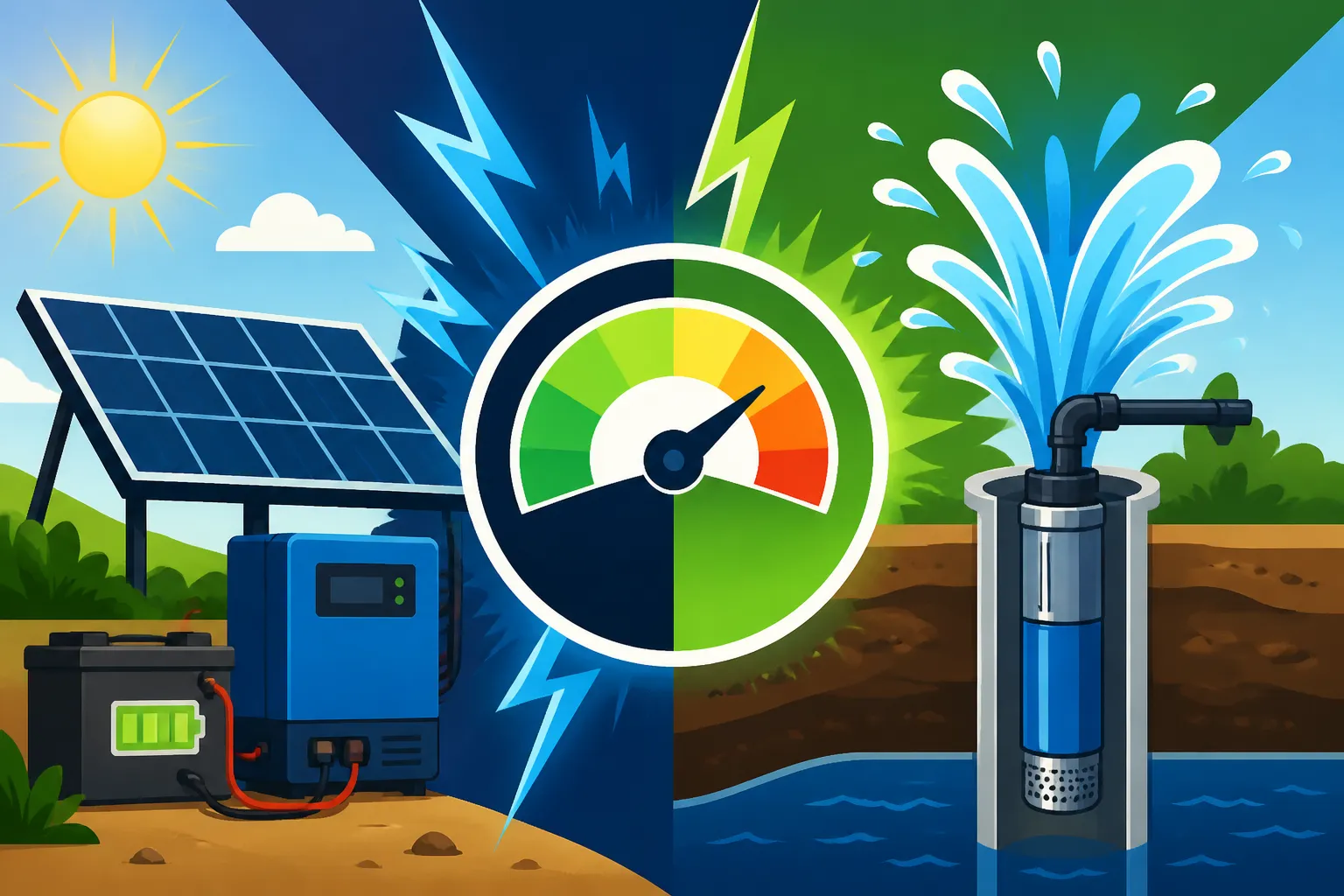
How to Size for a Well Pump Surge
Oh, the humble well pump! It's one of those essential appliances that can make or break an off-grid solar system, often leading to frustration and unexpected system shutdowns for folks who didn't account for its unique power demands. If you're struggling to keep your well pump running reliably on solar, or you're planning your system and want to avoid that headache, you've come to the right place. This comprehensive guide will walk you through exactly how to size your off-grid solar setup to handle the notorious well pump surge, ensuring your water supply is always flowing smoothly.
Understanding the Beast: Why Well Pumps Are Unique Off-Grid Challenges
You might think, "It's just a pump, how hard can it be?" But anyone who's tried to power a well pump with an undersized off-grid system quickly learns that these appliances are a different breed altogether. They don't just consume power; they demand it, especially during that critical moment when they first kick on. This distinction is vital for maintaining a stable and reliable off-grid homestead.
The Silent Power Hog: Running Watts vs. Starting Watts
The biggest misunderstanding surrounding well pumps, and frankly, many motor-driven appliances, is the difference between their running watts and their starting watts. When you look at an appliance's specifications, you'll usually see its "running watts" or "continuous wattage." This is the power it consumes once it's up and running smoothly. For a well pump, this might be a perfectly manageable 800-1500 watts, depending on its horsepower and depth.
However, motors, especially induction motors like those found in most well pumps, require a massive burst of power to overcome inertia and get the motor spinning from a complete stop. This initial, momentary draw is known as the "starting surge" or "locked rotor amps" (LRA). This surge can be anywhere from 3 to 7 times the continuous running wattage, sometimes even higher. Imagine a small 1/2 horsepower submersible well pump that typically sips around 1000 watts while it's pumping water. When it first starts up, that same pump might demand a startling 3000 to 7000 watts for just a fraction of a second.
It's this enormous, instantaneous power spike that causes most off-grid solar systems to falter. If your inverter isn't designed to handle this brief, intense demand, it will simply shut down, often displaying an "overload" error, leaving you without water. Many new off-gridders learn this lesson the hard way, spending countless hours troubleshooting an otherwise perfectly functional system, only to realize their inverter is just too small to manage the initial startup of their well pump.
Types of Well Pumps and Their Power Demands
Not all well pumps are created equal when it comes to their power requirements, particularly their starting surge. Understanding the type of pump you have, or plan to install, is crucial for accurate sizing. The two most common types are submersible pumps and jet pumps, each with slightly different characteristics that impact your off-grid solar design.
Submersible pumps, as their name suggests, are designed to be submerged directly into the well. They push water upwards, and because they're pushing a column of water from a deep source, they often experience a higher starting surge. The motor has to overcome the static pressure of the water above it, plus the inertia of getting the pump mechanism moving, all at once. This often results in higher LRA values and therefore a more significant power spike during startup. A 1 horsepower submersible pump in a deep well will likely have a more dramatic surge profile than a 1 horsepower jet pump.
Jet pumps, on the other hand, are typically located above ground, drawing water up from the well using an impeller and a venturi system. While they still have a starting surge, it can sometimes be less severe than that of a submersible pump because they don't have to overcome the same initial water column inertia directly from within the well itself. However, they still contain induction motors, so a significant surge is still a factor you absolutely cannot ignore. Regardless of the type, the pump's horsepower (HP) rating is your primary indicator of its overall power consumption, both running and starting. A higher HP generally translates to higher running watts and a more substantial starting surge, directly influencing your decision on How to Size an Off-Grid Inverter.
Decoding the Surge: How to Calculate Your Well Pump's Needs
The key to successfully powering your well pump off-grid lies in moving beyond guesswork and getting precise numbers for your specific pump. Estimating can lead to either an undersized system, which is useless, or an oversized system, which is unnecessarily expensive. Let's dig into how to find those critical figures.
Finding Your Pump's Real Numbers
The very first step is to consult the well pump's nameplate, its owner's manual, or the manufacturer's specifications. Do not skip this! This information is gold. On the nameplate, you'll typically find the pump's horsepower (HP), voltage (V), running amperage (A), and sometimes, critically, its "Locked Rotor Amps" (LRA) or "Starting Amps." The LRA is the maximum current drawn by the motor at the instant it starts, before the motor has begun to turn.
If you can find the LRA, you're in great shape. You can calculate the approximate starting wattage by multiplying the LRA by the system voltage (e.g., LRA x 240V for a typical household well pump). For instance, if your 240V pump has an LRA of 30 amps, its starting surge would be around 7,200 watts (30A * 240V = 7200W). This is a precise and reliable way to determine the surge. If the LRA isn't listed, you'll often find a surge multiplier for induction motors, usually in the range of 3 to 7 times the running wattage. So, if your pump's running watts are 1200W, you might estimate a surge of 3600W to 8400W. It's always safer to err on the higher side of this estimate if you can't find specific LRA data, as it ensures your inverter has enough headroom.
The Importance of a True Energy Audit
Knowing your pump's surge is only part of the equation; you also need to understand its daily usage patterns. This is where a thorough energy audit, as detailed in our guide on How to Calculate Daily Energy Usage, becomes indispensable. Even if your pump surges to 6000 watts, it only does so for a split second. What truly impacts your overall battery bank and solar array sizing is how long and how often that pump runs throughout the day.
Think about your water consumption: how many showers do you take? How often do you run the washing machine? Do you water a garden? Each of these activities triggers the well pump, adding to its "running time." If your pump runs for 30 minutes a day, that's significantly different from it running for 3 hours a day. While the surge dictates your inverter size, the cumulative running watts over time dictate how much energy your batteries need to store and how much your solar panels need to generate to replenish that energy.
For the most accurate assessment, consider using a clamp meter or a dedicated energy monitor. These devices can measure the actual running current and, in some cases, even capture the peak starting current when the pump kicks on. This real-world data is invaluable, especially if you have an older pump or missing documentation. By logging the pump's cycles and duration over a few days, you'll gain a much clearer picture of its actual impact on your off-grid system, allowing you to fine-tune your design and avoid costly mistakes down the line.
The Inverter is Your First Line of Defense: Sizing for the Surge
When it comes to handling a well pump's startup surge, your inverter is the absolute linchpin of your off-grid solar system. It's the component that transforms the DC power from your batteries into the AC power your pump needs. If your inverter can't handle that initial power spike, nothing else in your system will matter – it simply won't work.
Understanding Inverter Surge Capacity
Every inverter has two primary power ratings: its continuous power rating and its surge power rating. The continuous rating tells you how much power the inverter can supply constantly, day in and day out, without overheating or failing. This is the number you typically use to size your inverter for your regular household loads, like lights, refrigerators, and electronics.
However, the surge rating is what truly matters for a well pump. This rating indicates the maximum amount of power the inverter can provide for a very short duration, usually a few milliseconds up to a few seconds. For example, a 3000-watt continuous inverter might have a 6000-watt surge capacity for 100 milliseconds. Your well pump's starting surge must be comfortably within this surge capacity. If the pump tries to draw more power than the inverter's surge capability, the inverter's protection circuits will kick in, shutting down the power to prevent damage. This is why many people experience their inverters tripping when a well pump attempts to start.
When evaluating inverters, pay close attention to the duration of the surge rating. A higher surge rating for a longer duration is always better when dealing with inductive loads like motors. High-quality pure sine wave inverters are paramount for well pumps; modified sine wave inverters can damage motors over time and often struggle severely with surge demands. Brands like Victron and Sol-Ark are known for their robust surge capabilities, and you can explore this further by checking out reviews like our Victron Inverter Lineup Compared or the Sol-Ark 15K Review. They are designed with substantial headroom to handle these kinds of demanding loads.
Why Oversizing Your Inverter is Smart Within Reason
While it might seem counterintuitive to buy a larger inverter than your continuous loads strictly require, when a well pump is involved, oversizing your inverter is a smart and often cost-effective strategy in the long run. An inverter that is constantly struggling at the edge of its surge capacity will run hotter, work harder, and ultimately have a shorter lifespan. A little extra headroom makes a world of difference for the longevity and reliability of your entire system.
Let's say your well pump has a calculated maximum surge of 7000 watts. You might be tempted to buy an inverter with a 7000-watt surge rating. However, factoring in other simultaneous loads (a refrigerator kicking on, lights, etc.) and potential future expansions, choosing an inverter with an 8000-10000 watt surge capacity (and a correspondingly higher continuous rating) is a much safer bet. This provides a buffer, preventing nuisance trips and reducing stress on the unit. For example, if you anticipate needing How Much Solar to Run A Washing Machine or other power tools down the line, an oversized inverter can accommodate those additions more gracefully.
Investing in a slightly larger inverter initially might add a bit to your upfront How Much Does an Off-Grid Solar System Cost, but it significantly enhances system stability and reduces the risk of expensive component failures later. It also gives you more flexibility if you decide to expand your off-grid home or add more appliances in the future, as discussed in our guide on How to Design an Expandable System. Remember, your inverter is the heart of your AC system, and skimping here can lead to constant headaches and costly repairs.
The Ripple Effect: How Well Pump Surges Impact Batteries and Solar Arrays
While the inverter takes the brunt of the immediate surge, the effects of a well pump's power demands reverberate throughout your entire off-grid solar system. The battery bank and solar array, though not directly experiencing the "surge" in the same way the inverter does, are fundamentally affected by the pump's overall energy consumption and instantaneous current draw.
Battery Bank Capacity and Discharge Rates
Your battery bank isn't just a storage unit; it's also responsible for delivering the high currents demanded by your well pump, both during its brief surge and its continuous running. When the pump starts, it pulls a massive amount of current from the batteries. If your battery bank isn't designed to handle these high discharge rates, you'll experience a phenomenon called "voltage sag," where the battery voltage temporarily drops significantly. This voltage drop can confuse your inverter or even cause it to trip, even if its surge capacity is technically sufficient.
This is where the choice of battery chemistry really shines. Lithium Iron Phosphate (LiFePO4) batteries are incredibly well-suited for high-current applications like well pumps. They can typically handle much higher discharge rates (often expressed as a C-rating) compared to traditional lead-acid batteries, with minimal voltage sag. For instance, a quality LiFePO4 battery from a brand like Renogy or Battle Born can often discharge at 1C or even 2C for short periods, meaning a 100Ah battery could deliver 100-200 amps without breaking a sweat. Lead-acid batteries, on the other hand, perform much better with lower, slower discharge rates, and rapid, high-current draws can severely impact their lifespan and usable capacity. This significant difference can substantially impact How Batteries Drive Off-Grid Solar Cost over the long term, as LiFePO4 batteries offer a better return on investment despite a higher upfront price.
When sizing your battery bank, you need to ensure its total amp-hour capacity is sufficient to cover your daily well pump usage, plus all other loads, with enough days of autonomy for cloudy weather. Crucially, you must also verify that the battery bank's collective maximum continuous discharge current rating exceeds the maximum running current of your well pump, and its instantaneous peak current rating can handle the surge. For a comprehensive look, our guide on How to Size an Off-Grid Battery Bank covers these calculations in detail.
Solar Array Sizing and Daily Recharge
The solar array's primary role is to replenish the energy consumed by your appliances, including your well pump. While the array doesn't directly interact with the instantaneous surge, the pump's daily running watts add considerably to your overall energy consumption. If your well pump runs frequently throughout the day, drawing 1000-1500 watts each time it's active, that energy needs to be replaced by your solar panels.
If your solar array is too small to keep up with this demand, especially on days when the pump runs a lot, your battery bank will gradually deplete, eventually leading to low voltage shutdowns. This makes understanding How Much Solar to Charge Your Batteries Daily a critical part of your design. You must account for the total watt-hours consumed by the pump over an average day, then factor that into your overall energy budget.
Moreover, if you live in an area prone to cloudy days or expect your pump to run heavily during winter months, you'll need to size your solar array with even more buffer. Our guide on How to Account for Cloudy Days explains how to build in "days of autonomy" to ensure your system can still provide power when the sun isn't shining brightly. A robust solar array ensures that even after multiple pump cycles, your batteries remain healthy and charged, ready for the next demand. It's an interconnected system: an undersized array leads to drained batteries, which can't support the inverter, which then can't start the pump.
Practical Strategies and Components for Managing Well Pump Surges
Beyond just oversizing your inverter, there are specific technologies and components that can dramatically smooth out the well pump's power demands, making your off-grid system more stable, efficient, and reliable. These are often worth the additional investment, especially for larger pumps.
Soft Starters and Variable Frequency Drives (VFDs)
These two technologies are absolute game-changers for managing the notorious well pump surge. They are essentially intelligent motor controllers that eliminate the harsh, instantaneous power spike that causes so many problems for off-grid inverters.
A soft starter does exactly what its name implies: it gradually ramps up the voltage and current to the motor when it begins to spin. Instead of hitting the motor with full power all at once, which creates the massive surge, a soft starter delivers power smoothly over a few seconds. This gentler start significantly reduces the peak current draw, often bringing it down to just 2-3 times the running wattage, rather than 5-7 times. The benefits are tremendous: it prolongs the life of your well pump and motor by reducing mechanical stress, and crucially, it allows you to use a smaller, less expensive inverter because you no longer need to handle an extreme, momentary surge. You can often find a good soft starter for common well pump sizes on platforms like Amazon.
Even more advanced is a Variable Frequency Drive (VFD), sometimes called a Variable Speed Drive. A VFD not only provides a soft start but also allows you to control the motor's speed once it's running. This means you can adjust how fast your well pump operates, often slowing it down to just meet your water demands rather than running at full throttle. By reducing the speed, you also reduce the running wattage, leading to energy savings over time. A VFD essentially transforms your well pump from a power-gobbling "on/off" appliance into a more efficient, demand-driven machine. While VFDs are a larger investment than basic soft starters, the long-term energy savings and reduced strain on your entire off-grid system can make them incredibly cost-effective, especially for larger homes or those with high water usage.
| Pump Horsepower (HP) | Estimated Running Watts (Approx.) | Typical Surge Factor (x Running) | Estimated Peak Surge Watts | Recommended Inverter Continuous Rating (Min.) | Recommended Inverter Surge Rating (Min.) |
|---|---|---|---|---|---|
| 1/2 HP | 800 – 1200W | 3x – 5x | 2400 – 6000W | 1500W | 6000W |
| 3/4 HP | 1000 – 1500W | 3x – 6x | 3000 – 9000W | 2000W | 8000W |
| 1 HP | 1200 – 1800W | 4x – 7x | 4800 – 12600W | 3000W | 10000W |
| 1.5 HP | 1500 – 2200W | 4x – 7x | 6000 – 15400W | 4000W | 12000W |
| 2 HP | 2000 – 2800W | 5x – 8x | 10000 – 22400W | 5000W | 15000W |
Note: These are estimates. Always consult your specific pump's documentation for exact LRA or running/starting wattage values. For critical applications, always round up when selecting inverter sizes.
Real-World Example and Product Considerations
Let's walk through a common scenario. Imagine you have a 1 HP submersible well pump that you've determined runs at about 1500 watts continuously. Based on typical induction motor characteristics, you might estimate its starting surge to be 5 times its running wattage, which translates to a whopping 7500 watts (1500W x 5 = 7500W).
For this setup, you'd need an inverter with a continuous rating of at least 2000-3000 watts to comfortably handle the running load, plus any other minor loads that might be on simultaneously. More importantly, its surge rating would need to be well above 7500 watts, ideally closer to 10,000 watts, and capable of sustaining that surge for at least 100 milliseconds. Brands like Victron Energy (e.g., the MultiPlus II line) or Sol-Ark are excellent choices because they are specifically designed with high surge capacities for demanding loads.
Alternatively, if your budget is tighter for a larger inverter, or you simply want to optimize your system, you could install a soft starter or VFD. With a soft starter, that 7500-watt surge might be reduced to, say, 3000-4500 watts. This significant reduction means you could potentially use a smaller inverter, perhaps a 3000-watt continuous inverter with a 6000-watt surge, which would be much less expensive than one with a 10,000-watt surge capacity. This kind of strategic component selection demonstrates a deep understanding of Off-Grid Solar System Components Explained.
Remember to always buy quality components. While you might find cheaper inverters on Amazon, ensuring they have a true, robust surge capability is vital for motor loads. Look for reputable brands that clearly state their surge specifications (duration included!). Pairing a good inverter with a reliable battery bank, perhaps from Renogy, that can handle high discharge currents will ensure your well pump operates seamlessly, giving you reliable access to water without constant worry.
Disclaimer
Please remember that the information provided in this guide is for educational and informational purposes only. While we strive to offer accurate and helpful advice, off-grid solar system design and installation can be complex and involve significant electrical hazards. Always consult with certified electricians or solar professionals for specific designs, installations, and to ensure compliance with all local codes and safety regulations. Working with electricity can be dangerous if not handled properly.