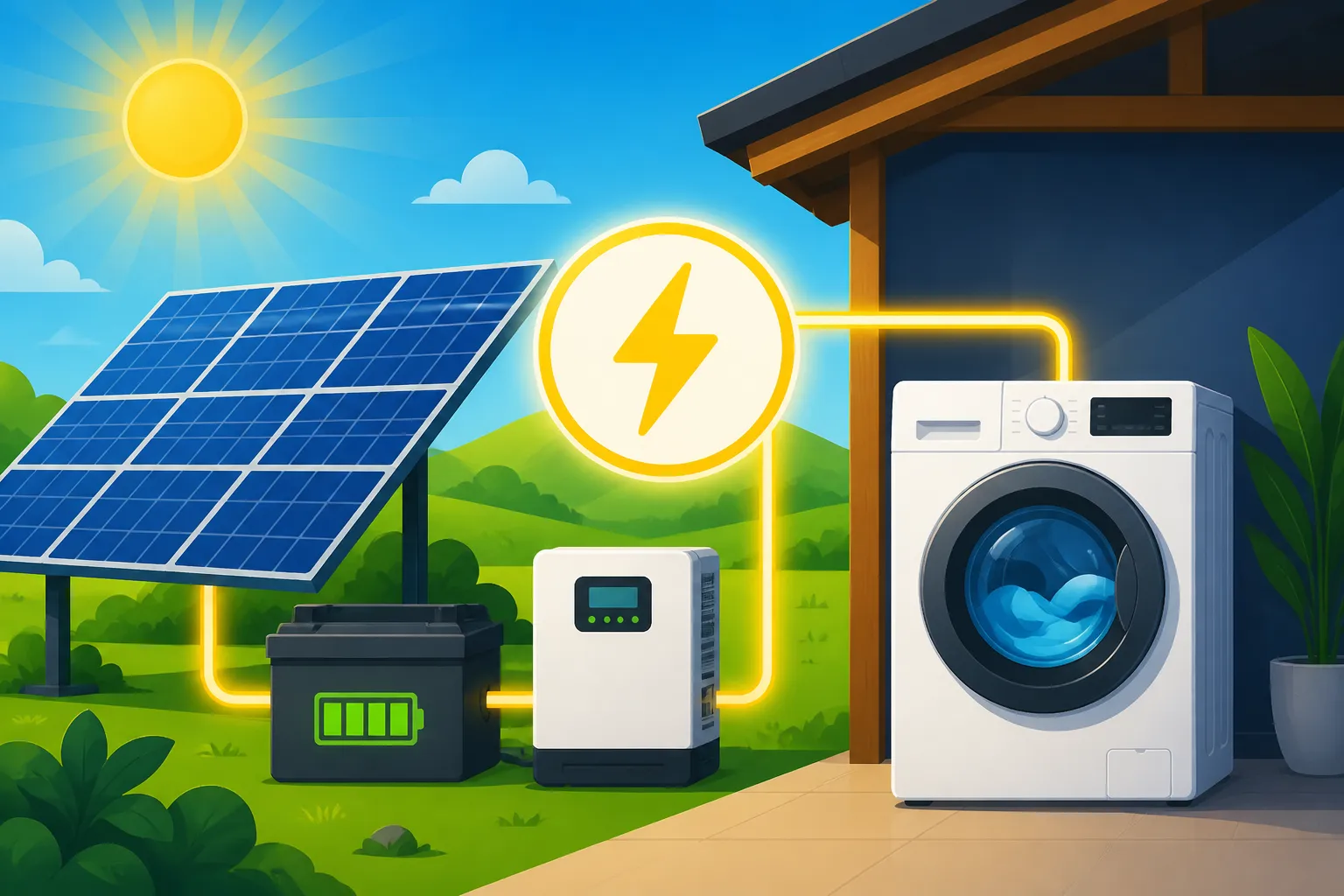
Cost to Run A Washing Machine on Off-Grid Solar
It’s a common dream for many of us seeking an off-grid lifestyle: the freedom to live independently, powered by the sun. But then reality hits when you think about your daily chores. Can you truly run all your creature comforts, like a washing machine, without a grid connection? Absolutely, but it’s not as simple as just plugging it in. Understanding the specific power demands and costs involved is crucial to avoid frustration and ensure your off-grid laundry day goes smoothly. This guide will walk you through everything you need to know about powering your washing machine with solar.
Unpacking the Energy Needs of Your Washing Machine
Before you even think about buying solar panels, you need to deeply understand what kind of power your washing machine demands. This isn't just about its advertised wattage; it's about how much energy it consumes over an entire cycle and the momentary peaks it hits.
Watts, Watt-Hours, and Cycles Explained
When we talk about electricity, there are a few terms that can get confusing, but they're essential for off-grid living:
- Watts (W): This is the instantaneous power an appliance uses at any given moment. Think of it like speed. Your washing machine might run at 500 watts for part of a cycle, but it might surge to 2000 watts for a split second when the motor first kicks in. This surge is critical for inverter sizing.
- Watt-hours (Wh) or Kilowatt-hours (kWh): This is the total amount of energy consumed over time. Think of it like distance traveled. If your washing machine uses 1000 watts for one hour, that's 1000 Wh, or 1 kWh. This is what you pay for on a utility bill and what your solar batteries need to store.
- Cycles: A complete wash cycle, from filling to spinning, involves different stages, each with varying power draws. The motor starting, the agitator or drum spinning, and especially any heating elements for hot water will all have different wattages.
A typical modern high-efficiency (HE) front-load washing machine might use anywhere from 0.5 kWh to 1.5 kWh per load, depending heavily on the cycle and water temperature. Older, traditional top-loaders can sometimes consume more, particularly if they are not energy-efficient models. For instance, a quick cold wash will naturally use far less energy than a heavy-duty hot wash. Knowing these numbers is the first step in figuring out how to build your solar system.
Key Factors Affecting Energy Consumption
It’s not just about the type of machine; several other factors play a huge role in how much energy your washing machine devours. Ignoring these can lead to an undersized and frustrating solar setup.
Washing Machine Type and Efficiency
- Front-Load vs. Top-Load: Generally, front-load washers are more energy-efficient and water-efficient than traditional top-loaders. They use less water, which means less energy is needed to heat it (if you choose hot cycles), and their tumble action is often more efficient for cleaning. High-efficiency (HE) top-loaders are also a good compromise, using less water than their traditional counterparts.
- Energy Star Rating: Always look for an Energy Star certified washing machine. These appliances are designed to use less energy and water, which translates directly into fewer solar panels and smaller battery banks needed for your off-grid system.
- Internal Water Heater: Some washing machines heat their own water, rather than drawing hot water from your home's water heater. While convenient, this function dramatically increases the electrical load, often demanding 1000-2000 watts or more just for heating, and for a sustained period. If you’re going off-grid, it’s usually more efficient to heat water with propane, a wood stove, or a separate solar hot water system rather than relying on your electric washing machine to do it.
Water Temperature and Load Size
Washing with hot water can consume significantly more energy than cold water. The heating element is often the biggest power hog in a washing machine. If your machine heats its own water, you’re looking at a substantial draw. Even if it draws hot water from your main hot water tank, that tank still needs energy to heat the water. Choosing cold water washes whenever possible is one of the easiest ways to slash your energy consumption. Similarly, running full loads maximizes efficiency. Doing multiple small loads uses more energy per pound of laundry than one large, efficient load.
Spin Speed
The spin cycle uses the motor, and a higher spin speed extracts more water from your clothes, leading to faster drying times. While the spin cycle itself is relatively short, it can have a moderate power draw. For off-grid living, a good spin cycle is your friend, as it reduces the energy or time needed for drying, whether that's using a solar-powered dryer or simply line-drying.
Calculating Daily and Weekly Energy Use
Let’s get practical. To properly size your off-grid solar system, you need a realistic estimate of your washing machine's energy footprint.
- Find Your Machine's Wattage and kWh per Cycle: Check the appliance's yellow EnergyGuide label or the manufacturer's specifications. It might list average annual kWh or kWh per cycle. If it only lists wattage, you'll need to estimate how long it runs at that wattage.
- Example: Let's say your HE front-loader uses 800 watts for 60 minutes (1 hour) for a warm wash. That's 800 Wh, or 0.8 kWh per cycle. If it has a heating element, it might draw 1500W for 15 minutes during the heating phase, adding 375 Wh (0.375 kWh) to that, totaling 1.175 kWh per warm load.
- Estimate Your Weekly Laundry Habits: How many loads do you do per week? What temperature settings do you typically use?
- Example: A family of four might do 4-5 loads per week. Let's say 3 cold washes (0.8 kWh/load) and 2 warm washes (1.2 kWh/load).
- Calculate Total Weekly kWh:
- 3 cold loads * 0.8 kWh/load = 2.4 kWh
- 2 warm loads * 1.2 kWh/load = 2.4 kWh
- Total weekly energy for laundry = 4.8 kWh
- Convert to Daily Average (for system sizing): Divide your total weekly kWh by 7 to get a daily average, even if you only do laundry one or two days a week. This helps distribute the energy generation requirement across your solar array.
- Example: 4.8 kWh / 7 days = ~0.68 kWh per day on average.
This daily average is just for the washing machine. You'll need to do similar calculations for all your other appliances, as detailed in our guide on "How to Calculate Daily Energy Usage".
Here's a quick reference table for typical washing machine energy consumption:
| Washing Machine Type | Cycle | Average Wattage (Running) | Peak/Surge Wattage | Average kWh per Load | Notes |
|---|---|---|---|---|---|
| High-Efficiency (HE) | Cold | 300 – 800 W | 1500 – 2500 W | 0.2 – 0.7 kWh | Most efficient, uses less water. |
| Warm | 500 – 1200 W | 1800 – 3000 W | 0.7 – 1.5 kWh | Heating water increases consumption. | |
| Traditional Top-Load | Cold | 400 – 900 W | 2000 – 3000 W | 0.5 – 1.0 kWh | Uses more water, less efficient agitation. |
| Warm | 800 – 2000 W | 2500 – 4000 W | 1.0 – 2.5 kWh | Older models can be very inefficient. |
Note: These are approximations. Always check your specific appliance's ratings.
Designing Your Off-Grid Solar System to Handle Laundry
Now that you have a clearer picture of your washing machine's energy demands, it's time to translate that into solar components. Remember, you're not just buying solar for the washer; it's part of your overall off-grid energy budget. You can find more comprehensive details in our "Off-Grid Solar System Sizing Guide".
Solar Panel Array Sizing
Your solar panel array is what generates the electricity. To power a washing machine reliably, you need enough panels to not only cover its average daily use but also contribute to charging your batteries for other household needs and for cloudy days.
Let's stick with our example of 0.68 kWh per day average for the washing machine. In an area with 5 "peak sun hours" per day (which is a good average for many parts of the US), a single 200-watt solar panel can produce roughly 1 kWh per day (200W * 5h = 1000 Wh = 1 kWh). So, for the washing machine alone, you might theoretically need less than one panel if it ran every day. However, this is an oversimplification.
In reality, you need to factor in:
- Efficiency Losses: There are always losses in the system (cables, inverter, battery charging inefficiency). Account for 15-25% losses.
- Other Loads: The washing machine isn't your only appliance.
- Days of Autonomy: You need enough panels to not only cover your daily use but also to recharge your batteries quickly after cloudy periods.
- Seasonal Variations: Winter months have fewer peak sun hours and lower sun angles, meaning your panels produce less. You'll need to size your array for the worst-case scenario.
For a household running a washing machine and other typical appliances, you're likely looking at an array of at least 1,000 to 3,000 watts (5-15 standard 200W panels or 2-6 larger 400-500W panels). A larger array allows you to do laundry even on partly cloudy days or during periods of lower solar irradiance.
Battery Bank Sizing for Autonomy
The battery bank is your energy reservoir, storing power generated by your panels for use whenever you need it – especially during the evenings or on cloudy days when the sun isn't shining.
To figure out how many batteries you'll need to run a washing machine, you first need to know your total daily energy consumption, including the washing machine. Let's say your entire off-grid home, with the washing machine included, uses 5 kWh per day.
You'll also need to decide on your "days of autonomy" – how many days your system can run without any solar input (e.g., during prolonged cloudy weather). For comfort and reliability, 2-3 days is a common target for full-time off-grid living.
- Total Energy Storage Needed: 5 kWh/day * 3 days autonomy = 15 kWh of usable battery energy.
- Battery Chemistry: Lithium Iron Phosphate (LiFePO4) batteries are generally preferred for off-grid systems due to their long lifespan, high depth of discharge (DoD), and efficiency. With LiFePO4, you can often use 80-90% of the battery's rated capacity without significantly impacting its lifespan.
- Calculating Raw Capacity: If you need 15 kWh of usable energy and your LiFePO4 batteries have an 80% DoD, you'd need approximately 15 kWh / 0.80 = 18.75 kWh of raw battery capacity.
- System Voltage: Most larger off-grid systems operate at 48V. To get 18.75 kWh at 48V, you'd need (18750 Wh / 48V) = 390.6 Ah of battery capacity. This could translate to four 100Ah 48V batteries or eight 100Ah 24V batteries wired in series/parallel. Our guide on "How Many Batteries for an Off-Grid System" goes into more detail.
Remember, running a washing machine is often a "burst" load. You'll likely do your laundry during daylight hours when your panels are generating, which helps reduce the direct draw from batteries. However, having ample battery storage means you're not beholden to sunny skies every laundry day.
Inverter Requirements
The inverter is the brains of your AC power system. It converts the DC (direct current) electricity from your batteries into AC (alternating current) electricity that your washing machine (and most other household appliances) can use.
The key considerations for an inverter are:
- Continuous Wattage: This is the maximum power the inverter can continuously supply. Your washing machine's running wattage needs to be well within this limit.
- Surge Wattage: This is the momentary peak power the inverter can handle, typically for a few seconds. Washing machine motors, especially during startup, can have a surge wattage 2-3 times their running wattage. If your washer runs at 800W, it might surge to 2000W or even 2500W. Your inverter must be able to handle this.
- Pure Sine Wave: For sensitive electronics and motor-driven appliances like washing machines, you must use a pure sine wave inverter. Modified sine wave inverters can damage motors, cause them to run inefficiently, or even overheat.
For most washing machines, an inverter with a continuous rating of 2000-3000 watts and a surge rating of at least 4000-6000 watts is a safe bet. Brands like Victron, Outback, and Sol-Ark are popular for their robust off-grid inverters. Ensure the inverter matches your chosen battery bank voltage (e.g., a 48V inverter for a 48V battery bank). You can learn more in "How to Size an Off-Grid Inverter".
Calculating the Investment: Components and Costs
Now for the part everyone wants to know about: the money. Going off-grid isn't cheap upfront, but the long-term savings and independence are invaluable. The cost to run a washing machine off-grid is really just a fraction of your overall off-grid solar system cost.
Estimated Costs of Core Components
Let's break down the main pieces of the puzzle:
Solar Panels
The cost of solar panels has come down significantly. You can expect to pay anywhere from $0.75 to $1.50 per watt for good quality monocrystalline panels.
- If you need a 2000-watt array for your whole system (including the washer), that’s $1,500 – $3,000 for panels alone.
Batteries
This is usually the most expensive component in an off-grid system, especially for substantial storage like what you'd need for a washing machine.
- LiFePO4 Batteries: A 100Ah 12V LiFePO4 battery (approx. 1.28 kWh) typically costs $500 – $1000. If you need 10-15 kWh of usable storage, you're looking at $5,000 – $15,000.
- Lead-Acid Batteries: While cheaper upfront (e.g., $150-$300 for a 100Ah 12V AGM battery), they have a shorter lifespan, lower usable capacity (only 50% DoD recommended), and require more maintenance. In the long run, LiFePO4 often proves more cost-effective. Check out "LiFePO4 vs Lead-Acid Battery Cost" for a detailed comparison.
Inverter/Charger
As discussed, you need a robust, pure sine wave inverter. Many off-grid systems use "inverter-chargers" that combine the inverter function with a battery charger (useful for generator backup).
- A quality 3000W 48V pure sine wave inverter can range from $700 – $2,000. More advanced inverter-chargers with grid-interactive or generator control features can be $2,000 – $6,000+. Brands like Victron Energy and Schneider Electric offer premium solutions, while options from Growatt or EG4 can provide excellent value.
Charge Controller
This device regulates the power flowing from your solar panels to your batteries, preventing overcharging and optimizing efficiency.
- MPPT (Maximum Power Point Tracking) controllers are highly recommended for their efficiency. A good MPPT charge controller for a mid-sized system might cost $150 – $500.
For smaller, more portable needs, especially if you're thinking about a very small washing machine (like a portable twin-tub unit for camping), a high-capacity solar generator could be an option. Products from brands like Jackery or Bluetti combine an inverter, battery, and charge controller into a single unit, and you can often find compatible portable solar panels on platforms like Amazon. However, these are typically not sized for regular, full-sized washing machine use in a permanent off-grid home.
Installation and Auxiliary Costs
It's not just the main components. Don't forget these often-overlooked expenses:
Wiring, Fuses, and Breakers
High-quality, appropriately sized copper wiring, fuses, and circuit breakers are essential for safety and performance. This can easily add $200 – $800 to your budget, depending on system size and layout.
Mounting Hardware
Whether you're mounting panels on a roof, on a pole, or a ground array, you'll need racking and mounting hardware. This typically costs $0.20 – $0.50 per watt of solar panels, so for a 2000-watt system, expect $400 – $1,000.
Safety Equipment and Monitoring
Items like disconnect switches, ground fault protection, and a good battery monitor (which is crucial for understanding your system's health) are vital. A quality battery monitor like those from Victron can run $150 – $300.
Permits and Professional Help
While many off-gridders do DIY installations, some parts, especially the AC wiring or tying into a breaker panel, might require a licensed electrician or permits, depending on your local regulations. This can range from a few hundred dollars for specific tasks to several thousands for a full professional installation. You can learn more about this in "Off-Grid Solar Installation Cost".
Comparing Energy-Efficient Models
One of the best ways to reduce your overall off-grid solar cost is to choose the most energy-efficient washing machine you can find. A more efficient appliance means you can get by with a smaller solar array and battery bank, leading to significant upfront savings.
- Initial Appliance Cost vs. Long-Term Solar Savings: An Energy Star rated washer might cost a bit more upfront than a basic model. However, if it consumes 50% less energy per cycle, it directly translates to needing fewer solar panels and smaller batteries, which can save you thousands of dollars on your solar system. This is a classic case of paying a little more now to save a lot more later.
- Water Efficiency: As mentioned, water efficiency is also important, especially if you're on a well or collecting rainwater. Less water used means less energy to pump it or heat it.
When budgeting for an off-grid system, always consider the total cost of ownership. The cheapest washing machine might end up being the most expensive when you factor in the additional solar infrastructure required to power it. Our article "Is Off-Grid Solar Worth the Cost" delves deeper into the economics of sustainable living.
Smart Strategies for Off-Grid Laundry and Long-Term Savings
Living off-grid is all about managing resources wisely. When it comes to laundry, a little planning and smart habits can make a huge difference in how smoothly your system runs and how long your components last.
Full-Time Off-Grid Living vs. Occasional Use
The demands on your off-grid system vary wildly depending on your lifestyle.
System Requirements for Permanent Residences
If you're living full-time off-grid and expect to run a washing machine regularly (multiple times a week), your system needs to be robust. You'll need:
- Larger Solar Array: To ensure consistent charging, even with fluctuating weather.
- Substantial Battery Bank: To provide several days of autonomy and handle continuous loads.
- High-Capacity Inverter: Capable of handling significant surge loads from motor-driven appliances.
- Generator Backup: Highly recommended for those inevitable stretches of cloudy weather, especially in winter. Our guide on "Cost of Adding a Generator to Off-Grid Solar" can help with planning.
The goal here is reliability and convenience, allowing you to run your washing machine without constant worry about draining your batteries.
System for Remote Cabins or Occasional Use
For a hunting cabin, a remote workshop, or a tiny home used only on weekends, your needs will be different. You might opt for a smaller, more modular system.
- Smaller Array and Battery: You might only need enough power for a load or two, perhaps charging the batteries slowly over the week when you're not there.
- Portable Options: For very occasional use, you might even consider a manual washing machine or a small, portable electric unit paired with a solar generator from brands like Jackery or Bluetti. These devices are fantastic for lightweight use and can be purchased easily from retailers like Amazon.
- No Generator Needed: If power isn't critical, you might forgo a generator, relying solely on solar and manual alternatives if power runs out.
Understanding your actual usage patterns is critical to avoid overspending on an oversized system or constantly being frustrated by an undersized one.
Maximizing Efficiency and Minimizing Costs
Every watt-hour saved is a watt-hour you don't need to generate or store, which directly saves you money and extends the life of your system.
Wash with Cold Water
This is, hands down, the biggest energy saver when it comes to laundry. The heating element in a washing machine is a huge power draw. By switching to cold water washes, you can often cut the energy consumption per load by 75-90%. Modern detergents are formulated to work effectively in cold water, so performance won't suffer.
Run Full Loads
Resist the urge to do small loads. Waiting until you have a full machine load means you're maximizing the efficiency of each cycle (water, detergent, and electricity).
Utilize Peak Sun Hours
Try to schedule your laundry for the middle of the day when your solar panels are producing their maximum output. This way, the power for the washing machine comes directly from your panels, reducing the drain on your battery bank and allowing them to stay topped off.
Line Dry Whenever Possible
Electric clothes dryers are notorious energy hogs. If you're serious about off-grid living, investing in a good old-fashioned clothesline is one of the smartest moves you can make. The sun and wind are free and effective drying agents. If you absolutely need a dryer, consider a propane-powered model, or a high-efficiency heat pump dryer, though even those will have significant electrical requirements.
Choose Energy-Efficient Appliances
As discussed, prioritizing Energy Star rated appliances right from the start will save you money and headaches down the line by reducing your overall energy footprint.
Backup Solutions and Expandability
No off-grid system is truly "set and forget." Planning for contingencies and future needs is essential.
Generator as Backup
A reliable backup generator is almost a necessity for most off-grid homes, especially if you rely on high-draw appliances like a washing machine. During extended cloudy periods or unexpected high usage, a generator can recharge your batteries and power your home when solar simply can't. Your inverter-charger can often manage the generator automatically, turning it on when battery levels are low.
Designing for Future Expansion
When you're first setting up your off-grid system, it's wise to design it with future expansion in mind. This means oversizing your charge controller slightly, leaving space on your inverter for additional loads, or selecting a battery management system that can easily accommodate more battery modules later on. This prevents you from having to completely overhaul your system if your energy needs grow (e.g., if you add more people to the household or new appliances). Our article on "How to Design an Expandable System" offers great insights here.
By carefully planning your washing machine's integration into your off-grid solar system, you can enjoy the convenience of clean clothes without compromising your energy independence or busting your budget. It's all about understanding your needs, choosing the right components, and adopting smart energy habits.
Disclaimer
The information provided in this guide is for general informational purposes only and does not constitute professional electrical engineering or financial advice. Off-grid solar system design and installation can be complex and involve significant risks, including electrical hazards. Always consult with qualified professionals, such as licensed electricians or solar energy specialists, for system design, installation, and compliance with local codes and regulations. Costs and energy consumption figures are estimates and can vary widely based on location, specific products, installation complexity, and individual usage patterns.