Best Off-Grid Solar for Air Conditioning
One of the biggest dreams for folks heading off-grid is often tempered by a cold, hard truth: how do you keep cool when summer hits, especially without a utility bill coming in? Air conditioning, for many, feels like an impossible luxury when you're relying solely on the sun. The frustration of sweltering heat, restless nights, and the sheer challenge of powering such a demanding appliance can be a real roadblock to living comfortably off the grid. This guide is all about tackling that challenge head-on, showing you how to design an off-grid solar system that can genuinely support air conditioning, ensuring you stay cool even when the mercury rises.
The Power-Hungry Reality of Air Conditioning Off-Grid
Let's be honest, air conditioning is a beast when it comes to power consumption. It's often the single largest draw in a typical home, and that doesn't magically change just because you've cut the cord to the utility company. Many people underestimate just how much juice an AC unit needs, leading to undersized systems and a lot of disappointment. Understanding this fundamental truth is the first step toward successfully integrating AC into your off-grid lifestyle.
Understanding AC's Energy Appetite
When you look at an air conditioner, whether it's a window unit, a portable AC, or a more robust mini-split system, you're dealing with a motor and a compressor. These components require a significant amount of electricity, not just to run continuously, but especially during startup. That initial surge, sometimes called "starting watts" or "LRA" (Locked Rotor Amps), can be several times higher than the running wattage. This surge is critical to consider because your inverter has to be able to handle it without tripping or failing.
For example, a typical 10,000 BTU window AC unit might run at around 1,000-1,200 watts, but its starting wattage could easily jump to 3,000-4,000 watts for a brief moment. If your inverter isn't sized to handle that peak, your AC simply won't turn on. Beyond the wattage, you also need to think about how many hours a day you plan to run it. If you're looking for 8-10 hours of cooling during peak summer, that translates into a massive daily watt-hour demand that your solar array and battery bank must meet. This is where many off-gridders find themselves in a bind, realizing their existing system, designed for lights and a fridge, simply isn't up to the task.
The Myth of "Small" AC Units
It's tempting to think that a tiny 5,000 BTU window unit or a small portable AC will be a breeze to power off-grid. While they are indeed smaller than a central air system, they still consume a substantial amount of power relative to the typical off-grid appliance. Even a 5,000 BTU unit can draw 400-600 running watts and still have a significant startup surge. For many smaller off-grid setups, like an RV or a modest cabin, this can still represent a huge portion of their daily energy budget.
Consider a hot summer day in Arizona. That small AC might run almost constantly. If it's pulling 500 watts for 10 hours, that's 5,000 watt-hours (or 5 kWh) per day just for cooling! Add to that your refrigerator, lights, water pump, and charging electronics, and your daily energy usage can easily skyrocket. This often necessitates a much larger solar array and battery bank than what was initially budgeted or planned for. It's a stark reminder that even "small" AC units are serious energy consumers when you're completely self-reliant for power.
Climate Considerations and Insulation
The amount of solar power you need for air conditioning is heavily influenced by your climate. Living in the humid south of Florida, where AC runs almost year-round, is a completely different ballgame than a cabin in the Pacific Northwest that only sees a few weeks of real heat each summer. Regions with consistently high temperatures and humidity will demand far more from your solar system. You'll need more panels to generate the power and a larger battery bank to store it, especially for overnight cooling.
Beyond just the climate, the insulation and construction of your off-grid dwelling play a monumental role. A well-insulated, airtight tiny home with good windows will retain cool air much better than an old, leaky cabin. Investing in proper insulation, quality windows, and even passive cooling strategies like strategic shading from trees or awnings can significantly reduce your AC run time and, consequently, your power demands. Before you even think about buying solar panels, evaluate your structure's thermal efficiency. It's often cheaper to reduce your cooling load through insulation than to try and generate endless amounts of electricity for a leaky building.
Essential Components for Off-Grid AC
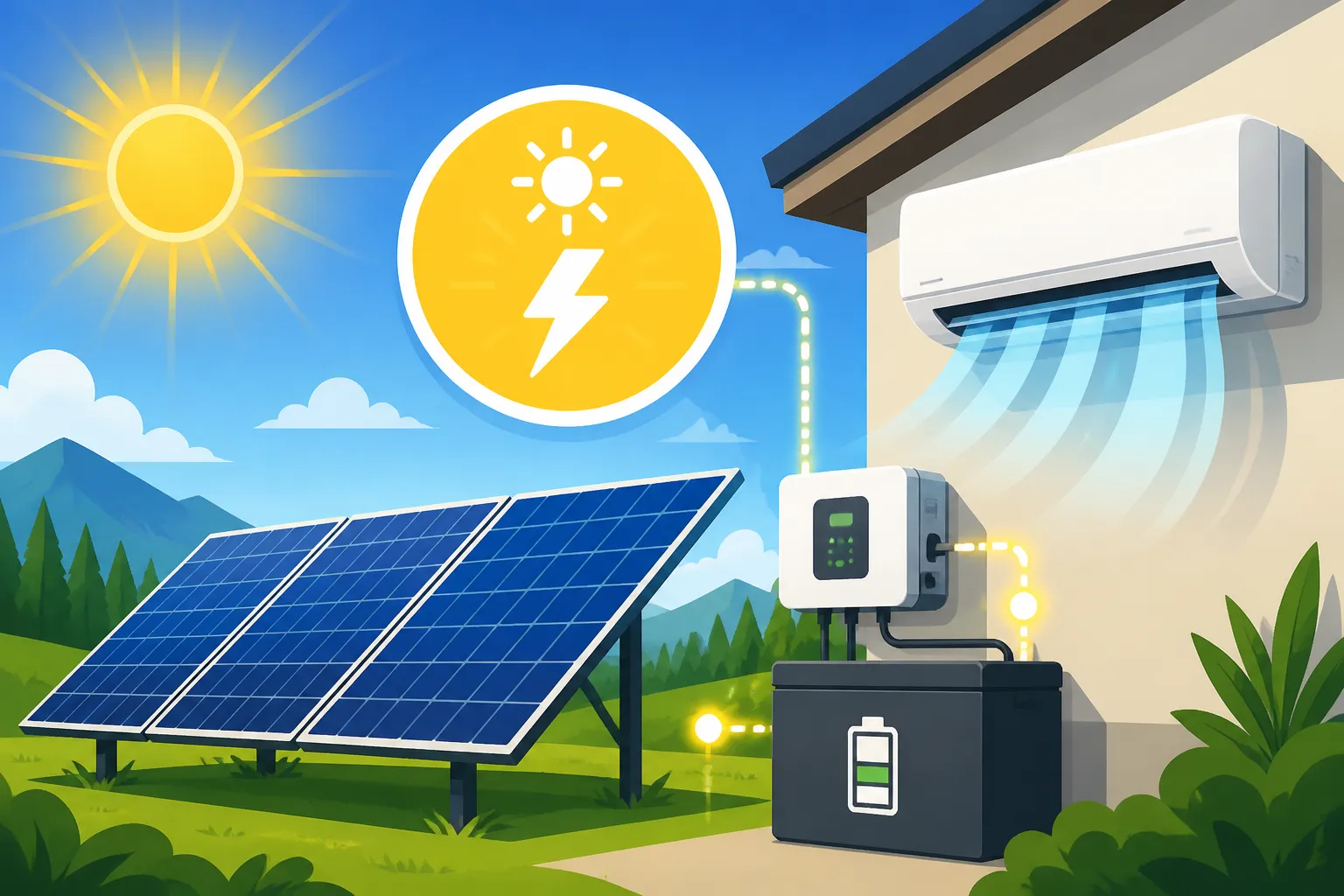
Building an off-grid solar system capable of handling air conditioning isn't just about throwing a few more panels on the roof. It requires a robust, well-designed system where each component is carefully matched to the demanding load of an AC unit. Skimping on any part of the system can lead to frustration, inefficiency, or even system failure.
Robust Solar Panel Array
To power an air conditioner, you're going to need a substantial solar panel array. This means more wattage than what's typically recommended for general off-grid living. Your goal is to generate enough power during peak sun hours to both run your AC and recharge your batteries for evening or overnight use. Depending on your location and sun exposure, you might need to install anywhere from 1,000 watts (1 kW) to 5,000 watts (5 kW) or more in solar panels for even a single efficient AC unit.
It’s not just about the raw wattage, though. Consider the type of panels. Monocrystalline panels are generally more efficient, meaning they produce more power per square foot, which can be crucial if you have limited roof space on a cabin or RV. You also need to think about . An optimized tilt angle and proper orientation to the sun are paramount to maximizing your energy harvest, especially during the hot summer months when you'll need that AC the most. For year-round cooling needs, you might even consider an oversized array to account for less-than-ideal weather or shorter winter days if you also plan to use other high-draw appliances.
High-Capacity Battery Bank
This is arguably the most critical component when it comes to powering AC off-grid. Air conditioning demands continuous power, and if you want to run it when the sun isn't shining – like overnight or on a cloudy day – you need a battery bank with ample storage capacity. For AC, LiFePO4 (Lithium Iron Phosphate) batteries are almost universally recommended over traditional lead-acid options. Their ability to be deeply discharged without damage, their high cycle life, and their superior efficiency make them ideal for handling the heavy and prolonged discharge cycles that AC requires.
For a modest AC unit running a few hours a day, you might be looking at a battery bank of 200Ah to 400Ah at 48V, which translates to roughly 10-20 kWh of usable energy. For a full-time residence with significant cooling needs, that could easily double or triple. Brands like Battle Born, EG4, and Victron offer excellent LiFePO4 options that are known for their reliability and performance. While the upfront can be higher, their longevity and performance often make them more cost-effective in the long run. Thinking about can give you a better idea of the total investment.
Powerful Inverter
As we discussed, AC units have a significant starting surge. Your inverter needs to be robust enough to handle this surge without blinking. You'll want a pure sine wave inverter, as modified sine wave inverters can damage sensitive electronics and run motors less efficiently and often hotter. When selecting an inverter, always look at its continuous wattage rating and its surge rating. For a 10,000 BTU AC unit that runs at 1,000 watts but surges to 3,000-4,000 watts, you’d typically want an inverter rated for at least 3,000-4,000 watts continuous, with a surge capability significantly higher than that. Many off-grid setups opt for inverters in the 5,000-watt to 8,000-watt range to safely handle AC and other loads simultaneously.
Consider models like the Victron MultiPlus or the Sol-Ark series, which are renowned for their robust inverters and integrated inverter-chargers. These units are designed to handle high loads and often come with advanced features for managing power flow, including grid-assist capabilities if you ever integrate a generator. Choosing one of the available is crucial for the longevity and smooth operation of your system.
Smart Charge Controller
With a large solar array and a substantial battery bank needed for AC, an efficient charge controller is non-negotiable. While PWM (Pulse Width Modulation) controllers are fine for smaller, simpler systems, you absolutely want an MPPT (Maximum Power Point Tracking) charge controller for any off-grid system designed to power AC. MPPT controllers are significantly more efficient at converting the power from your solar panels into usable energy for your batteries, especially during varying light conditions. This extra efficiency can translate into a 20-30% gain in charging power, which is vital when you're trying to keep up with the demands of an air conditioner.
An MPPT controller will ensure your expensive solar panels are working at their peak performance, delivering the maximum possible charge to your batteries. This becomes even more important on those slightly cloudy days or when the sun isn't directly overhead, providing valuable watt-hours that a less efficient controller might miss. For a large array, you might even need multiple MPPT controllers, or a single, high-capacity unit to manage the incoming power effectively.
Sizing Your Off-Grid System for Air Conditioning
Successfully powering AC off-grid hinges entirely on accurate system sizing. This isn't a guess-and-check operation; it requires careful calculation and a realistic understanding of your energy needs. Overlooking critical factors here will almost certainly lead to a system that can't keep you cool when you need it most.
Calculating Your AC's Power Needs
The first step in sizing is a detailed load analysis, especially focusing on your air conditioner. Don't just look at the label's running watts; consider the starting surge. Most manufacturers will provide a "BTU" rating, which stands for British Thermal Units, indicating its cooling capacity. A general rule of thumb is that 12,000 BTUs is roughly equivalent to 1 ton of cooling, and consumes about 1,000-1,500 watts per hour.
You need to estimate how many hours a day you realistically expect to run your AC. For example, if you have a 10,000 BTU mini-split that draws 1,000 running watts and you want to run it for 6 hours during the day and 4 hours at night, your daily AC consumption alone would be 1,000 watts * 10 hours = 10,000 watt-hours (or 10 kWh). Add to this all your other appliances, like your refrigerator, lights, water pump, and electronics. For a comprehensive overview, check out our guide on How to Calculate Daily Energy Usage. It's a fundamental step that too many off-gridders gloss over.
Determining Panel and Battery Capacity
Once you have your total daily energy consumption, including the significant chunk for AC, you can start to size your solar panels and battery bank. You'll need to know your "peak sun hours" for your location. This is the average number of hours per day that the sun is intense enough to generate 1,000 watts per square meter (the standard rating condition for solar panels). You can find this data online or through solar calculators for your specific region.
Let's say your total daily consumption is 15 kWh (15,000 Wh), and you get an average of 5 peak sun hours per day. To generate 15,000 Wh, you'd need 15,000 Wh / 5 hours = 3,000 watts of solar panel capacity. However, you'll want to add a buffer for efficiency losses (wires, inverter, battery charging) and cloudy days. A common practice is to oversize your array by 20-30%. So, in this example, you might aim for 3,600 to 3,900 watts (3.6-3.9 kW) of solar panels. When considering , remember that more panels mean more power to keep you cool.
For your battery bank, you need to store enough energy to last through your desired "days of autonomy" – how many days your system can run without sun. For AC, especially if you want overnight cooling or multiple cloudy days, you might aim for 2-3 days of autonomy. If your daily usage is 15 kWh, and you want 2 days of autonomy, you need 30 kWh of usable battery storage. With LiFePO4 batteries, which can be discharged to 80-90% of their capacity, you'd aim for a battery bank slightly larger than 30 kWh raw capacity. Our guide on can help you dial in the specifics.
Here’s a simplified table for estimating typical AC power needs:
| AC Unit Type (BTU) | Running Watts (Approx.) | Starting Watts (Approx. Peak) | Daily kWh (8 hrs run) | Suggested Minimum Solar Array (Watts) | Suggested Minimum LiFePO4 Battery (kWh) |
|---|---|---|---|---|---|
| 5,000 BTU Window | 500-600 W | 1,500-2,000 W | 4-5 kWh | 1,000-1,500 W | 5-8 kWh |
| 10,000 BTU Window | 1,000-1,200 W | 3,000-4,000 W | 8-10 kWh | 2,000-2,500 W | 10-15 kWh |
| 12,000 BTU Mini-Split | 900-1,100 W | 2,500-3,500 W | 7-9 kWh | 1,800-2,200 W | 9-14 kWh |
| 18,000 BTU Mini-Split | 1,400-1,700 W | 4,000-5,500 W | 11-14 kWh | 2,800-3,500 W | 15-20 kWh |
Note: These are estimates. Actual needs vary greatly by efficiency, insulation, and climate.
Inverter Sizing for AC Surge
The inverter is your system's gateway to AC appliances. As mentioned, its surge capacity is paramount for air conditioning. Let's revisit the 10,000 BTU window AC that runs at 1,000 watts but has a 3,000-watt surge. Your inverter needs to handle that 3,000-watt surge plus the running watts of any other appliances that might be on at the same time. If your refrigerator (which also has a startup surge) is running, and you're charging a laptop, your inverter needs to be able to handle the combined running watts and the highest individual surge at any given moment.
It’s always safer to slightly oversize your inverter than to undersize it. A good rule of thumb is to take your highest expected surge load (often the AC) and add the running watts of all other appliances you anticipate running simultaneously. Then, choose an inverter that meets or exceeds that total surge requirement. Many choose a 48V system for larger loads like AC, as it allows for smaller wire sizes and less power loss over distance. Understanding will help you make an informed decision for your power needs.
Strategies and Tips for Efficient Off-Grid Cooling
Successfully running air conditioning off-grid isn't just about having a big enough solar system; it's also about smart energy management and maximizing efficiency wherever possible. Every watt saved is a watt you don't have to generate or store.
Energy-Efficient AC Units
When choosing an AC unit for off-grid use, efficiency is key. Forget those old, inefficient window shakers. Look for units with high SEER (Seasonal Energy Efficiency Ratio) or EER (Energy Efficiency Ratio) ratings. The higher the number, the more efficient the unit. Ductless mini-split systems are often the champions of off-grid cooling. They are incredibly efficient, quieter, and many models offer variable speed compressors (inverter technology), which means they don't constantly cycle on and off at full power. Instead, they can ramp up or down, maintaining a more consistent temperature with much lower power draw and no harsh startup surges.
There are also specific DC-powered air conditioners available, typically 12V, 24V, or 48V. These units can run directly off your battery bank, bypassing the inverter altogether, which eliminates inverter losses and can make them incredibly efficient for smaller spaces, like an RV or a single room in a cabin. Brands like SunDanzer and EcoCool offer DC-powered options. While they might have a higher upfront cost, their efficiency can significantly reduce the overall size and cost of your solar array and battery bank over time.
Passive Cooling Techniques
Before you even turn on an AC unit, think about how you can passively keep your space cool. These strategies require no electricity and can drastically reduce the amount of time your AC needs to run:
- Insulation and Air Sealing: This is number one. Ensure your walls, ceiling, and floors are well-insulated. Seal any gaps or cracks around windows, doors, and utility penetrations to prevent hot air from leaking in.
- Shading: Plant deciduous trees on the south and west sides of your dwelling to provide natural shade in the summer (and let sun through in winter). Install awnings or exterior shades over windows to block direct sunlight.
- Ventilation: Use strategically placed windows and doors to create cross-ventilation in the evenings when temperatures drop. Consider a whole-house fan or an exhaust fan in the highest part of your building to push hot air out.
- Light-Colored Roofing/Siding: Lighter colors reflect sunlight, keeping your building cooler than dark colors which absorb heat.
- Window Films: Reflective window films can block a significant amount of heat while still allowing light in.
By implementing these passive strategies, you can often keep your space tolerable for longer without any power, or at least reduce your AC run time, which directly translates to less demand on your solar system and longer battery life.
Integrating Backup Solutions
Even with a perfectly sized off-grid solar system, Mother Nature can throw a wrench in your plans with extended cloudy periods or unexpected heat waves. Having a backup power source is crucial for peace of mind and continuous comfort. A fossil fuel generator (propane, gas, or diesel) is a common choice. You can wire it into your inverter-charger, allowing it to automatically start when your batteries get low, charging them up and providing power until the sun returns.
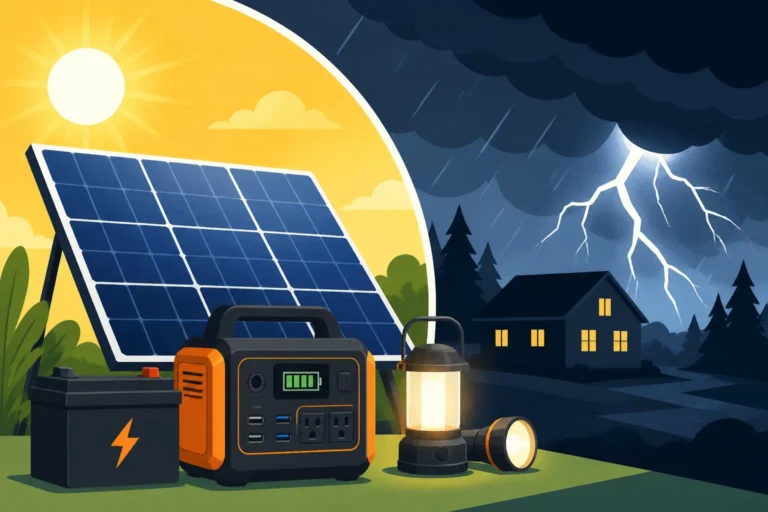
Another excellent backup or supplemental option, especially for smaller AC needs or specific rooms, is a portable power station. Companies like Jackery offer powerful units, such as the Jackery Explorer series, that can power smaller window AC units for a few hours, or run DC-powered fans and evaporative coolers for extended periods. While a single Jackery unit won't power a whole-house AC for days, it can be an invaluable emergency backup or a way to run a specific cooling appliance without touching your main battery bank. For example, if you have a small AC in your bedroom, you could power it with a Jackery overnight, saving your main system's batteries for your critical loads. can also be integrated to provide that extra boost when needed.
If you're looking for a temporary or portable cooling solution, perhaps for a camper van or a remote shed, a Jackery solar generator paired with portable solar panels might be an entry-level way to experiment with off-grid AC before committing to a larger, more permanent system. Just be aware of the limitations on continuous, high-wattage AC usage with portable power stations compared to a dedicated whole-system setup.
Off-Grid Solar Installation Considerations for AC
The installation process for an off-grid solar system, especially one designed for high-demand appliances like air conditioning, is more complex than a simple plug-and-play setup. Proper installation ensures safety, efficiency, and longevity. If you're tackling this yourself, attention to detail is paramount. If hiring a professional, ensure they have experience with off-grid systems and not just grid-tied.
Wiring and Safety Protocols
When dealing with the high current and voltages required for a substantial off-grid system, proper wiring is non-negotiable. You'll need appropriately sized wires and cables to prevent voltage drop and overheating, especially between the batteries and the inverter, which carry the heaviest loads. Refer to the National Electrical Code (NEC) for guidance on wire sizing, overcurrent protection, and grounding requirements. Using can make a huge difference in performance and safety.
Safety components like fuses, circuit breakers, and disconnect switches are essential at various points in the system: between solar panels and charge controller, between charge controller and batteries, and between batteries and inverter. These components protect your equipment from surges and short circuits and allow you to safely shut down sections of your system for maintenance. provides excellent, in-depth instructions for setting up your electrical infrastructure safely. Always assume wires are live and wear appropriate personal protective equipment (PPE).
Panel Mounting and Placement
For an AC-heavy off-grid system, maximizing solar harvest is critical. This means paying close attention to panel mounting and placement. Your panels should be mounted in a location that receives maximum unobstructed sunlight throughout the day, especially during the summer months when AC is most needed. Avoid any potential shading from trees, buildings, or other obstructions. Even partial shading on one panel can significantly reduce the output of an entire string of panels.
Consider adjustable tilt mounts, especially if you live in a region with significant seasonal sun angle changes. Being able to adjust your panel's tilt can dramatically increase your winter production, ensuring your batteries stay charged year-round. Ground mounts offer more flexibility for orientation and tilt adjustment compared to roof mounts. If you're installing on an RV or tiny home, can be slightly different, focusing on compact and aerodynamic solutions, but the principles of sun exposure remain the same.
Maintenance and Monitoring
An off-grid solar system is a living, breathing entity that requires ongoing attention. Regular maintenance and diligent monitoring are crucial to ensure your system continues to perform optimally, especially when relying on it for high-demand loads like air conditioning.
Routine checks should include cleaning your solar panels periodically to remove dust, dirt, and debris, which can reduce their efficiency. Inspect wiring for any signs of wear, corrosion, or loose connections. Check battery terminals and ensure they are clean and tight. For lead-acid batteries (though less common for AC setups), regularly check electrolyte levels. provides a comprehensive checklist for keeping your system in top shape.
A good battery monitor is an absolute must-have. It will give you accurate readings of your battery's state of charge, voltage, current in and out, and overall health. Knowing precisely how much power you're consuming and how much is being put back into your batteries helps you manage your AC usage responsibly and prevent over-discharging your batteries, which can shorten their lifespan. Many inverters and charge controllers from brands like Victron or Sol-Ark come with integrated monitoring systems, often accessible via a smartphone app, providing real-time data and historical logs.
Disclaimer
The information provided in this guide is for general informational purposes only and does not constitute professional advice. Off-grid solar system design and installation can be complex and involve significant electrical hazards. Always consult with qualified and licensed professionals for specific design, installation, and safety requirements. Improper installation or sizing can lead to property damage, injury, or death. Local codes and regulations may apply to your off-grid installation.