Sol-Ark vs Victron Inverters
Choosing the right inverter for your off-grid solar system can feel like trying to pick between two Olympic athletes – both are incredibly strong, reliable, and perform at the highest level, but they have different specialties. When it comes to top-tier off-grid inverters, Sol-Ark and Victron Energy are two names that consistently rise to the top, leaving many folks scratching their heads about which one is truly best for their unique setup. This guide aims to clear up that confusion, offering a deep dive into what makes each brand shine, helping you understand their core differences, and ultimately, making your decision a whole lot easier.
Understanding the Core Role of an Off-Grid Inverter
Before we dive into the specifics of Sol-Ark and Victron, let's just take a moment to appreciate what an inverter actually does in an off-grid system. It's the brain and brawn that takes the direct current (DC) electricity stored in your batteries – the kind your solar panels make – and converts it into alternating current (AC) electricity, which is what almost all your household appliances and electronics use. Without a good inverter, all that beautiful solar power collecting in your batteries is pretty much useless for running your refrigerator, charging your laptop, or powering your well pump.
Beyond simple conversion, modern off-grid inverters, especially those from premium brands like Sol-Ark and Victron, are sophisticated power management hubs. They often include charge controllers to efficiently manage the flow of power from your solar panels to your batteries, and many even integrate AC charging capabilities to top up your batteries from a generator or grid connection if you have a hybrid setup. It's a critical piece of equipment, and choosing wisely here directly impacts the reliability and efficiency of your entire off-grid experience. Think of it as the heart of your system; if it falters, everything else struggles.
Why Quality Inverters Matter for Off-Grid Living
For those living off-grid, reliability isn't just a convenience; it's a necessity. A cheap, unreliable inverter can turn your off-grid dream into a frustrating nightmare. Imagine your power dropping out every time your microwave kicks on, or your battery bank draining faster than it should because of inefficient conversion. That's the kind of headache a subpar inverter can bring.
High-quality inverters, like those from Sol-Ark and Victron, offer robust construction, advanced features, and sophisticated software that ensures stable power delivery, protects your appliances, and maximizes the lifespan of your battery bank. They're designed to handle the demanding, often fluctuating loads of off-grid living, from handling high surge currents when appliances start up to efficiently managing multiple power sources. Investing in a premium inverter reduces stress, minimizes maintenance, and provides the peace of mind that comes with a reliable power supply, especially when you're far from the nearest hardware store or electrician. This is particularly true for applications like a remote cabin or a full-time RV where consistent power is paramount.
Diving into Sol-Ark Inverter Systems
Sol-Ark has rapidly become a favorite in the off-grid and hybrid solar world, especially among those who want an all-in-one solution that's powerful and relatively straightforward to set up. They're known for their integrated design, which bundles several key components into a single, compact unit.
Sol-Ark's All-in-One Philosophy
What sets Sol-Ark apart immediately is its "all-in-one" approach. Instead of needing separate components for your inverter, charge controller, transfer switch, and system controller, Sol-Ark packs them all into one smart box. This design philosophy simplifies installation, reduces wiring complexity, and often saves space, which is a huge benefit for homeowners and RV dwellers alike. Imagine having fewer boxes to mount and fewer cables to run – it really streamlines the whole process, making it an attractive option for DIY enthusiasts or those working with limited space.
Their integrated design typically includes multiple Maximum Power Point Tracking (MPPT) charge controllers, which are crucial for optimizing solar panel output, especially if you have panels facing different directions or experiencing varying levels of shade throughout the day. This intelligence helps your system harvest as much energy as possible. Sol-Ark units are also usually equipped with a robust transfer switch, allowing for seamless switching between solar, battery, generator, and even grid power (for hybrid applications), ensuring your home or vehicle stays powered without interruption.
Key Features and Capabilities of Sol-Ark Inverters
Sol-Ark inverters are packed with features designed for high performance and user convenience. Here are some of the standout capabilities:
- Integrated Design: As mentioned, they combine an inverter, charge controller(s), transfer switch, and system controller into one unit. This isn't just about reducing clutter; it's about optimizing how these components work together for maximum efficiency and simplified troubleshooting.
- High Surge Capacity: Off-grid living often involves appliances with high "starting watts" or surge loads, like well pumps, refrigerators, or power tools. Sol-Ark inverters are engineered to handle these sudden power demands gracefully, preventing system shutdowns.
- Fast Transfer Time: For hybrid systems or those relying on a generator backup, the speed at which the inverter switches between power sources is crucial. Sol-Ark units boast extremely fast transfer times, often imperceptible, meaning your sensitive electronics won't even notice a blip when power shifts.
- Advanced Monitoring: Their integrated screens and web-based monitoring platforms offer comprehensive data on solar production, battery state of charge, load consumption, and system health. This level of insight is invaluable for optimizing your energy use and identifying potential issues early.
- Grid-Interactive Capabilities: While fantastic for off-grid, Sol-Ark excels in hybrid scenarios too, allowing homeowners to blend grid power with solar and battery storage, often leveraging net metering or time-of-use rates. This flexibility makes them a strong contender for those considering a future transition or looking for robust backup power. You can even use them to go off-grid for a family home while retaining the option to connect to the grid if needed.
One popular model, the Sol-Ark 12K, for instance, offers impressive power output suitable for larger homes and integrates seamlessly with various battery chemistries, including LiFePO4, which many off-grid enthusiasts prefer for its longevity and performance.
Exploring Victron Energy Inverter Systems
Victron Energy, a Dutch company, has built a formidable reputation in the off-grid world for its modularity, exceptional build quality, and incredible versatility. Unlike Sol-Ark's all-in-one approach, Victron encourages a component-based system design, allowing for highly customized and scalable setups.
Victron's Modular and Scalable Approach
Victron's philosophy is rooted in modularity. Instead of one big box, you're building a system with individual, high-quality components: a MultiPlus or Quattro inverter/charger, a separate MPPT charge controller (or several), a battery monitor, and a central communication device like a Cerbo GX. This might sound more complex, and in some ways it is, but it offers unparalleled flexibility and scalability.
This modularity means you can start small and expand your system over time as your needs grow or your budget allows. Need more solar input? Add another MPPT. Want more AC power? Add another inverter/charger in parallel. This design also means that if one component fails (which is rare with Victron, given their quality), you only need to replace that specific part, not the entire system. It empowers users to truly design an off-grid solar system from the ground up, perfectly tailored to their specific requirements.
Key Features and Capabilities of Victron Inverters
Victron inverters, often referred to as inverter/chargers (like the MultiPlus or Quattro), are renowned for their robust engineering and advanced features:
- Exceptional Build Quality: Victron products are known for their industrial-grade construction, designed to withstand harsh environments and provide years of reliable service. This is a huge factor for permanent off-grid installations where durability is paramount.
- True Sine Wave Output: This ensures that all your sensitive electronics and appliances run smoothly and efficiently, just as they would on grid power, without any hum or potential damage from "dirty" power.
- PowerAssist Feature: This intelligent feature allows the inverter/charger to supplement a limited AC source (like a small generator or shore power in an RV) with battery power. If your generator can only provide 2000W, but your appliances temporarily demand 3000W, the Victron unit will seamlessly pull the extra 1000W from your batteries, preventing the generator from being overloaded. This is incredibly useful for smaller generators on larger loads.
- Parallel and Three-Phase Capability: For very large off-grid homes or commercial applications, Victron units can be paralleled together to achieve massive power outputs, or configured for three-phase power, offering unmatched scalability. You can learn more about this when looking into How to Wire a 48V Battery Bank or other complex setups.
- Comprehensive Monitoring with VRM Portal: Victron's Venus OS devices (like the Cerbo GX) and the associated Victron Remote Management (VRM) portal provide arguably the most detailed and customizable monitoring available. You can view every aspect of your system, control settings, and even receive alerts from anywhere in the world with an internet connection. This is fantastic for peace of mind, especially if your off-grid property is remote.
- Wide Compatibility: Victron components are designed to be highly compatible with a vast array of battery types and brands. While they don't produce their own solar panels, they integrate perfectly with panels from various manufacturers, including popular options often found on Amazon or from Renogy.
The Victron MultiPlus series, especially the MultiPlus II, is a cornerstone of many high-performance off-grid and marine systems, offering a fantastic blend of inverter and charger capabilities in various sizes. For even more robust applications with multiple AC inputs, the Victron Quattro series steps up.
Sol-Ark vs Victron Inverters: A Head-to-Head Comparison
Now that we've looked at each brand individually, let's put them side-by-side to highlight their differences and help you decide which is the better fit for your off-grid adventure.
Hybrid vs Modular Design Philosophy
This is perhaps the most significant divergence between the two.
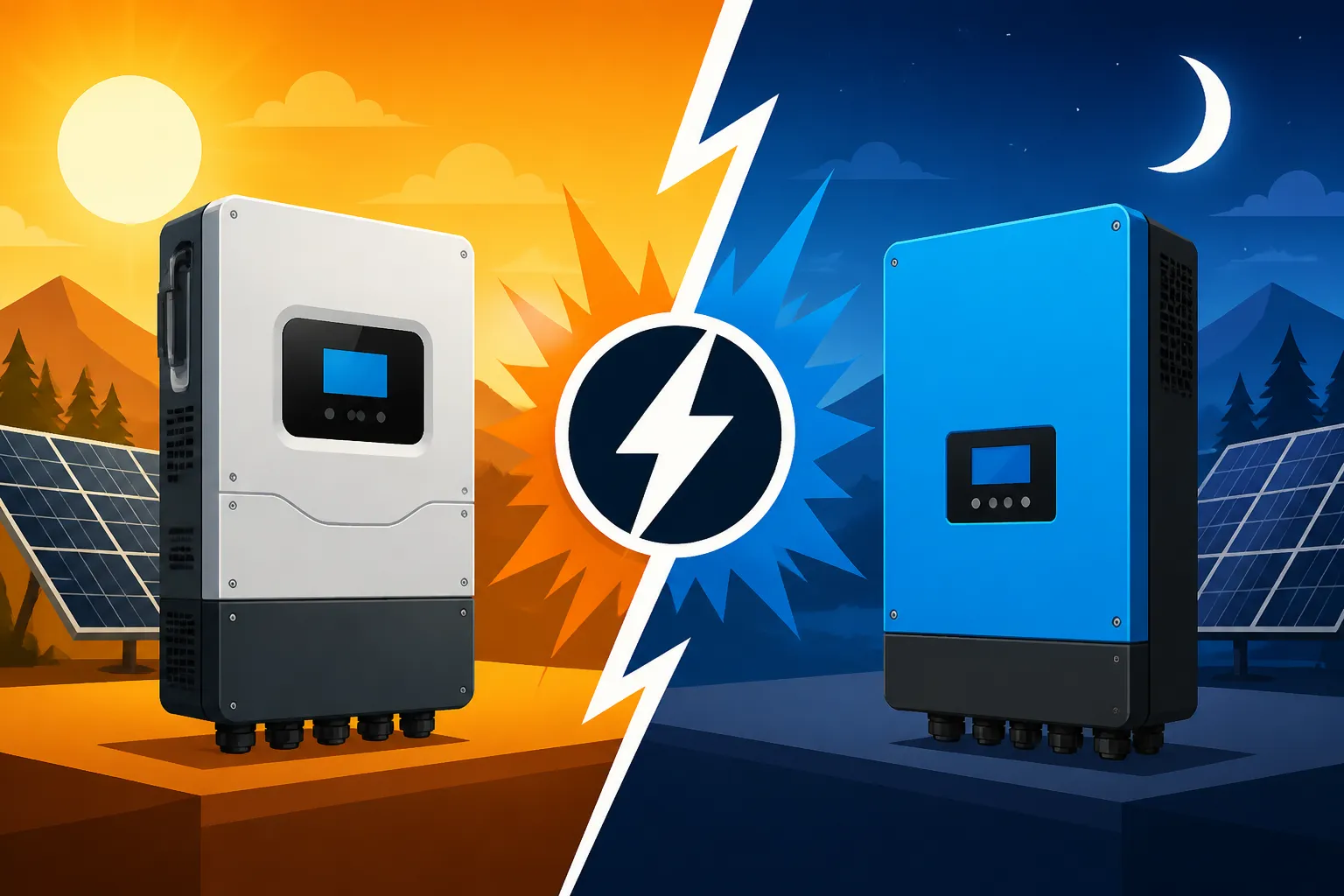
Sol-Ark: Embraces the hybrid, all-in-one approach. Everything you need for power conversion and management is contained within a single chassis. This means fewer components to purchase, simpler wiring, and a quicker, more integrated installation process. For someone who wants a powerful, complete solution without having to piece together separate components, Sol-Ark is incredibly appealing. It’s a bit like buying a high-performance sports car where all the engineering is perfectly tuned and hidden under the hood. This can be great for DIY Off-Grid Solar Installation Step by Step guides where simplicity is key.
Victron: Follows a modular design. You select individual components – inverter/charger, MPPT charge controllers, battery monitor, system controller (Cerbo GX) – and build your system piece by piece. While this requires a deeper understanding of system design and potentially more complex wiring initially, it offers unparalleled flexibility, customization, and scalability. It’s like having a master mechanic build you a bespoke racing machine, choosing the absolute best components for each function. This modularity means you can easily expand or upgrade specific parts of your system as your needs evolve, making it an excellent choice for those who are planning for the Cost of Expanding an Off-Grid System.
| Feature/Aspect | Sol-Ark Inverters | Victron Inverters (MultiPlus/Quattro) |
|---|---|---|
| Design Philosophy | All-in-one hybrid inverter/charger/charge controller | Modular, component-based system |
| Installation | Simpler, fewer connections, integrated | More complex wiring, multiple components |
| Scalability | Good, some models allow parallel expansion | Excellent, highly scalable with parallel/3-phase |
| Charge Controllers | Integrated MPPTs (multiple inputs) | Separate, dedicated MPPTs (e.g., SmartSolar series) |
| Monitoring | Integrated display, web portal | VRM Portal via Cerbo GX (highly detailed, customizable) |
| Generator Control | Excellent integrated auto-start/stop | Excellent via Assistants/Cerbo GX |
| Surge Capacity | High | Very High (often higher than rated continuous) |
| Transfer Time | Very fast (often <4ms) | Very fast (often <20ms, MultiPlus II <10ms) |
| System Voltage | Available in 48V (primary), some smaller 12/24V | Wide range: 12V, 24V, 48V |
| Cost (Initial) | Often appears higher for a single unit, but comprehensive | Can be similar or higher when accounting for all components |
| DIY Friendliness | High (due to integration) | Moderate to High (requires more understanding) |
| Maintenance | Fewer points of failure in one unit | Component-based replacement easier (if one part fails) |
Power Output, Efficiency, and Reliability
Both brands are top-tier in terms of power delivery and overall reliability, but there are nuances.
Sol-Ark units are known for their robust power output and excellent surge handling capabilities, often exceeding their continuous ratings for short bursts. Their efficiency is high, ensuring minimal power loss during conversion. Reliability is a strong suit, with many users reporting years of trouble-free operation. The fact that everything is in one unit can sometimes simplify troubleshooting, as you're dealing with a single point of failure (or success!).
Victron components, particularly their MultiPlus and Quattro inverter/chargers, are legendary for their rock-solid reliability and long-term durability. Their efficiency is also among the best in the industry. Victron often emphasizes the "power factor" correction, meaning they deliver high-quality AC power that is very kind to sensitive electronics. While one component might fail (rarely), the modular nature means the rest of your system can often remain operational, and replacement is often straightforward for that specific part. Their units are often built to an industrial standard, making them ideal for off-grid solar for year-round living in demanding environments.
Monitoring and Control
Modern off-grid systems rely heavily on intelligent monitoring, and both brands excel here, albeit with different interfaces.
Sol-Ark provides an integrated color touchscreen display right on the unit, offering real-time data and control. They also have a comprehensive web portal for remote monitoring via an internet connection. The interface is generally user-friendly and provides a good overview of your system's performance, allowing you to easily track your Off-Grid Solar Return on Investment.
Victron systems, when paired with a Venus OS device like the Cerbo GX, offer an incredibly deep and customizable monitoring experience through the Victron Remote Management (VRM) portal. This cloud-based platform allows you to monitor every single Victron component in your system, log data, configure settings, and receive alarms from anywhere in the world. While there's a steeper learning curve to set up the VRM portal and customize it, the level of detail and control it offers is unparalleled, especially for complex systems or those who really want to geek out on their power data. It's truly a powerhouse for understanding How to Calculate Daily Energy Usage in intricate detail.
Cost Considerations
When comparing costs, it's essential to look beyond the sticker price of a single unit.
Sol-Ark: The initial cost for a Sol-Ark inverter can seem higher than a single Victron inverter/charger, but remember, you're buying an integrated solution that includes multiple charge controllers and a transfer switch. When you factor in the cost of all those separate components for a comparable Victron system, the overall price can be quite similar, or even lower for Sol-Ark, especially in smaller to medium-sized systems. The reduced installation complexity might also save on labor costs if you're hiring a professional.
Victron: A bare Victron MultiPlus or Quattro unit might appear cheaper initially, but you then need to add separate MPPT charge controllers (which can add up, especially if you need several for your How to Size an Off-Grid Solar System), a battery monitor, and a Cerbo GX for comprehensive monitoring. The total component cost for a full Victron system can often be higher, particularly for smaller setups. However, the ability to expand gradually or replace individual components might offer long-term cost advantages. For instance, comparing the Cost of an Off-Grid Solar Inverter alone doesn't tell the whole story.
Ideal Use Cases for Each Brand
Understanding which scenarios each inverter system is best suited for can be the deciding factor.
When Sol-Ark Shines Brightest
Sol-Ark systems are particularly well-suited for users who value simplicity, integration, and robust performance in a single package.
- All-in-One Simplicity: If you're looking for a powerful, comprehensive solution that's relatively easy to install without needing to source and connect many individual components, Sol-Ark is an excellent choice. It’s perfect for the DIYer who wants a high-quality system without becoming an expert in component matching.
- Residential Off-Grid or Hybrid Homes: For medium to large off-grid homes or those looking for a powerful hybrid system with generator backup, Sol-Ark offers excellent performance, high surge capabilities, and seamless power management. The Sol-Ark 15K, for instance, can comfortably power most homes.
- Emergency Backup Power: The fast transfer times and integrated design make Sol-Ark units fantastic for whole-home backup solutions, switching instantly from grid power to battery power during an outage.
- Installations with Limited Space or Time: Because it's an integrated unit, Sol-Ark can be a space-saver compared to racks of separate components. This is beneficial for smaller cabins, workshops, or even larger RVs where every inch counts. This can make them ideal for Off-Grid Solar Cost for a Tiny Home or a similar setup.
When Victron is the Undisputed Champion
Victron Energy systems are the choice for those who prioritize customization, extreme reliability, and scalability, often for more complex or specialized applications.
- Customizable and Scalable Systems: If you want absolute control over every aspect of your system, plan to expand in the future, or need to accommodate very specific power demands, Victron's modularity is unbeatable. You can truly build a system that grows with you.
- Large, Complex Off-Grid Installations: For very large off-grid homes, businesses, or remote industrial sites that require massive power outputs, three-phase power, or highly redundant systems, Victron's ability to parallel multiple units is a game-changer.
- Marine and RV Enthusiasts: Victron has a massive following in the marine and RV world due to its robust build quality, excellent charging capabilities, and sophisticated power management features like PowerAssist, which can make the most of limited shore power or small generators. Many choose Victron for their Off-Grid Solar Cost for an RV or boat setup.
- Advanced Monitoring and Remote Management: For users who demand the most detailed data, remote control, and proactive alerts for their system, the Victron VRM portal and Cerbo GX offer a level of insight that is hard to match.
- Harsh Environments: The industrial-grade construction of Victron components makes them incredibly durable and reliable in challenging conditions, from extreme temperatures to vibrations.
Ultimately, if you're building a simpler system and prefer a single, powerful unit, Sol-Ark is fantastic. If you're a tinkerer, building a truly custom system, or have very specific and demanding needs, Victron's modularity offers unmatched flexibility.
Installation and Integration Considerations
No matter how powerful an inverter is, its effectiveness hinges on proper installation and integration with the rest of your system. Both Sol-Ark and Victron have their own considerations here.
Sol-Ark Installation Simplicity
One of Sol-Ark's biggest draws is its simplified installation. Because it integrates the inverter, charge controller(s), and transfer switch into one unit, you have fewer main components to mount and fewer high-voltage connections to make. This can significantly reduce the complexity of your wiring diagram and the overall installation time. For many DIYers, this is a huge relief.
However, "simplified" doesn't mean "easy." You're still dealing with high-voltage DC from your solar panels, high-current DC from your batteries, and high-voltage AC for your loads. Proper cable sizing, fusing, grounding, and adherence to electrical codes are absolutely critical. While the physical connections might be fewer, they are still substantial and require careful attention to safety and proper technique. You'll still need to understand How to Connect an Inverter to Batteries and your main breaker panel. Sol-Ark units often have clearly labeled terminals, which helps, but professional installation or a thorough understanding of electrical wiring is always recommended.
Victron's Modular Wiring and Setup
Installing a Victron system, by its very nature, involves connecting several individual components. This means more wiring runs (DC from panels to charge controller, charge controller to battery, battery to inverter/charger, inverter/charger to AC distribution), more terminals to connect, and a greater need for careful system design.
The beauty, however, is that each component is specialized and often easier to troubleshoot independently. Victron also offers an extensive range of accessories like Lynx distributors for clean battery bank connections and SmartShunts for accurate battery monitoring, which, while adding to the component count, simplify and professionalize the overall wiring. The configuration of Victron systems is done through software (VE.Configure or VictronConnect app), which offers deep control but also has a steeper learning curve than Sol-Ark's integrated display. However, once mastered, this software allows for incredibly fine-tuned performance and integration. For those looking to build out their system, the steps in How to Wire an Off-Grid Solar System become even more important.
Support, Warranty, and Community
Beyond the hardware and features, the support you receive and the community around a brand can significantly impact your long-term off-grid experience.
Sol-Ark's Support and Community
Sol-Ark has a reputation for strong customer support, often praised for being responsive and helpful. Their technical support team can assist with installation questions, troubleshooting, and warranty claims. As a growing brand, they actively engage with their customer base and continually update firmware to improve performance and add features.
The Sol-Ark community, while perhaps not as long-standing as Victron's, is vibrant and growing, with many online forums and social media groups dedicated to sharing knowledge and experiences. This can be a valuable resource for DIYers looking for advice or solutions to common issues. Their warranty policies are generally robust, offering good coverage on their integrated units.
Victron's Global Network and Extensive Resources
Victron Energy boasts a truly global network of distributors, dealers, and installers. This means access to support, service, and spare parts is often readily available in many parts of the world. Their documentation is incredibly extensive, with detailed manuals, wiring diagrams, and application notes for almost every component they make.
The Victron community is vast and incredibly active. The official Victron Community forum is a treasure trove of information, with thousands of users and experts sharing solutions, advanced configurations, and troubleshooting tips. There are also countless independent online groups and YouTube channels dedicated to Victron systems. This level of community support is invaluable for anyone running an off-grid system, especially considering the modularity and customization options. Victron's warranty is also excellent, reflecting their confidence in the quality and durability of their products. If you're looking into Off-Grid Solar Maintenance Costs, having a strong support network is key.
In terms of brand mentions, both companies offer fantastic components that can easily integrate with other quality products. For example, if you're building a system with a Sol-Ark inverter, you might still choose high-quality solar panels from Renogy or explore battery options readily available on Amazon. The key is ensuring all components are appropriately sized and compatible for your specific needs, regardless of the core inverter brand you choose.
Wrapping Up Your Inverter Decision
Choosing between Sol-Ark and Victron isn't about one being definitively "better" than the other. It's about finding the right fit for your unique needs, comfort level with technology, budget, and long-term vision for your off-grid power system.
If you prioritize an integrated, high-performance, and relatively straightforward setup with excellent monitoring, Sol-Ark is an incredibly compelling choice. It offers powerful, reliable energy management in one clean package, ideal for many residential and backup applications where simplicity and robust output are key.
If you value unparalleled modularity, extreme customization, industrial-grade reliability, and the ability to scale your system indefinitely, all backed by an incredibly deep monitoring platform and a vast global support network, then Victron Energy is likely your best bet. It offers the ultimate flexibility for those who want to meticulously design and expand their off-grid power solution, no matter how complex it becomes.
Whichever path you choose, remember that both Sol-Ark and Victron represent the pinnacle of off-grid inverter technology. Investing in either brand is a step towards a more reliable, efficient, and independent power future. Do your research, assess your needs honestly, and don't hesitate to consult with experienced off-grid solar professionals if you need personalized guidance.
Disclaimer
This article is intended for informational purposes only and does not constitute professional electrical or solar engineering advice. Always consult with qualified professionals and adhere to local electrical codes and safety regulations when designing, installing, or modifying any off-grid solar power system. Working with electricity can be dangerous and should only be performed by individuals with appropriate training and experience.