Cost to Run An Air Conditioner on Off-Grid Solar
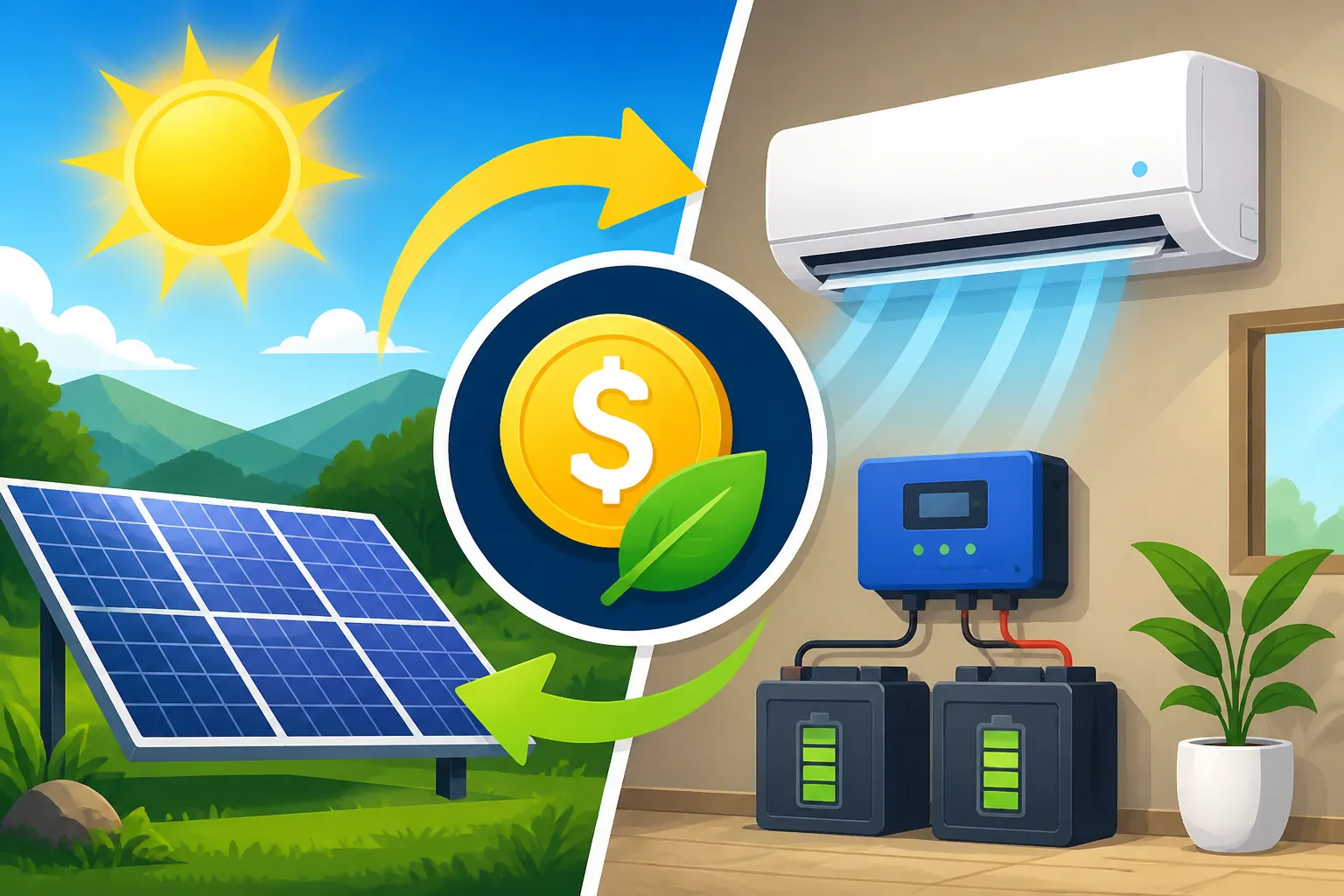
Trying to keep cool with off-grid solar, especially when the summer heat hits, can feel like a daunting challenge. Many folks dream of escaping the grid, but the thought of powering something as energy-hungry as an air conditioner often brings them crashing back to reality, wondering if it's even feasible without breaking the bank. This comprehensive guide is here to walk you through the true cost and critical considerations of running an air conditioner on your off-grid solar system, helping you understand exactly what it takes to stay comfortable.
Understanding the Energy Appetite of Air Conditioners
Let's be honest, air conditioners are notorious power hogs, and for good reason—they're moving heat, which takes a lot of energy. But not all AC units are created equal, and understanding their different appetites is the first step toward smart off-grid living.
Different Types of Air Conditioners and Their Power Consumption
When you're thinking about cooling your off-grid space, you'll encounter a few main types of air conditioners, each with its own power profile. Knowing these differences is absolutely crucial for planning your solar system.
- Window Units: These are probably the most common sight in conventional homes and can be found in various sizes, typically measured in BTUs (British Thermal Units). A smaller 5,000 BTU window unit might pull around 500-600 watts, while a larger 12,000 BTU unit could easily consume 1200-1500 watts or more. They're often cheaper upfront but can be less efficient than other options, and their energy draw is pretty consistent once running. For an off-grid cabin or RV, a smaller, highly efficient window unit might seem appealing for its simplicity, but its continuous draw still adds up.
- Portable Units: Similar to window units in their convenience, portable ACs sit on the floor and usually vent hot air out through a hose in a window. Their power consumption is generally comparable to window units of similar BTU ratings. The downside for off-grid users is often their lower efficiency and the fact that the unit itself takes up valuable interior space, radiating some heat back into the room.
- Mini-Split Systems: Now we're talking about efficiency! Ductless mini-split air conditioners are often the darlings of the off-grid community for a reason. They consist of an outdoor compressor/condenser and one or more indoor air-handling units. What makes them special is their inverter technology, which allows the compressor to vary its speed rather than just cycling on and off at full blast. This means they use significantly less power once they've reached the desired temperature, often running at 30-50% of their rated maximum. A 9,000-12,000 BTU mini-split might have a maximum draw of 800-1200 watts, but its average running consumption could be much lower, sometimes in the 300-600 watt range, making them a far more viable option for solar.
- Central Air Conditioning: This is usually a non-starter for most conventional off-grid setups, mainly due to its massive power requirements. A typical residential central AC unit can draw anywhere from 3,000 to 5,000 watts, and sometimes even more, when running. Powering something like this would demand an exceptionally large and expensive solar array and battery bank, usually reserved for very large, high-budget off-grid homes.
Factors like the SEER (Seasonal Energy Efficiency Ratio) rating, the age of the unit, and even how well your space is insulated will dramatically affect actual power consumption. A higher SEER rating means more efficient operation, and newer units generally boast better efficiency. Remember, these are not just numbers on a spec sheet; they directly translate into how many solar panels and batteries you'll need.
The Difference Between Starting Watts and Running Watts
This is a critical concept that trips up many off-grid newbies. You can't just look at an air conditioner's running wattage and call it a day, especially for units with a compressor, which includes almost all ACs.
- Running Watts: This is the power an appliance needs to operate continuously once it's up and running. For a 10,000 BTU window AC, this might be around 1000-1200 watts. This is what you'll typically see listed as "rated wattage" on the label.
- Starting Watts (or Surge Watts): This is the brief, but often significant, burst of power an appliance draws when it first kicks on. Motors, like those in AC compressors, need a much higher initial surge of power to overcome inertia and start spinning. This surge can be 2 to 7 times higher than the running wattage, lasting for a fraction of a second to a few seconds. For that 10,000 BTU AC running at 1200 watts, its starting wattage could easily be 3000-4000 watts.
Why does this matter for off-grid solar? Your inverter, the component that converts DC battery power to AC power for your appliances, must be able to handle this starting surge. If your inverter is only rated for 2000 watts continuous and your AC tries to pull 3500 watts to start, your inverter will likely trip, shut down, or even be damaged. This is a common point of frustration for folks who underestimate the power draw of their AC units. When you're learning How to Size an Off-Grid Inverter, always factor in these surge requirements, especially for your largest motor loads.
Calculating Your AC's Daily Energy Demand
Before you buy a single solar panel or battery, you absolutely must figure out how much power your chosen air conditioner will actually consume on a daily basis. This is where your homework really begins.
First, identify the running wattage of your specific AC unit. This can usually be found on a sticker on the unit itself, in the owner's manual, or on the manufacturer's website. Let's say you've picked a highly efficient 9,000 BTU mini-split that averages 500 watts while running (after the initial surge).
Next, consider how many hours a day you actually plan to run it. This is highly dependent on your climate and personal comfort levels. Are you in the scorching Arizona desert, needing it for 12 hours a day? Or in a milder climate, perhaps only 4-6 hours?
Let's use an example:
- AC Running Watts: 500 watts (average)
- Daily Run Time: 8 hours
To calculate daily Watt-hours (Wh), which is your energy demand, you multiply running watts by run time:
500 watts * 8 hours = 4000 Wh (or 4 kWh) per day.
This 4 kWh per day is a significant number. It's roughly equivalent to running 40 100-watt light bulbs for an hour! This number will be the foundation for calculating How to Calculate Off-Grid Solar Needs and determining the appropriate size for your solar array and battery bank. Don't forget that this is a per day calculation, and it needs to hold up through cloudy days or periods of lower sun exposure. This detailed Off-Grid Solar Load Calculation Explained will help you gather all the data you need for accurate sizing.
Sizing Your Off-Grid Solar System for AC
Once you have a solid understanding of your AC's energy demands, it's time to translate that into actual solar equipment. This is where the rubber meets the road, and getting it right means the difference between comfortable cooling and constant frustration.
Determining the Required Solar Panel Array Size
Your solar panel array is the engine of your off-grid system, capturing sunlight and turning it into electricity. Sizing it correctly for an AC unit means ensuring it can replenish your battery bank daily, even on less-than-perfect days.
Let's stick with our example of needing 4000 Wh (4 kWh) per day for the AC. However, you can't just divide that by typical panel output. You need to account for a few crucial factors:
- Peak Sun Hours: This is the average number of hours per day when the intensity of sunlight is equivalent to 1,000 watts per square meter (STC conditions). It varies significantly by location and season. In sunny Arizona, you might get 5-7 peak sun hours, while in cloudy Oregon, it might be 3-4. You always size for your worst-case scenario (e.g., winter or heavy cloud cover). You can find this data from online resources or weather apps for your specific location.
- System Losses: No solar system is 100% efficient. You'll lose power due to temperature, wiring resistance, inverter inefficiency, dust/dirt on panels, and charge controller losses. A general rule of thumb is to add 20-30% for these losses.
So, if you need 4000 Wh per day, and let's say your location gets 4 peak sun hours per day in winter, and you factor in 25% system losses:
- Daily Energy Needed (with losses): 4000 Wh / 0.75 (for 25% losses) = 5333 Wh
- Required Panel Wattage (DC): 5333 Wh / 4 peak sun hours = 1333 Watts
So, you'd need roughly 1300-1400 watts of solar panels. If you're buying 400-watt panels, you'd need four of them (1600 watts total). This ensures that even with less-than-ideal conditions, you're generating enough power to run your AC and any other loads. It's often smart to oversize your array a bit more, especially if you're planning for year-round comfort or want extra power for other appliances. Many people start by figuring out How Many Solar Panels for Off-Grid Living based on their total daily needs, not just for one appliance.
When looking for panels, check out options available on platforms like Amazon. You can often find decent deals, especially on popular brands. For more detailed information, consider researching the Cost of Off-Grid Solar Panels to understand the investment involved.
Building an Adequate Battery Bank for AC Use
The battery bank is the heart of your off-grid system, storing the solar energy collected during the day for use when the sun isn't shining—like at night or on cloudy days. Powering an AC requires a substantial battery bank.
Again, using our 4 kWh (4000 Wh) daily AC consumption:
- Desired Days of Autonomy: This is how many days your battery bank can power your loads without any solar input. For an AC, especially if you want consistent comfort, you might aim for 2-3 days of autonomy to handle prolonged cloudy periods. Let's aim for 2 days.
- Total Battery Capacity Needed: 4000 Wh/day * 2 days = 8000 Wh (or 8 kWh).
- Depth of Discharge (DoD): Batteries should not be fully discharged to maximize their lifespan. Lithium iron phosphate (LiFePO4) batteries can typically be discharged to 80-90% without significant harm, while lead-acid batteries (AGM, flooded) should only be discharged to 50%. Always factor this in. For LiFePO4 at 80% DoD: 8000 Wh / 0.80 = 10,000 Wh (10 kWh) usable capacity needed.
So, you'd need a battery bank with at least 10 kWh of total capacity if using LiFePO4. If you were using lead-acid, you'd need 16 kWh total capacity for the same 8 kWh usable. This highlights why LiFePO4 vs Lead-Acid Battery Cost is such an important consideration—LiFePO4 might be more expensive upfront, but you get more usable capacity and a much longer lifespan.
A 48V system is almost always recommended for larger loads like AC, as it reduces current (amps) and allows for thinner wiring, minimizing voltage drop and heat. For a 48V system, 10 kWh translates to approximately 200 Amp-hours (Ah) at 48V (10,000 Wh / 48V = ~208 Ah). This would typically be two 100Ah 48V LiFePO4 batteries wired in parallel, or four 100Ah 12V LiFePO4 batteries wired in series for a 48V system.
The Cost of an Off-Grid Solar Battery Bank is often the single largest expense in an off-grid system, especially when sizing for something like an air conditioner. High-quality LiFePO4 batteries from brands like Battle Born or EG4 can significantly improve performance and longevity, but they come with a higher price tag.
Choosing the Right Inverter for AC Loads
Your inverter is the gatekeeper, converting the DC power from your batteries into the AC power your air conditioner needs. This component is paramount for AC, mainly because of those pesky starting watts.
As discussed, your inverter needs to handle both the continuous running wattage and the surge (starting) wattage of your AC unit, plus any other appliances you might run simultaneously.
- Continuous Power Rating: If your AC runs at 1200 watts, and you want to run a few lights (100W), a fridge (150W), and a laptop (50W) at the same time, your total continuous load could be around 1500 watts. You'd want an inverter rated for at least 2000-3000 watts continuous to give yourself some headroom.
- Surge Power Rating: This is critical. If your AC has a starting surge of 3500 watts, your inverter needs to be able to supply that for a short period. Many quality inverters, like those from Victron Energy or Sol-Ark, have surge ratings that are 2x or even 3x their continuous rating for a few seconds. A 3000-watt continuous inverter might have a 6000-watt surge rating, which would be perfect for our example AC.
- Pure Sine Wave: For any modern appliance, especially sensitive electronics and motors like those in an AC unit, a pure sine wave inverter is non-negotiable. Modified sine wave inverters are cheaper but can damage appliances, cause them to run inefficiently, or even overheat.
Don't skimp on your inverter. A cheap, undersized inverter will be a constant source of headaches and potential equipment damage. When you're considering How to Choose an Off-Grid Inverter, prioritize quality and proper sizing for surge loads. Remember that for larger off-grid homes, a system that can handle What a 5000W Off-Grid System Can Power and Cost would require an even more robust inverter setup.
Real-World Costs and Practical Considerations
Now that we've delved into the technicalities, let's talk about the cold, hard cash and the practical choices that influence your overall investment in running an AC on off-grid solar. This is where many off-gridders have to make tough decisions.
Component Cost Breakdown for an AC-Capable System
The cost to run an air conditioner on off-grid solar isn't a single figure; it's a sum of several crucial components. The scale of these components directly relates to the size and efficiency of the AC unit you choose, and how often you plan to run it. Here’s a typical breakdown for a system designed to handle a moderate AC load (like our 4 kWh/day example):
| Component | Description | Estimated Cost Range (USD) |
|---|---|---|
| Solar Panels | (e.g., 1600W array) | $800 – $1,600 |
| Batteries | (e.g., 10 kWh LiFePO4, 48V) | $4,000 – $8,000 |
| Inverter/Charger | (e.g., 3000W continuous, 6000W surge, pure sine wave 48V) | $1,500 – $4,000 |
| Charge Controller | (e.g., MPPT, 48V, sized for 1600W array) | $300 – $800 |
| Mounting Hardware | (for roof or ground mount) | $200 – $800 |
| Wiring, Fuses, Breakers | (DC and AC cabling, safety components) | $400 – $1,000 |
| Balance of System (BOS) | (Connectors, combiners, enclosures, monitoring) | $300 – $1,200 |
| Installation Labor | (If professional help is used, highly variable) | $2,000 – $8,000+ |
| Total Estimated Cost | (DIY, without labor, for a moderate AC-capable system) | $7,500 – $17,400+ |
This table provides a snapshot, but prices fluctuate based on brands, quality, and where you purchase them. For instance, a basic Jackery or Bluetti portable power station might temporarily run a very small AC unit, but it won't sustain continuous cooling for an off-grid home. For a permanent, robust setup, you're looking at dedicated components. Building a proper off-grid solar system involves a significant investment, and it's essential to plan your How to Budget for an Off-Grid Solar System carefully. Remember, these costs are typically higher than a basic system only powering lights and a laptop.
Strategies to Minimize Energy Consumption and Cost
You don't just throw money at the problem; you get smart about it. Minimizing your AC's energy consumption is perhaps the most impactful thing you can do to lower the overall cost of your off-grid solar system. Every watt-hour you save means fewer panels and fewer batteries needed, which directly translates to significant savings.
- Choose High-Efficiency Units: As mentioned, mini-splits with inverter technology are often the most efficient choice for off-grid. They sip power compared to the older, on/off style window units once they're maintaining temperature. Look for units with high SEER ratings (18+ is good, 20+ is excellent).
- Insulation and Sealing: This is paramount. A well-insulated cabin or RV will retain cool air much better, meaning your AC runs less often and for shorter durations. Seal all cracks and gaps around windows and doors. Add reflective window coverings or awnings to block direct sunlight.
- Strategic Use: Don't run your AC 24/7 if you don't need to. Pre-cool your space during peak sun hours when your panels are generating maximum power. Then, let the system coast on battery power for as long as possible. Consider running it only when you're actively in the space.
- Passive Cooling Techniques: Before even turning on the AC, employ passive cooling. Open windows at night to let cool air in, use fans (which consume far less power than AC), and utilize cross-ventilation. Plant shade trees or use trellises with climbing plants to block direct sun on your home.
- Optimize System Voltage: For larger systems, going with a 48V system is more efficient. Higher voltage means lower current, which reduces resistive losses in wiring and allows for smaller wire gauges. This might not directly reduce AC consumption, but it makes the system more efficient at delivering that power. When you're researching How to Size an Off-Grid Solar System, always consider the implications of system voltage.
Every degree you can live with, and every hour you can avoid running the AC, will save you money on your system components. It's about a holistic approach to comfort, not just brute-forcing it with more equipment.
The Impact of Climate and Usage Patterns on Cost
Where you live and how you live dictates the size and cost of your off-grid AC setup more than almost anything else.
-
Climate Zones:
- Hot & Sunny (e.g., Arizona, Southern California): While you get abundant sun, your cooling needs are intense and prolonged. This means a larger AC unit, longer run times, and consequently, a much larger solar array and battery bank. You might need to size for 8-12 hours of AC run time daily, which significantly increases the "4 kWh/day" example to perhaps 8-12 kWh/day. This could easily double or triple your battery and panel requirements and thus the total cost.
- Moderate Climates (e.g., Pacific Northwest, parts of the Midwest): Here, AC might only be needed for a few weeks or months a year, and usually for shorter durations. A smaller system, or even one where the AC is an "optional" luxury for the hottest days, is much more feasible. You might only size for 2-4 hours of AC use daily, dramatically reducing your component costs.
- Cloudy Regions: Even if it's hot, consistent cloud cover reduces your effective peak sun hours, forcing you to buy more panels to compensate or rely more heavily on a generator backup.
-
Usage Patterns:
- Full-time, Year-Round Living: If you plan to live off-grid full-time and rely on AC for daily comfort, your system must be robust. This requires serious investment in large battery banks and a substantial solar array, along with a reliable backup generator.
- Seasonal or Part-Time Use (e.g., a cabin): For a hunting cabin used only in the summer, or a tiny home where you're only present on weekends, you can scale back your system significantly. You might only need to run the AC for a few hours at a time, making a smaller, more affordable system viable. For instance, a small system for a Cost to Power a Cabin with Solar might only include a few panels and batteries.
- Backup Only: Some folks only want AC as an emergency backup. In this case, a smaller system with a robust portable power station like a Jackery Explorer paired with a small window unit might suffice, running only when absolutely necessary and for limited periods. These portable units are often found on Amazon, offering a lower entry point for occasional cooling needs.
It's a delicate balance between desired comfort, geographical realities, and your budget. Understanding these influences is key to making informed decisions and avoiding costly mistakes or an underperforming system.
Disclaimer
Please remember that the information provided in this article is for educational and informational purposes only and is not intended as professional advice. Off-grid solar system design and installation can be complex and involve electrical hazards. Always consult with qualified professionals and adhere to all local codes and regulations when planning or installing your off-grid solar system. Individual costs and performance will vary based on specific circumstances, equipment choices, and usage patterns.