How to Choose Off-Grid Solar for a Remote Cabin
Trying to figure out how to bring reliable power to your remote cabin can feel like solving a complex puzzle. You've got the vision of peaceful, self-sufficient living, but the practicalities of wires, panels, and batteries can quickly become overwhelming, especially when grid power is miles away and generators are noisy and fuel-hungry. This guide is here to demystify the process, walking you through the essential steps and considerations for choosing the perfect off-grid solar system for your unique remote retreat.
Understanding Your Remote Cabin's Energy Needs
Before you even think about buying solar panels or batteries, the absolute first step is to get a crystal-clear picture of your cabin's energy demands. This isn't just a guessing game; it's a critical process that will dictate the size and cost of your entire system. Many folks dive in without this step and end up with a system that's either too small, leaving them constantly short on power, or too large, costing them a fortune unnecessarily.
Conducting a Detailed Load Analysis
A load analysis is essentially an inventory of every single electrical device you plan to use in your cabin, along with how much power each one consumes and for how long. Think about your daily routine at the cabin, from the moment you wake up until you turn out the lights. What appliances will you be running? This includes everything from the obvious big hitters like a refrigerator or a well pump, down to smaller items you might overlook, like charging your phone, running a fan, or even the power draw of your internet router.
To do this effectively, grab a pen and paper or a spreadsheet. List every appliance. For each item, you'll need its wattage (how much power it uses when running) and the estimated hours per day you'll operate it. Appliance labels often list wattage, or you can find it in the owner's manual. Don't forget seasonal items, either! That space heater you only use in the winter, or the window AC unit for summer, needs to be factored in. Remember that some appliances, like refrigerators or well pumps, cycle on and off, so you'll need to estimate their total run time over a 24-hour period. You can learn more about how to approach this by checking out our guide on How to Calculate Daily Energy Usage.
It's also crucial to consider "phantom loads" – devices that draw power even when turned off or in standby mode. Small chargers, TVs, and microwaves can all quietly sip electricity throughout the day. While individually minor, these can add up over time, especially in a remote setting where every watt-hour counts. Being meticulous now prevents frustrating power shortages later.
Estimating Daily Watt-Hour Consumption
Once you have your detailed list, it's time to crunch some numbers to get your total daily energy requirement, typically measured in watt-hours (Wh) or kilowatt-hours (kWh). This is the sum of all your appliances' power consumption over a 24-hour period.
Here's the simple calculation for each item: Wattage (W) x Hours Used Per Day (H) = Watt-Hours (Wh) per day. For instance, a 100-watt LED lightbulb used for 5 hours a day consumes 500 Wh. A small, energy-efficient refrigerator that runs at 60 watts but only cycles for a total of 8 hours a day would consume 480 Wh (60W x 8H). Summing these up for every item on your list gives you your total estimated daily watt-hour consumption. This grand total is the cornerstone for accurately sizing your entire solar system. If you consistently use more than your system can generate and store, you'll find yourself in the dark. Conversely, oversizing means you've spent money on capacity you don't actually need, which is a common mistake that increases the initial Off-Grid Solar Cost: Complete Breakdown.
Key Components of a Remote Cabin Off-Grid Solar System
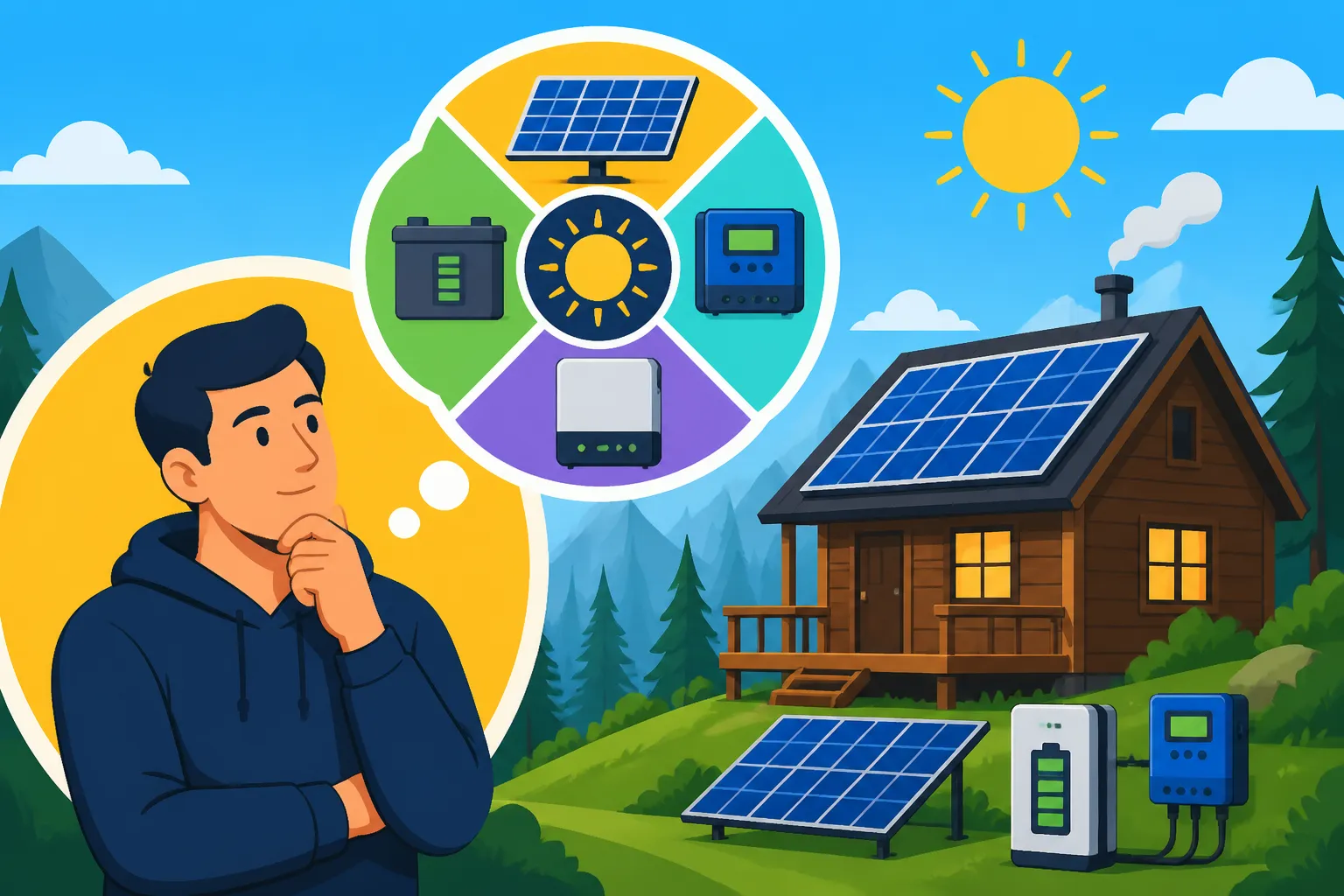
Building a robust off-grid solar system for a remote cabin involves several interconnected components, each playing a vital role in harvesting, storing, and delivering power. Understanding these parts is crucial for making informed decisions and ensuring your system meets your specific needs and the challenging conditions often found at remote locations.
Solar Panels: Your Energy Harvesters
Solar panels are the frontline of your off-grid system, converting sunlight into usable electricity. When choosing panels for a remote cabin, durability and efficiency are paramount. Monocrystalline panels are generally preferred for their higher efficiency and sleeker appearance, performing slightly better in low-light conditions, which can be a real plus during cloudy days or shorter winter daylight hours. Polycrystalline panels are a bit less efficient but are often more budget-friendly. Given the investment, leaning towards higher quality, durable panels will pay off in the long run, especially if replacement means a long trek to your cabin.
The physical mounting of panels is another critical consideration. For a cabin, you'll often have the choice between roof-mounted or ground-mounted arrays. Roof mounts save ground space and can be less visible, but they require careful sealing to prevent leaks and can be trickier to adjust for optimal sun exposure throughout the seasons. Ground mounts, while taking up space, offer flexibility in angle and orientation, making it easier to maximize sun exposure and perform maintenance like cleaning snow or debris. Many remote cabins benefit from adjustable ground mounts, allowing you to optimize for winter's lower sun angle. Our detailed guide on How to Install Off-Grid Solar Panels offers more insights into the mounting process.
Batteries: The Heart of Your System
The battery bank is arguably the most critical component for a remote off-grid cabin. Without grid connection, your batteries are what store the energy generated by your panels for use when the sun isn't shining – at night, on cloudy days, or during long winter stretches. The choice of battery chemistry significantly impacts performance, lifespan, and maintenance.
Traditionally, lead-acid batteries (like AGM or flooded lead-acid) have been common due to their lower upfront cost. However, they require more maintenance (especially flooded variants), have a shorter lifespan (typically 3-7 years), and offer a shallower depth of discharge (meaning you can only safely use about 50% of their rated capacity without shortening their life). For a remote cabin, where frequent maintenance might be difficult, this can be a drawback.
Lithium iron phosphate (LiFePO4) batteries, while having a higher initial price tag, offer significant advantages. They boast a much longer lifespan (10-15+ years), can be discharged deeper (80-100% depending on the battery management system), are virtually maintenance-free, and perform better in a wider range of temperatures. Their higher efficiency also means less energy is lost during charging and discharging, which is important for maximizing the power harvested from your panels. For comprehensive details, you can compare LiFePO4 vs Lead-Acid Battery Cost. If you're looking for flexibility or need backup power for smaller devices, a portable power station, like those offered by Jackery, can be a fantastic addition, providing supplemental power or acting as a temporary solution for critical needs without tapping into your main battery bank.
Inverters and Charge Controllers
These two components are the unsung heroes of your off-grid system, managing the flow of electricity. A charge controller sits between your solar panels and your batteries. Its job is to regulate the voltage and current coming from the panels to prevent overcharging your batteries, which can severely damage them. For remote cabins, Maximum Power Point Tracking (MPPT) charge controllers are highly recommended over cheaper Pulse Width Modulation (PWM) controllers. MPPT controllers are significantly more efficient, especially in varying weather conditions and when panel voltage differs greatly from battery voltage, meaning you'll harvest more energy from your solar array – a huge benefit for maximizing your limited sun exposure.
The inverter converts the direct current (DC) electricity stored in your batteries into alternating current (AC) electricity, which is what most standard household appliances use. For a remote cabin, you absolutely want a pure sine wave inverter. Modified sine wave inverters are cheaper but can damage sensitive electronics (like laptops, TVs, and many kitchen appliances) and cause motors to run inefficiently or overheat. A pure sine wave inverter produces clean, reliable power, mimicking what you'd get from the utility grid, ensuring your cabin appliances run smoothly and last longer. You might even consider an inverter-charger, which combines the functions of an inverter and a battery charger (useful if you ever incorporate a backup generator). Learning about How to Size an Off-Grid Inverter is a crucial step in ensuring your system can handle peak loads.
Sizing Your System for Reliability and Longevity
Accurate system sizing is the difference between an off-grid cabin that feels truly independent and one that leaves you constantly conserving power. It’s not just about matching panels to batteries; it’s about creating a harmonious system that can reliably meet your needs, even when Mother Nature isn't cooperating.
Calculating Solar Array Size
Once you have your total daily watt-hour consumption, you need to determine how many solar panels are required to generate that energy. This calculation isn't as simple as just dividing your total consumption by a panel's wattage, because the sun doesn't shine consistently all day. You need to factor in your location's "peak sun hours." Peak sun hours refer to the average number of hours per day when solar irradiance reaches 1,000 watts per square meter (the standard measurement for panel ratings). This value varies significantly by geographic location and time of year. For instance, a cabin in sunny Arizona might get 6-7 peak sun hours in summer, while one in a heavily forested area of the Pacific Northwest might only get 2-3 in winter.
To calculate your total panel wattage, you'll take your total daily watt-hour consumption and divide it by your location's lowest average daily peak sun hours (usually in winter). You'll also want to add a buffer, perhaps 20-30%, to account for inefficiencies in the system (like wiring losses, temperature effects on panels, and less-than-perfect panel angles), as well as periods of extended cloudy weather. For example, if you need 5,000 Wh per day and only get 3 peak sun hours in winter, you'd need approximately 1667W of panels (5000 Wh / 3 H = 1667W). Add a 20% buffer, and you're looking at about 2000W of panels. This ensures you have enough generating capacity even on those shorter, darker days. To dive deeper into these calculations, explore our guide on How to Size an Off-Grid Solar System.
Determining Battery Bank Capacity
Your battery bank needs to be large enough to store sufficient energy to power your cabin during periods without sun – primarily at night, but also during extended cloudy weather. This is often referred to as "days of autonomy." For a remote cabin, especially one used year-round, aiming for at least 3-5 days of autonomy is a smart move. This buffer will save you from dark nights and silent pumps if a winter storm rolls in for several days.
When calculating battery capacity, you need to consider two main factors: your daily energy consumption and the battery's usable depth of discharge (DoD). As mentioned, LiFePO4 batteries allow for a much deeper discharge (often 80-100%) compared to lead-acid (typically 50%). So, if you need 5,000 Wh per day and want 3 days of autonomy using LiFePO4 batteries at 80% DoD, you'd calculate: (5,000 Wh/day * 3 days) / 0.80 DoD = 18,750 Wh of total battery capacity. This watt-hour capacity then needs to be converted to amp-hours (Ah) based on your system voltage (e.g., 12V, 24V, 48V), with 48V being a common choice for larger cabin systems to reduce wire sizes and system losses. Our guide on How Many Batteries for an Off-Grid System will walk you through the specifics.
Considering Expansion and Backup Options
It's tempting to build a system just large enough for your current needs, but planning for future expansion is a wise strategy for a remote cabin. Your power demands might grow as you add more comforts or if friends and family visit more frequently. Design your initial system with the ability to easily add more solar panels and battery capacity down the line. This might mean installing a charge controller that can handle more input than your initial panel array, or selecting an inverter with a higher capacity than you currently need.
Even the most meticulously designed solar system can face challenges, especially in a remote location with unpredictable weather. That's why a robust backup power source is almost essential. A traditional gasoline or propane generator is a common choice, providing power to directly run appliances or recharge your batteries during prolonged periods of low sun. Ensure your generator is properly sized and consider an automatic transfer switch to seamlessly switch power sources. For smaller, critical loads, or to extend the life of your main battery bank, a high-capacity portable solar generator, like the Jackery Explorer series, can be an excellent supplementary backup. It's fantastic for running a CPAP machine overnight, charging phones, or powering emergency lights without kicking on the big generator. This layering of power sources dramatically increases your cabin's energy security and overall reliability.
Practical Considerations for Remote Cabin Solar
Beyond the technical components and sizing calculations, bringing off-grid solar to a remote cabin involves a unique set of practical challenges and ongoing responsibilities. Understanding these upfront will help you prepare for a smoother, more sustainable experience.
Installation Challenges and DIY vs. Professional
Installing an off-grid solar system at a remote cabin presents unique hurdles. Access can be difficult, often requiring specialized vehicles or even manual hauling of heavy components. You're likely dealing with uneven terrain, potentially harsh weather, and limited access to tools or supplies once on-site. The remoteness also means that calling in a professional at a moment's notice for troubleshooting isn't always feasible.
Many cabin owners opt for a DIY installation, especially if they have a good grasp of electrical principles and are comfortable with construction. This can significantly reduce costs, as professional installation can be a substantial portion of the overall expense. However, a DIY approach demands meticulous planning, adherence to safety protocols (especially when working with high voltage DC and heavy batteries), and a solid understanding of wiring diagrams and electrical codes. Incorrect wiring can be dangerous and damage expensive equipment. If you're not confident in your electrical skills, or if your system is particularly complex, investing in a professional installation, even if it means higher upfront costs, can provide peace of mind and ensure your system is safe, efficient, and code-compliant. Our article on DIY vs Professional Off-Grid Solar Cost explores this decision in detail.
Maintenance and Longevity
An off-grid solar system isn't a "set it and forget it" solution, especially in a remote cabin environment. Regular maintenance is key to maximizing its lifespan and ensuring consistent performance. Solar panels need to be kept clean from dirt, dust, leaves, and snow to ensure optimal sunlight absorption. This is particularly important for cabins in wooded areas or regions with heavy snowfall. A simple rinse with a hose or a soft brush can make a big difference.
Batteries, especially lead-acid types, require periodic checks of water levels (for flooded batteries) and terminals for corrosion. LiFePO4 batteries are largely maintenance-free but still benefit from occasional terminal inspections. Your charge controller and inverter should be checked for any fault codes or unusual sounds. Monitoring your system's performance – how much energy is being generated, how much is being consumed, and your battery state of charge – is crucial. A good battery monitor will provide invaluable insights, helping you understand your energy budget and make adjustments to your consumption habits. Taking good care of your components, from proper wiring to regular cleaning, will ensure the long-term viability of your remote cabin's power source, ultimately helping you to save money in the long-term. For specifics on how to maintain your system, you can refer to our Off-Grid Solar Maintenance Guide.
Budgeting and Cost Implications
The cost of setting up off-grid solar for a remote cabin can vary wildly, from a few thousand dollars for a very basic system powering only lights and a small fridge, to tens of thousands for a full-sized system capable of running a modern home. The primary drivers of cost are the size of your system (panel wattage and battery capacity), the type of batteries you choose, and whether you go DIY or hire professionals.
| Component | Estimated Cost Range (USD) | Key Considerations for Remote Cabin |
|---|---|---|
| Solar Panels | $1 – $1.50 per watt | Efficiency, durability, mounting type |
| Batteries | $300 – $1000 per kWh | LiFePO4 (higher upfront, lower lifecycle cost) vs. Lead-Acid (lower upfront, higher lifecycle cost and maintenance) |
| Inverter | $500 – $4,000+ | Pure sine wave, surge capacity, system voltage |
| Charge Controller | $150 – $1,000+ | MPPT recommended for efficiency |
| Wiring & BOS | $500 – $2,000+ | Fuses, breakers, disconnects, cables, mounting hardware |
| Installation | $0 (DIY) – $10,000+ (Pro) | Accessibility, complexity, local labor rates |
| Backup Generator (Optional) | $500 – $5,000+ | Fuel type, noise, auto-start features |
While the initial investment might seem significant, consider the long-term savings. You eliminate monthly utility bills entirely and gain energy independence. The lifespan of modern solar equipment means your system can provide free electricity for decades. You can also explore options like phasing in your build, starting with a smaller system and expanding it as your budget allows or as you identify your true energy needs. Additionally, it’s worth investigating whether your system qualifies for incentives like the 2026 Solar Tax Credit and Off-Grid Systems or state-specific rebates, which can help offset the initial outlay.
Ultimately, choosing an off-grid solar system for a remote cabin is a deeply personal decision, influenced by your lifestyle, budget, and desired level of comfort. By thoroughly understanding your needs, carefully selecting quality components like those offered by reputable brands, sizing your system appropriately, and preparing for the practicalities of installation and maintenance, you can create a reliable, sustainable power solution that truly allows you to enjoy the tranquility of your remote cabin.
Disclaimer
The information provided in this guide is for general informational purposes only and does not constitute professional advice. Off-grid solar system design and installation can be complex and involve electrical hazards. Always consult with qualified professionals and adhere to local codes and regulations when designing, purchasing, and installing any solar power system.