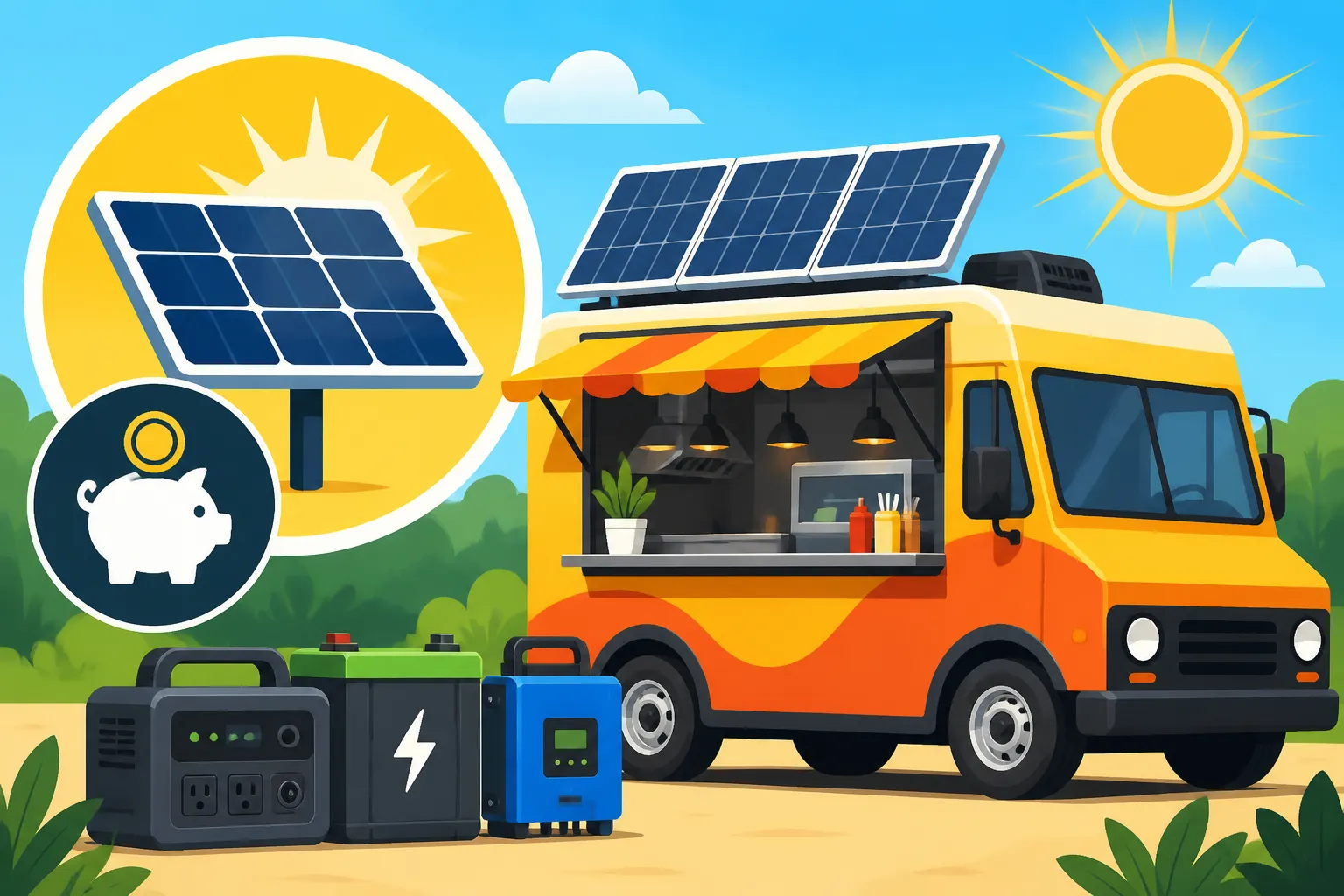
Off-Grid Solar Cost for a Food Truck
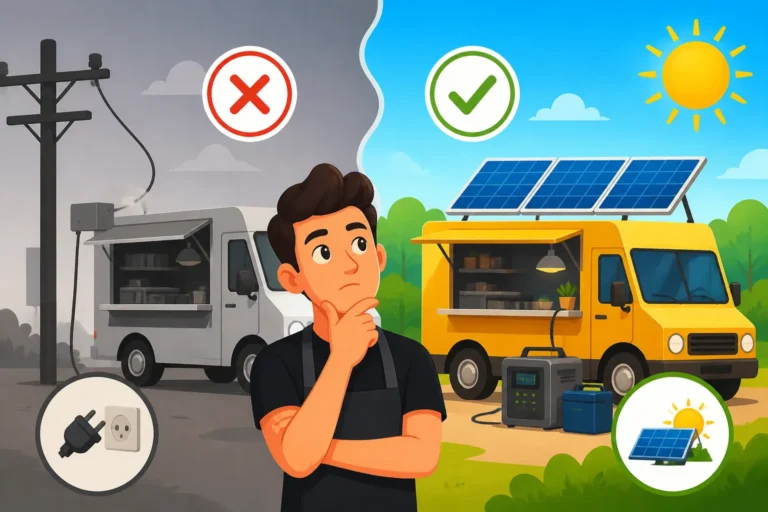
Starting a food truck is an adventure, but keeping it powered can feel like a constant battle against unreliable generators, noisy engines, and the rising cost of fuel. You're trying to create delicious food and a great experience, not wrestle with electrical cords or wonder if your fridge will hold up. This guide is here to walk you through the realistic costs and considerations of transitioning your mobile kitchen to off-grid solar power, helping you understand what it really takes to achieve energy independence on the road.
The Unique Power Demands of a Food Truck
Powering a food truck isn't like powering a cabin or an RV; it comes with its own set of distinct challenges and intense energy needs. You're essentially running a compact, full-service kitchen on wheels, often in varying environments and with peak demands that can strain even robust systems.
Why Food Trucks Are Different
Think about it: your average food truck isn't just a place to sleep; it's a bustling commercial operation. You've got everything from refrigeration units that need to run continuously, often through hot summer days, to high-wattage cooking equipment that cycles on and off rapidly. Unlike a stationary home, your truck is constantly on the move, facing vibrations, changing weather, and different sun angles depending on where you park for the day. This mobility means your solar panels need to be robustly mounted and ideally optimized for quick angle adjustments or maximum flat surface coverage. The confined space also limits where you can put components like batteries and inverters, demanding compact, efficient solutions.
Essential Appliances and Their Power Draw
Before you can even begin to think about costs, you need to get a crystal-clear picture of what you're actually trying to power. This is where most people get tripped up, underestimating the sheer demand of commercial kitchen equipment.
Let's break down some common food truck appliances and their typical power requirements:
- Refrigeration: This is your constant load. A commercial refrigerator might draw 150-300 watts when running, but it's always running, or at least cycling frequently. Freezers are similar, sometimes even higher.
- Cooking Equipment: This is where the big draws come in. A commercial griddle can easily pull 3,000-6,000 watts when heating up. Fryers are often in the 3,000-5,000 watt range. Ovens, coffee makers, microwaves – these all have significant surge and continuous demands.
- Lights: While often low-wattage LED, they add up over a long service day.
- POS System & Electronics: Cash registers, card readers, tablets, phones – these are relatively small draws but essential for business.
- Water Pump: For your sinks and sanitation, usually a small, intermittent draw.
- Exhaust Fan: Critical for ventilation, these can draw 100-300 watts continuously.
The real kicker is the simultaneous use. You might have your fridge running, a griddle heating up, the fryer maintaining temperature, and an exhaust fan blowing, all at the same time during a lunch rush. This means your system needs to handle high surge loads and continuous draws.
Calculating Your Daily Energy Needs
This is the most critical first step, and honestly, where most food truck owners contemplating solar need to spend the most time. You absolutely cannot skip this. You need to perform a thorough load analysis to figure out your total daily watt-hour (Wh) consumption and peak wattage (W) demand.
Here's how to approach it:
- List Every Appliance: Go through your food truck and list absolutely everything that uses electricity.
- Find Wattage: For each item, find its running wattage. This is usually on a label or in the user manual. For motors (like blenders or pumps), note both running and starting (surge) wattage, as starting watts can be 2-7 times higher than running watts.
- Estimate Daily Use: For each appliance, estimate how many hours per day it will run. Be realistic, especially during peak service times. For cycling appliances like refrigerators, estimate the percentage of time they are actively running.
- Calculate Daily Watt-Hours: Multiply the wattage by the hours of use for each appliance. Sum them all up. This gives you your total daily Wh.
- Identify Peak Load: Look at your list and imagine your busiest moment. Which high-wattage appliances will be running simultaneously? Add up their running wattages, plus the starting wattage of any motor-driven appliances that might kick on during that peak. This is your maximum instantaneous power demand.
Let's say a small food truck uses about 5,000 Wh per day, with a peak demand of 3,500 watts. A larger, full-service truck could easily hit 15,000-20,000 Wh per day with peak demands of 6,000-8,000 watts. This detailed calculation is the bedrock upon which your entire solar system design will be built, influencing everything from the number of panels you need to the size of your battery bank. If you want to learn more about this, check out our guide on how to size an off-grid solar system.
Breaking Down the Costs of Off-Grid Solar Components for a Food Truck
Once you have a solid understanding of your power needs, you can start looking at the individual components that make up an off-grid solar system for a food truck. The costs can vary wildly based on quality, capacity, and brand.
Solar Panels: Capturing the Sun
Solar panels are the workhorses, converting sunlight into electricity. For a food truck, you're looking at rigid monocrystalline panels, which offer the best efficiency per square foot – a crucial factor when roof space is limited.
- Types and Wattage: Panels typically come in wattages from 100W to 400W+. For a food truck, you'll likely want higher wattage panels to maximize energy harvesting from a smaller footprint.
- Cost: A single 100W panel might cost $80-$150, while a 400W panel could be $250-$400.
- Mounting Challenges: Food truck roofs often have vents, AC units, and other obstructions. Mounting needs to be incredibly secure to withstand constant vibrations and highway speeds. Tilt mounts can increase efficiency but might not be practical for a constantly moving vehicle. Many food truck owners opt for fixed, low-profile mounts to reduce aerodynamic drag and potential damage.
You'll need enough panels to not only meet your daily consumption but also to account for cloudy days, shorter winter daylight hours, and the fact that panels rarely produce their rated power at 100% efficiency in real-world conditions. This is where calculating your peak sun hours becomes essential.
Batteries: Your Energy Bank
Batteries are arguably the most critical and often the most expensive component for a food truck. They store the energy captured by your panels for use when the sun isn't shining, like during a dinner rush or overnight.
- LiFePO4 vs. Lead-Acid: For a food truck, there's really only one recommendation: LiFePO4 (Lithium Iron Phosphate) batteries.
- LiFePO4: While more expensive upfront ($500-$1,500+ per 100Ah 12V battery), they offer superior advantages: lighter weight (critical for a truck's payload capacity), much longer lifespan (2,000-5,000+ cycles vs. 300-1,000), much higher usable capacity (80-100% vs. 50%), faster charging, and maintenance-free operation. Brands like Battle Born or EG4 are popular for their reliability.
- Lead-Acid (AGM/Gel): Cheaper initially ($200-$400 per 100Ah 12V battery), but heavier, bulkier, shorter lifespan, require more maintenance, and you can only use about half their rated capacity without damaging them. The cost to replace off-grid solar batteries over time with lead-acid often outweighs any initial savings.
- Capacity Needs: You'll need enough battery capacity to cover your evening and overnight loads, plus a few "days of autonomy" for cloudy weather. A small food truck might need 200-400Ah (at 12V), while a larger one could require 600-1000Ah or more, often configured in a 24V or 48V system for efficiency with higher power demands.
Inverters and Charge Controllers: The Brains of the Operation
These components manage the flow of electricity.
- Charge Controller: This regulates the power from your solar panels to your batteries, preventing overcharging.
- MPPT (Maximum Power Point Tracking) controllers: Essential for efficiency, especially in varying light conditions. They are more expensive ($150-$600) but can improve charging efficiency by 15-30% compared to PWM controllers. Given the high demand of a food truck, MPPT is the only sensible choice.
- Inverter: This converts the DC (direct current) power from your batteries into AC (alternating current) power that your standard appliances use.
- Pure Sine Wave Inverters: Absolutely necessary for sensitive electronics and motor-driven appliances found in food trucks. Modified sine wave inverters can damage electronics and cause motors to run hot or inefficiently.
- Cost: Quality pure sine wave inverters for the kind of continuous and surge power a food truck needs can range from $400 for a 2,000W model up to $2,000+ for a 5,000W or larger inverter-charger combination (like those from Victron or Sol-Ark). Remember to size your inverter for surge loads! A 3,000W griddle might have a 6,000W surge when it first kicks on.
Wiring, Safety, and Miscellaneous Costs
Don't forget the small but essential items that add up.
- Cables and Wiring: High-gauge, marine-grade copper wire is critical for safety and efficiency, especially for connecting batteries to the inverter.
- Fuses and Breakers: Essential safety components to protect your system from overcurrents and short circuits.
- Mounting Hardware: Sturdy racking for your panels, battery boxes, and secure enclosures for other components.
- Battery Monitor: A good battery monitor (like a Victron SmartShunt) is invaluable for knowing your battery's state of charge and overall health, usually $100-$300.
- Installation Accessories: Connectors, crimpers, sealants, conduit – these small items add up.
- Backup Generator (Optional but Recommended): Even with solar, a small, quiet inverter generator (like a Honda EU2200i or a comparable Jackery or Bluetti portable power station if scaled appropriately) can be a lifesaver for prolonged cloudy spells or unexpected high demand. This adds to the initial cost but drastically increases reliability.
Real-World Scenarios and Budgeting for Your Food Truck Solar
Let's look at some hypothetical scenarios to give you a clearer picture of what different levels of off-grid solar might cost for a food truck. Keep in mind these are estimates, and actual costs can vary.
Small Truck, Basic Needs
Imagine a small coffee truck or a simple hot dog stand that primarily needs to power a few lights, a small commercial mini-fridge, a point-of-sale system, and maybe a small blender or coffee maker. Their daily consumption might be 3-5 kWh (3,000-5,000 Wh), with a peak load of around 2,000-3,000 watts.
- Solar Panels: 800W – 1200W array (2-3 x 400W panels)
- Batteries: 200Ah – 400Ah LiFePO4 (12V or 24V configuration)
- Inverter: 2,000W – 3,000W Pure Sine Wave inverter
- Charge Controller: 60A MPPT controller
- Wiring/Safety/Misc.: Cables, fuses, mounting, battery monitor
- Estimated Cost Range: $3,500 – $7,000
This setup might be supplemented with shore power or a small portable solar generator like a Jackery Explorer 1000 or EcoFlow Delta for emergencies.
Mid-Size Truck, Moderate Cooking
This is your typical burger or taco truck, running a fridge, a small freezer, a 3,000W griddle (intermittent use), an exhaust fan, lights, and POS. Daily consumption might be 8-12 kWh, with peak loads hitting 4,000-5,000 watts.
- Solar Panels: 1600W – 2400W array (4-6 x 400W panels)
- Batteries: 400Ah – 600Ah LiFePO4 (24V or 48V configuration)
- Inverter: 4,000W – 5,000W Pure Sine Wave inverter-charger
- Charge Controller: 80A-100A MPPT controller
- Wiring/Safety/Misc.: More extensive wiring, robust mounting, battery monitoring, possible generator integration
- Estimated Cost Range: $8,000 – $15,000
For a system this size, a good quality inverter from a brand like Victron or Sol-Ark often makes sense for its reliability and integration capabilities. If you want to dive deeper, you can also look into the Cost of an Off-Grid Solar Inverter.
Large Truck, Full Kitchen
This includes trucks with multiple fryers, large griddles, oven, multiple refrigerators, freezers, powerful exhaust, and potentially even an air conditioning unit for operator comfort. Daily consumption could easily be 15-25 kWh, with peak loads ranging from 6,000-10,000 watts.
- Solar Panels: 3000W – 5000W array (8-12 x 400W panels) – likely requiring creative mounting solutions or even fold-out arrays.
- Batteries: 800Ah – 1200Ah LiFePO4 (48V configuration for maximum efficiency and reduced cable sizes)
- Inverter: 8,000W – 12,000W Pure Sine Wave low-frequency inverter-charger
- Charge Controller: 100A+ MPPT controller, possibly two controllers
- Wiring/Safety/Misc.: Professional-grade electrical components, robust grounding, advanced battery monitoring, mandatory automatic transfer switch for generator backup
- Estimated Cost Range: $18,000 – $35,000+
For these larger, more complex systems, the Cost of an Off-Grid Solar Battery Bank will be a significant factor.
Here's a simplified table summarizing the component cost ranges:
| Component | Small Truck (Basic) | Mid-Size Truck (Moderate) | Large Truck (Full Kitchen) |
|---|---|---|---|
| Solar Panels | $500 – $1,500 | $1,500 – $3,000 | $3,000 – $6,000+ |
| LiFePO4 Batteries | $1,000 – $3,000 | $3,000 – $6,000 | $6,000 – $12,000+ |
| Inverter | $400 – $1,000 | $1,000 – $2,500 | $2,500 – $5,000+ |
| Charge Controller | $150 – $300 | $300 – $600 | $600 – $1,200+ |
| Wiring & Safety | $200 – $500 | $500 – $1,000 | $1,000 – $2,000+ |
| Mounting Hardware | $100 – $300 | $200 – $500 | $400 – $800+ |
| Battery Monitor | $100 – $200 | $150 – $300 | $200 – $400+ |
| Generator (Backup) | $500 – $1,500 (optional) | $1,000 – $3,000 (recomm.) | $2,000 – $5,000+ (essential) |
| Total Estimate | $3,500 – $7,000 | $8,000 – $15,000 | $18,000 – $35,000+ |
This table gives you a starting point. Remember that the initial cost can seem high, but the long-term savings on fuel and maintenance compared to a generator, plus the benefit of quiet operation, can make it a worthwhile investment. You might also want to explore Off-Grid Solar Cost by System Size for more general sizing information.
DIY vs. Professional Installation and Long-Term Considerations
Deciding whether to tackle the installation yourself or hire a professional is a major factor in the total cost and overall success of your food truck's solar system.
The DIY Route: Savings vs. Challenges
Many people are tempted by the idea of a DIY off-grid solar build, especially when they see component prices on platforms like Amazon or specialized solar retailers. The potential savings on labor can be substantial, often cutting 20-40% off the total project cost. If you're mechanically inclined, have a good understanding of electrical systems, and are meticulous with planning and execution, a DIY approach can be rewarding.
However, for a food truck, the stakes are incredibly high. This isn't just about powering your lights; it's about keeping thousands of dollars worth of inventory cold, ensuring your cooking equipment runs reliably during critical service hours, and most importantly, ensuring the safety of your staff and customers.
- Time Commitment: Researching, designing, sourcing, and installing a robust system takes a lot of time – time you could be spending running your business.
- Expertise Required: You'll need to understand DC and AC wiring, proper fusing, grounding, voltage drop calculations, and component compatibility. Mistakes can be dangerous and costly.
- Safety: Improper wiring can lead to fires or electrocution, a risk you absolutely cannot afford in a commercial vehicle.
- Warranty Issues: Some manufacturers may void warranties if components are not installed by a certified professional.
For smaller, simpler systems, like those powering just a few basic electronics, a DIY approach might be more feasible. Many excellent resources and kits (available from places like Renogy or even a curated selection on Amazon) can guide you. But as soon as you introduce high-wattage cooking equipment, the complexity escalates rapidly. Considering the unique challenges, it’s also good to know how much cheaper is DIY off-grid solar in general.
Hiring a Pro: Peace of Mind
For most food truck owners, hiring a professional solar installer or a specialized mobile electrical technician is often the wiser choice. Yes, it adds to the upfront cost (expect installation to be 10-25% of your total system cost, depending on complexity), but it buys you invaluable peace of mind.
- Expert Design: A professional can accurately assess your specific load requirements, optimize panel placement given your truck's layout, and design a system that maximizes efficiency and reliability. They'll know about crucial factors like vibration resistance, thermal management for confined spaces, and proper ventilation for battery banks.
- Safe Installation: They'll ensure all wiring meets safety standards, is properly fused and grounded, and is robust enough for a mobile environment. They'll also handle any necessary permits or inspections, if applicable, which can vary by locality.
- Warranty and Support: Professional installers typically offer warranties on their workmanship, and you'll have someone to call if issues arise. They often have established relationships with equipment suppliers, streamlining the process.
- Specialized Knowledge: A professional who understands commercial mobile applications can advise on specific equipment that holds up best in a food truck environment, possibly introducing you to robust solutions you might not find searching online.
For intricate setups, especially those that need to power large cooking appliances, investing in professional help is almost always worth it. It's a business asset, and you want it built right.
Maintenance and Longevity
Regardless of who installs your system, ongoing maintenance is crucial for longevity and performance.
- Panel Cleaning: Dust, grease, and grime can accumulate on your solar panels, reducing their efficiency. Regular cleaning (with mild soap and water) is essential.
- Battery Checks: While LiFePO4 batteries are largely maintenance-free, it's good practice to periodically check connections and ensure they're in a stable environment. For lead-acid batteries (if you chose them against advice), electrolyte levels need regular monitoring. You can learn more about how to maintain an off-grid battery bank.
- System Inspections: Periodically check all wiring connections, fuses, and mounting hardware for any signs of wear, corrosion, or loosening due to vibration.
- Software Updates: Many modern inverters and charge controllers have firmware that can be updated for improved performance or bug fixes.
- Component Lifespan: Panels typically last 20-25 years, while LiFePO4 batteries can last 10-15 years or more. Knowing your Off-Grid Solar Battery Replacement Cost Over Time can help you budget for future upgrades.
An off-grid solar system for your food truck is a significant investment, but when properly designed, installed, and maintained, it offers a pathway to quieter operation, reduced fuel costs, and greater energy independence, allowing you to focus on serving up fantastic food.
Disclaimer
Please note that the information provided in this guide is for general informational purposes only and does not constitute professional electrical engineering or financial advice. Off-grid solar system design and installation can be complex and potentially dangerous if not executed correctly. Always consult with qualified professionals for system design, installation, and compliance with local codes and regulations for commercial vehicles. Costs are estimates and can vary significantly based on location, equipment choices, and market fluctuations.