Best Panels for a Ground Mount
Deciding to go off-grid, especially with a ground-mounted solar system, is an exciting step towards energy independence, but let's be honest, the sheer number of panel options out there can feel utterly overwhelming. You're trying to figure out how to get the most bang for your buck, ensuring your homestead, cabin, or RV setup has reliable power, and often, what you find feels like a tech manual written in a foreign language. This guide is here to cut through the jargon and help you confidently choose the very best solar panels for your ground mount system, ensuring you invest wisely in your off-grid dream.
Why Ground Mounts Are a Smart Choice for Off-Grid Solar
When you're envisioning your off-grid solar setup, the first image that often comes to mind is panels neatly arranged on a rooftop. However, for many living the off-grid life, ground mounts actually offer some incredible advantages that are worth seriously considering. They might take up a bit more real estate, but the flexibility and performance gains can be well worth it.
Advantages Over Roof Mounts
Think about it: when panels are fixed to your roof, you're pretty much stuck with your roof's orientation and tilt. With a ground mount, you have the freedom to position your panels precisely for optimal sunlight capture throughout the day and year. This means you can easily adjust the tilt angle to maximize solar gain during those short, low-sun winter days, and then flatten them out a bit for summer. This kind of flexibility is a game-changer for maximizing your energy harvest, especially when every watt counts for your off-grid system.
Another huge plus is accessibility. Imagine having to climb onto your roof every time you need to clean your panels, inspect wiring, or troubleshoot an issue. It's not just a hassle; it can be downright dangerous. Ground-mounted panels, on the other hand, are right there, easy to reach. This makes maintenance a breeze, allowing you to keep your system performing at its peak without risking a fall or needing specialized equipment. Plus, if you ever need to expand your system, adding more panels to a ground array is typically far simpler than retrofitting them onto an already crowded roof. If you're looking for a deeper dive into the installation process, you might find our guide on How to Install Ground-Mounted Solar Panels helpful.
Considerations for Installation
While ground mounts offer fantastic benefits, they do come with their own set of considerations. The most obvious one is space. You'll need a clear, unshaded area on your property that's large enough to accommodate your chosen number of panels and their racking. For a small cabin, this might just be a small corner of the yard, but for a whole house system, you could be looking at a significant footprint.
Another important aspect is ensuring structural stability. Ground mounts, especially in regions with high winds or heavy snow, need robust foundations. This could involve concrete footings, driven poles, or ballasted systems. It's not just about keeping the panels from blowing away; it's about protecting your investment and ensuring safety. You'll also need to consider trenching for underground wiring runs from your array to your battery bank and inverter, which adds to the labor and material costs. Local permits and zoning regulations can also vary significantly, so always check with your county or municipality. Even for off-grid setups, sometimes there are rules about structures and electrical work. Understanding Off-Grid Solar Permit Requirements can save you a lot of headaches down the line.
Key Factors When Choosing Panels for Ground Mounts
Selecting the right solar panels for your ground mount system isn't just about picking the cheapest option. It’s about finding panels that will perform reliably for decades in your specific environment. There are several critical factors to weigh to ensure your off-grid power supply is as robust and efficient as possible.
Efficiency and Power Output
When we talk about solar panel efficiency, we're really discussing how well a panel converts sunlight into usable electricity. For ground mounts, especially if space is somewhat limited or you're aiming for a high-output system, higher efficiency panels are often a worthwhile investment. Monocrystalline panels are generally recognized for their higher efficiency rates, often ranging from 17% to over 22%. This means you can generate more power from a smaller physical footprint, which can be beneficial if your prime sun-exposure area is constrained.
Considering the power output, often expressed in watts, is also crucial. Modern panels typically range from 300W to 500W, or even higher. Choosing higher wattage panels means you'll need fewer individual panels to reach your desired system size. For instance, if you're aiming for a 3000W (3kW) array, you could use ten 300W panels or six 500W panels. Fewer panels often translates to less racking, fewer wiring connections, and a simpler installation overall, saving you time and potentially money on other components. Brands like Renogy offer a range of high-wattage monocrystalline panels that are popular among DIY off-gridders due to their accessibility and performance. Learning How to Choose an Off-Grid Solar Panels is a great next step after understanding these basics.
Durability and Weather Resistance
Off-grid systems, especially ground mounts, are exposed to the elements constantly. You need panels that can stand up to whatever Mother Nature throws at them. Look for panels with high-quality tempered glass, robust aluminum frames, and strong junction boxes. These components protect the delicate photovoltaic cells inside.
Pay close attention to specific ratings like hail impact resistance, often indicated by a panel's ability to withstand a certain size and speed of ice ball. Snow load capacity is another critical factor, particularly if you live in a region that gets heavy snowfall. Panels are typically rated for a certain amount of pounds per square foot, and you want to ensure your chosen panels can handle the accumulated weight without structural damage. Temperature coefficients are also important: this metric tells you how much a panel's output will decrease as its temperature rises. Lower (closer to zero) negative temperature coefficients mean better performance in hot climates. While you can find many panels online, like on Amazon, for larger systems it's often worth looking at manufacturers who specifically detail these robust specifications.
Physical Size and Weight
While ground mounts offer more flexibility than roof mounts, the physical dimensions and weight of your chosen panels still matter. Larger, heavier panels can be more challenging to transport and maneuver, especially if you're doing a DIY installation with limited help. A standard 60-cell or 72-cell panel might weigh anywhere from 40 to 60 pounds, making it a two-person job to lift and secure safely.
The size also directly impacts your racking design. If you choose particularly large panels, you'll need racking systems designed to accommodate their dimensions and weight, which could influence the spacing between support posts and the overall material needed. For instance, if you're building a ground mount from scratch, knowing the exact dimensions of your panels will dictate the length of your rails and the width of your array. It's not just about the space the panels take up; it's about the practicalities of building the structure that holds them.
Cost per Watt and Warranty
Let's talk money, because for most of us, budget is a real concern. Comparing the "cost per watt" is one of the most effective ways to evaluate solar panel value. To calculate this, simply divide the panel's price by its wattage. For example, a 400W panel costing $200 has a cost per watt of $0.50 ($200/400W). This helps you compare different brands and models fairly, allowing you to see which gives you the most power for your dollar.
Beyond the initial price, the warranty is your long-term assurance. Solar panels typically come with two types of warranties: a product warranty and a performance warranty. The product warranty covers manufacturing defects and material failures, usually for 10-12 years. The performance warranty guarantees that the panel will still produce a certain percentage of its rated power (e.g., 80% or 85%) after 20 or 25 years. A strong, long-term performance warranty is a good indicator of a manufacturer's confidence in their product's durability and output over time, which is exactly what you need for a reliable off-grid system. Considering Off-Grid Solar Payback Period Explained highlights the importance of long-term reliability.
Top Panel Types for Ground Mount Applications
With the basics covered, let's zero in on the panel types that truly shine in ground-mounted off-grid systems. The choices you make here will significantly impact your system's output and long-term performance.
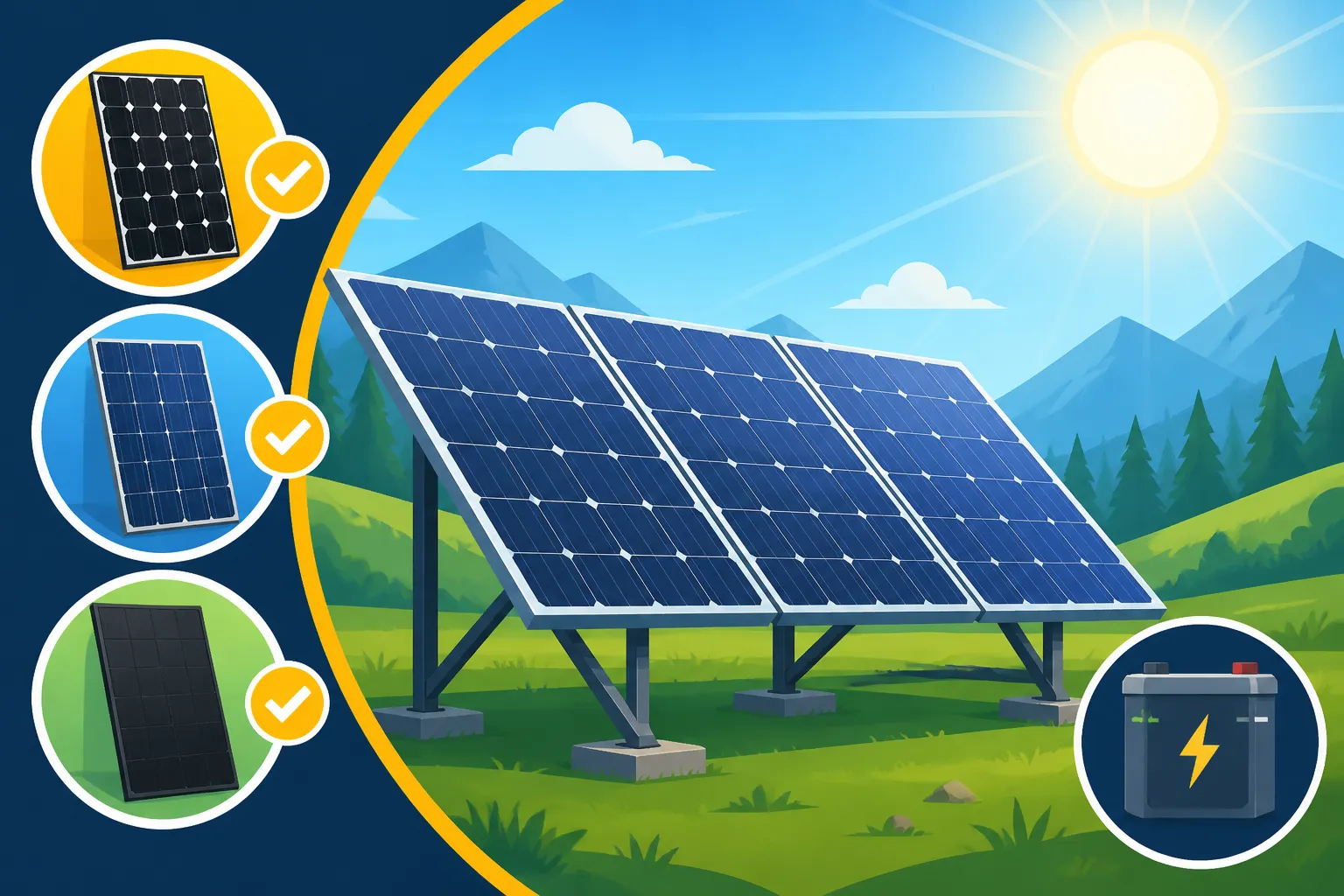
High-Wattage Monocrystalline Panels
For most ground mount off-grid setups, high-wattage monocrystalline panels are the go-to choice, and for good reason. These panels are made from a single crystal of silicon, giving them a uniform black appearance and, more importantly, higher efficiency. Because they are more efficient, you'll need fewer panels to achieve your desired power output. This is a huge advantage for ground mounts, where reducing the physical footprint can save on racking materials and simplifies the installation of your How to Install Off-Grid Solar Panels.
Consider a homestead aiming for 5kW of power. With 400W monocrystalline panels, they'd need 13 panels. If they opted for less efficient 300W panels, they'd need 17 panels. That difference of four panels means more racking, more wiring, and a larger overall array. Many reputable brands like Renogy offer excellent high-wattage monocrystalline panels, often with durable frames and good temperature coefficients, making them suitable for a wide range of climates and ideal for situations where you want maximum power generation from a given area.
Bifacial Solar Panels
This is where things get really interesting, especially for ground mounts! Bifacial solar panels are designed to capture sunlight from both their front and back surfaces. The front side works just like a traditional panel, but the back side can absorb reflected light from the ground, snow, or even light bouncing off nearby surfaces. This unique capability can increase a panel's energy output by an additional 5% to 30%, depending on the ground surface and array design.
For ground mounts, bifacial panels truly excel. Imagine setting them up over a light-colored gravel bed, white TPO roofing material (if they're over a structure), or even snow in winter – the reflected light gives you a significant boost. They also tend to be more durable because they often use dual glass construction, meaning a glass layer on both the front and back, which enhances their resistance to micro-cracks and environmental degradation. While they might have a slightly higher upfront cost, the increased energy harvest over their lifespan can offer an excellent return on investment for your off-grid system. They are definitely worth considering if you have a suitable ground surface and are looking to maximize every photon.
Considerations for Different Climates
Your local climate plays a massive role in which panels will perform best for you. In sunny, hot climates like Arizona, panels with excellent temperature coefficients are paramount. As panels heat up, their efficiency drops, so a panel that performs well at higher temperatures will maintain better output throughout the scorching summer days. Conversely, in cold, snowy regions like the mountains of Colorado, snow load capacity becomes a top priority. You need panels that can withstand heavy snow accumulation without structural damage. You also want to consider how easily snow will shed from the panel's surface, which can sometimes be aided by the panel material or the array's tilt angle.
For cloudy regions, like parts of the Pacific Northwest, panels with good low-light performance are beneficial. Some manufacturers specifically design panels to capture diffuse light more effectively. While all panels perform better in direct sunlight, some lose less efficiency in overcast conditions. Ultimately, understanding your specific climate's challenges will guide you towards the most resilient and productive panel choices. You can dive deeper into specific choices with our article on Best Solar Panels for Cold Weather or Best Solar Panels for High Heat.
Here's a quick comparison of panel types commonly used for ground mounts:
| Feature | Monocrystalline Panels | Bifacial Solar Panels |
|---|---|---|
| Efficiency | High (17-22%+) | Very High (17-22%+ on front, plus 5-30% from back) |
| Power Output | Excellent, high wattage per panel | Superior due to dual-sided capture |
| Cost | Moderate to High | Higher initial cost |
| Durability | Very Good, tempered glass, strong frame | Excellent, often dual-glass, highly resilient |
| Appearance | Uniform black | Often clear or semi-transparent backsheet |
| Optimal Use Case | General ground mounts, limited space, all climates | Ground mounts with reflective surfaces (gravel, snow) |
| Primary Benefit | High power in compact size | Maximum energy harvest, enhanced durability |
Where to Source Your Ground Mount Solar Panels
Once you've narrowed down the type and specifications of panels you need, the next step is actually getting them. The sourcing strategy can vary greatly depending on the size of your project and your comfort level with different purchasing avenues.
Online Retailers and Specialized Suppliers
For many off-gridders, especially those starting with smaller systems or looking for specific components, online retailers are a fantastic resource. Websites like Amazon offer a vast selection of solar panels from various brands, including popular choices like Renogy. The convenience of having panels shipped directly to your door, often with detailed customer reviews and competitive pricing, is a huge plus. You can easily compare specifications, read user experiences, and even find complete kits that simplify the buying process. However, it's worth noting that for very large or heavy orders, shipping costs can add up, and handling returns for damaged items might be more complex than with a specialized supplier.
Specialized solar suppliers, often found online as well, frequently carry a deeper inventory of higher-end panels and offer more technical support. These are companies that focus solely on solar equipment, so their staff are often incredibly knowledgeable and can help you select the exact panels that match your system's needs. Brands like Victron Energy or Sol-Ark, while more known for inverters and charge controllers, often partner with distributors who also carry premium panel brands. They might offer bulk discounts or freight shipping options that are more economical for larger orders. If you're building a substantial system, they can be invaluable for their expertise and ability to provide a comprehensive package. To understand more about overall equipment, check out our guide on Off-Grid Solar Equipment Explained.
Local Distributors and Bulk Purchases
For larger, permanent ground mount installations, especially those powering an entire off-grid home, exploring local solar distributors or making bulk purchases directly from manufacturers or their regional representatives can be the most cost-effective route. Local distributors often have warehouses, allowing you to pick up panels directly and save on shipping costs. They also tend to have established relationships with local installers and electricians, which can be helpful if you need professional assistance or want to ensure your system meets local codes.
Purchasing in bulk, whether from an online wholesaler or a local distributor, almost always results in a lower cost per watt. If you're building a large system, say 10kW or more, the savings can be substantial. For example, buying a full pallet of 30 panels instead of just a few individually can significantly reduce your overall Cost of Off-Grid Solar Panels. This approach also ensures all your panels are from the same batch, which can sometimes provide consistency in performance. It's a bit more of an upfront commitment, but for a serious off-grid homestead, it's a strategy that can yield significant long-term value. Don't forget to consider How to Budget for an Off-Grid Solar System when planning such a large purchase.
Designing Your Ground Mount for Optimal Panel Performance
Choosing the right panels is just one piece of the puzzle. How you design and install your ground mount system is equally important for maximizing the performance of those panels and ensuring a reliable power supply.
Panel Tilt and Azimuth Adjustment
One of the biggest advantages of ground mounts is the ability to optimize your panel's tilt and azimuth (the direction they face). Unlike a fixed rooftop, you can orient your panels due south (in the Northern Hemisphere) for maximum year-round sun exposure. More importantly, you can often adjust the tilt angle seasonally. For example, in winter, when the sun is low in the sky, tilting your panels steeper can significantly increase their output. In summer, you might flatten them out a bit.
Some advanced ground mount systems even incorporate active tracking, where the panels slowly follow the sun's path across the sky. While these can be more expensive and complex, they offer the highest possible energy harvest. For most off-gridders, a seasonally adjustable fixed tilt is a perfect compromise, providing significant gains over a static roof mount without the added complexity and cost of a tracker. Always check your local solar insolation data and consider a tilt that favors your highest energy demand season. Our article on Best Tilt Angle for Off-Grid Panels can provide more specific guidance.
Managing Shading and Micro-Shading
Shading is the silent killer of solar output. Even a small shadow from a tree branch, antenna, or chimney can drastically reduce the power output of an entire string of panels, especially with older string inverter technologies. For ground mounts, you have a distinct advantage in that you can choose an area free from existing obstructions. However, you still need to think about future growth – will that small sapling eventually become a huge tree casting a shadow? Will a planned shed or fence block the sun?
Beyond major shadows, consider micro-shading. This is where dirt, dust, bird droppings, or even leaves can partially cover a cell or part of a panel. While you can clean panels, choosing panels with good bypass diodes is crucial. Bypass diodes allow electricity to flow around shaded or malfunctioning cells, preventing the entire panel (or string) from shutting down due. Regular cleaning and careful placement are key strategies to mitigate shading losses and keep your panels performing optimally, contributing to your overall Off-Grid Solar System Sizing Guide.
Wiring and System Voltage Considerations
The way you wire your panels, and the system voltage you choose, will have a direct impact on performance and efficiency, especially in a ground mount where wire runs can sometimes be longer. Most off-grid systems today operate at 12V, 24V, or 48V. For larger ground mount arrays, 48V is almost always the preferred choice. Higher voltage systems experience less energy loss due to voltage drop over long wire runs, meaning more of the power your panels generate actually makes it to your batteries. This allows you to use smaller gauge (and thus cheaper) wiring, or have longer wire runs without significant power loss.
You'll also need to decide between wiring panels in series, parallel, or a combination (series-parallel). Series wiring increases voltage, while parallel wiring increases amperage. Your choice will depend on the requirements of your charge controller and inverter. MPPT (Maximum Power Point Tracking) charge controllers are highly recommended for ground mounts, especially with larger arrays, as they can efficiently convert the panel's voltage to the battery bank's voltage, maximizing charge efficiency. Our comprehensive guide on How to Wire an Off-Grid Solar System delves into these details.
Final Thoughts on Ground Mount Panel Selection
Choosing the best solar panels for a ground mount is about more than just watts and dollars. It's about building a resilient, efficient, and reliable off-grid power system that serves your needs for decades to come. By carefully considering efficiency, durability, your specific climate, and smart design choices, you can make an informed decision that empowers your independent lifestyle. Take your time, do your research, and don't hesitate to reach out to experienced off-gridders or solar professionals if you have specific questions about your unique setup.
Disclaimer
The information provided in this guide is for general informational purposes only and does not constitute professional advice. While we strive to provide accurate and up-to-date content, off-grid solar system design and installation can be complex. We recommend consulting with qualified solar professionals or electricians for specific guidance tailored to your individual needs and local regulations. Always prioritize safety and adhere to all applicable electrical codes and building standards.