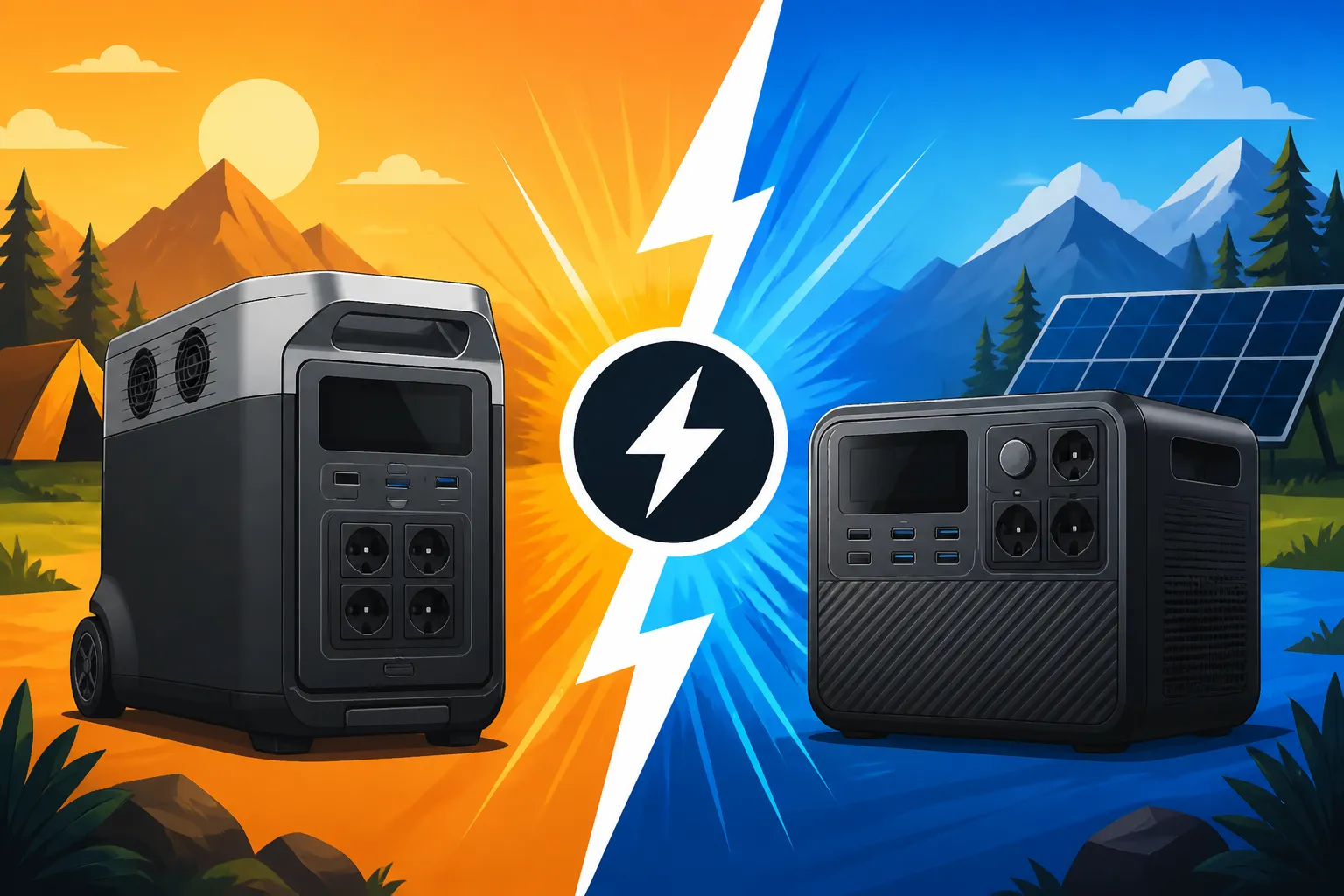
EcoFlow Delta Pro vs Bluetti AC200L
Deciding on the right portable power station for your off-grid adventures or emergency home backup can feel like navigating a maze, especially when two powerhouse contenders like the EcoFlow Delta Pro and the Bluetti AC200L are vying for your attention. Many people grapple with comparing their robust features, trying to figure out which one will truly meet their unique demands without overspending or falling short on power when it matters most. This comprehensive guide is here to untangle the complexities, offering a clear, empathetic breakdown of both systems so you can confidently choose the best fit for your needs.
Understanding Your Power Needs Before Choosing
Before you even start comparing technical specifications, the absolute first step is to get a solid grasp on what you actually need to power. It’s easy to get swept away by impressive numbers, but without a clear understanding of your own energy consumption, you might end up with a system that's either overkill or woefully inadequate. This foundational step ensures you're investing wisely and that your off-grid experience or emergency preparedness is genuinely reliable.
Daily Energy Consumption and Peak Loads
Let's talk about daily energy consumption first. This isn't just about how many gadgets you have, but how long you run them and what their average wattage is. Think about your essential appliances: your refrigerator, lights, phone chargers, laptop, perhaps a CPAP machine, or even a mini-split air conditioner if you're planning for more comfort. For each item, you need to know its running wattage and how many hours a day it will operate. For instance, a small RV fridge might pull 50 watts, but run for 8 hours a day, totaling 400 watt-hours. A laptop charger might pull 60 watts for 4 hours, that’s 240 watt-hours. Summing these up gives you your total daily watt-hour requirement. If you're struggling with this, our guide on How to Calculate Daily Energy Usage can walk you through the process step-by-step.
Beyond daily consumption, there’s the crucial concept of peak loads or surge wattage. Many appliances, especially those with motors like refrigerators, well pumps, or power tools, draw a much higher burst of power for a split second when they first start up. While their running wattage might be manageable, their surge wattage can be two to five times higher. Your portable power station needs to be able to handle this momentary surge, otherwise, it will simply shut down. Imagine trying to start your well pump on your cabin's solar system only for the inverter to fault out immediately – that’s a frustrating scenario you want to avoid by understanding these peak demands upfront.
Runtime Expectations
Once you've nailed down your daily energy consumption, you need to consider how long you expect your power station to run without recharging. This is often referred to as "days of autonomy" in larger off-grid systems. For a portable unit, it means: how many hours or days can this device sustain your essential loads if there's no sun for solar charging, or no grid power for AC charging? If you're using it for short camping trips, a few hours might be fine. But if it's for emergency home backup during an extended outage or full-time RV living, you'll want significantly more capacity.
Consider the worst-case scenario: a stretch of cloudy, rainy days. Will your solar panels still generate enough power? Probably not much. So, your battery capacity needs to be robust enough to carry you through those low-production periods. Understanding How Much Battery Capacity You Need directly relates to these runtime expectations. A larger battery, while heavier and more expensive, provides a longer buffer, giving you peace of mind when Mother Nature isn't cooperating. This consideration directly impacts which of these two robust units will be the better choice, as their capacities, while both impressive, do differ.
EcoFlow Delta Pro: A Deep Dive
The EcoFlow Delta Pro has quickly become a darling in the off-grid and backup power communities, known for its incredible capacity and expandability. It's often seen as a significant step up from smaller portable power stations, almost bridging the gap between a portable unit and a full home backup system. Many DIY enthusiasts and seasoned off-gridders have sung its praises for its versatility.
Key Features and Specifications
At its core, the EcoFlow Delta Pro boasts a massive 3,600Wh (watt-hour) capacity, which is substantial for a single portable unit. What truly sets it apart, however, is its expandable nature. You can connect up to two Smart Extra Batteries, each adding another 3,600Wh, bringing the total capacity to an astounding 10,800Wh (10.8kWh). This modularity means you can start small and grow your system as your needs evolve, a feature that's incredibly appealing for those still figuring out their long-term power requirements.
In terms of power output, the Delta Pro delivers a continuous 3,600W (watts) of AC power, with a surge capability of up to 7,200W. This means it can confidently run almost any standard home appliance, from a full-sized refrigerator and microwave to power tools and even some smaller air conditioning units. Its X-Stream charging technology is another major highlight, allowing it to charge from 0-80% in just over an hour when plugged into a standard AC outlet. It also supports up to 1,600W of solar input, which is fantastic for rapid recharging in sunny conditions, making it a strong contender for those wondering How to Choose an Off-Grid Solar Generator. This flexibility in charging, from wall outlets to solar panels, makes it exceptionally adaptable for various scenarios.
Pros and Cons in Real-World Scenarios
One of the biggest advantages of the EcoFlow Delta Pro in real-world use is its sheer capacity and ability to handle high-wattage appliances. Imagine a power outage: you can keep your refrigerator running, brew coffee, charge all your devices, and even run a small electric heater or window AC unit without breaking a sweat. For RVers or tiny home dwellers, this means a level of comfort and utility previously only possible with much more complex and expensive fixed installations. The companion app also offers excellent control and monitoring, allowing you to track energy usage and charging status from your phone, which is a modern convenience often overlooked until you really need it.
However, no product is perfect. The Delta Pro's significant capacity comes with a considerable weight penalty, tipping the scales at around 99 pounds (about 45 kg) for the main unit. While it has wheels and an extendable handle for portability, moving it up and down stairs or loading it into a vehicle can be a challenge for one person. Its price point is also on the higher end of the portable power station spectrum, which can be a barrier for some budgets, though its features often justify the cost. Furthermore, while the X-Stream charging is fast, it can draw a lot of power from your home circuit, potentially tripping older breakers if other high-draw appliances are in use simultaneously.
Bluetti AC200L: A Closer Look
The Bluetti AC200L is another strong contender in the higher-capacity portable power station market, building on the success of its predecessors while introducing enhanced features. It’s designed to be a reliable workhorse for those seeking substantial power for their off-grid endeavors or as a robust emergency backup solution. Bluetti has carved out a reputation for durable, feature-rich power solutions, and the AC200L carries that torch proudly.
Key Features and Specifications
The Bluetti AC200L features a robust 2,048Wh (watt-hour) LiFePO4 battery, a chemistry known for its longevity and safety, offering over 3,000 charge cycles to 80% capacity. While its base capacity is less than the Delta Pro, it also offers expandability by connecting up to two B230 (2048Wh each) or B300 (3072Wh each) external battery packs, pushing its total potential capacity up to 8,192Wh (with two B300s). This flexibility allows users to tailor the system to their specific energy needs over time, making it adaptable for various scenarios, from powering a small cabin to providing essential backup for a larger home.
For power output, the AC200L provides a continuous 2,400W of pure sine wave AC power, with a surge capability of 3,600W. This is ample power for most common household appliances, including refrigerators, blenders, and typical electronics. Its charging capabilities are impressive too, supporting up to 2,400W of AC input (with a 30A plug) for super-fast charging, or 1,200W of solar input. This high solar input capability means you can quickly recharge the unit even on a partially sunny day, which is a major benefit for those relying on renewable energy sources. Understanding How to Choose an Off-Grid Charge Controller might be less relevant for these integrated units, but the high solar input definitely leverages panel efficiency.
Pros and Cons for Everyday Use
In practical, day-to-day scenarios, the Bluetti AC200L shines with its fantastic balance of power, capacity, and portability. It weighs in at around 62 lbs (28 kg), which is significantly lighter than the EcoFlow Delta Pro, making it easier to transport for camping trips, job sites, or moving around the house during an outage. Its durable construction and comprehensive port selection, including multiple AC outlets, USB-A, USB-C, and a 30A RV outlet, make it incredibly versatile. The use of LiFePO4 batteries means a longer lifespan and enhanced safety compared to other battery chemistries, which is a huge peace of mind for long-term users. Many users, after purchasing solar panels from brands like Renogy or searching for battery solutions on Amazon, find these integrated power stations offer a more streamlined experience.
On the flip side, while the AC200L's 2,400W continuous output is robust, it's not quite as high as the Delta Pro's 3,600W. This might mean it struggles with a few specific high-draw appliances simultaneously, or certain larger tools that require a higher continuous wattage. Its maximum solar input (1,200W) is also less than the Delta Pro's (1,600W), meaning slightly slower solar recharging if you have a very large solar array. While expandable, its maximum capacity of 8.192kWh (with two B300 batteries) falls short of the Delta Pro's 10.8kWh potential. These aren't deal-breakers for most, but they are important distinctions depending on your specific power demands.
Direct Comparison: EcoFlow Delta Pro vs. Bluetti AC200L
When you’re looking at two top-tier portable power stations like the EcoFlow Delta Pro and the Bluetti AC200L, the differences often lie in the details that cater to specific user needs. It's not just about which one is "better," but which one is "better for you." Let's break down the head-to-head.
Power Output and Battery Capacity
This is often the first metric people look at, and for good reason. The EcoFlow Delta Pro clearly takes the lead in raw numbers here. Its base capacity is 3,600Wh, compared to the Bluetti AC200L's 2,048Wh. When fully expanded, the Delta Pro can reach an impressive 10,800Wh, while the AC200L maxes out at 8,192Wh (with B300 expansion batteries). This means the Delta Pro offers significantly more stored energy, which translates directly into longer runtimes for your appliances or the ability to power more items simultaneously. If you need to run your entire off-grid cabin for several days without sun, or have multiple heavy-duty appliances, the Delta Pro's larger capacity is a distinct advantage.
Similarly, with power output, the Delta Pro pushes out a continuous 3,600W with a 7,200W surge, while the AC200L offers 2,400W continuous with a 3,600W surge. This difference in continuous wattage is critical if you plan to run large appliances like a heavy-duty air compressor, a demanding well pump, or certain electric water heaters. The Delta Pro has a higher ceiling for power-hungry devices, reducing the risk of overload shutdowns. However, for most common RV or essential home backup loads, the AC200L's 2,400W is still more than sufficient. You might want to review How to Size an Off-Grid Inverter to understand what these numbers really mean for your specific appliances.
Charging Speeds and Flexibility
Both units offer excellent charging flexibility, but there are nuances. The EcoFlow Delta Pro, with its X-Stream AC charging, boasts an incredibly fast 0-80% charge in just over an hour, utilizing up to 1,800W from an AC outlet. It can also accept up to 1,600W of solar input. This speed is unmatched by many competitors and can be a lifesaver when you have limited time to charge up. For RVers, its capability to integrate with the EcoFlow Smart Home Panel also allows for even faster 3,000W AC charging if you have the appropriate electrical setup.
The Bluetti AC200L, while not as blisteringly fast on standard AC, still offers impressive charging, especially if you have access to a 30A RV plug or similar high-power outlet, which allows it to charge at 2,400W. Its solar input is also very respectable at 1,200W. While not quite the Delta Pro's 1,600W, it's still more than capable of topping up the battery quickly on sunny days. For many, the difference between 1,200W and 1,600W solar input might be negligible unless you're maximizing every watt from a huge array of panels. Ultimately, both offer diverse charging options, including car charging, providing peace of mind whether you're at home or far afield.
Expandability and Ecosystem
The ability to expand your power system is a huge factor for long-term users, and both units excel here, albeit with different ecosystems. The EcoFlow Delta Pro’s modular design truly stands out. Beyond its Smart Extra Batteries, it integrates seamlessly with the EcoFlow Smart Home Panel, turning it into a semi-permanent home backup solution that can even pass through solar energy directly to your home's circuits. This creates a much more integrated and automated off-grid or backup experience, mimicking a grid-tied setup in many ways. You can also connect it to a Smart Generator for automatic fossil fuel backup charging when solar isn't enough, which aligns well with the topic of How to Add a Generator to Your Design.
The Bluetti AC200L also offers robust expandability with its B230 and B300 external batteries. While it doesn't have a direct equivalent to the Smart Home Panel for seamless home integration, Bluetti has a broad range of other products, like their EP500 and AC300 systems, that allow for larger, more permanent installations. The AC200L can be seen as a strong building block within the broader Bluetti product family, offering reliability and consistent performance across their lineup. If you're looking for a more standalone, high-performance portable unit that can also grow, the AC200L's expansion options are still very strong.
Price Point and Value
When it comes to your wallet, the difference between these two powerhouses becomes quite apparent. The EcoFlow Delta Pro generally sits at a higher price point than the Bluetti AC200L. This is largely due to its larger base capacity, higher continuous power output, and its more advanced, integrated ecosystem capabilities, especially with the Smart Home Panel. If you're eyeing the full 10.8kWh setup with extra batteries, the investment can be substantial, though many argue the capabilities justify the Off-Grid Solar Cost: Complete Breakdown.
The Bluetti AC200L, on the other hand, typically offers excellent value for its capacity and features. It provides significant power and expandability at a more accessible price point. For many users, the AC200L hits a sweet spot, delivering more than enough power for most needs without the premium cost associated with the Delta Pro's top-tier specifications and extensive ecosystem. This makes it a very attractive option for those on a slightly tighter budget who still demand high performance and reliability. You can often find both units, as well as components from brands like Renogy, on platforms like Amazon, making price comparisons straightforward.
Here's a quick comparison table to summarize the key differences:
| Feature | EcoFlow Delta Pro | Bluetti AC200L |
|---|---|---|
| Battery Capacity (Base) | 3,600Wh LiFePO4 | 2,048Wh LiFePO4 |
| Battery Capacity (Max) | 10,800Wh (with 2x Smart Extra Batteries) | 8,192Wh (with 2x B300 batteries) |
| Continuous AC Output | 3,600W (7,200W Surge) | 2,400W (3,600W Surge) |
| AC Charging Input | 1,800W (standard), up to 3,000W (with Smart Home Panel) | 2,400W (with 30A AC plug), 1,000W (standard) |
| Solar Input | 1,600W Max (11-150V, 15A) | 1,200W Max (10-145V, 15A) |
| Weight (Base Unit) | ~99 lbs (45 kg) | ~62 lbs (28 kg) |
| Expandability | Smart Extra Batteries, Smart Home Panel, Smart Generator | B230/B300 External Batteries, various other Bluetti products |
| Cycle Life | 3,500+ cycles to 80% capacity | 3,000+ cycles to 80% capacity |
| 30A RV Outlet | Yes | Yes |
Making Your Final Decision
Choosing between the EcoFlow Delta Pro and the Bluetti AC200L isn't about finding a universal "best" product, but rather aligning the features and capabilities with your personal power needs, lifestyle, and budget. Both are exceptional pieces of equipment that offer reliable, clean power, but they cater to slightly different niches within the off-grid and backup power community. Think about your primary use case, the appliances you absolutely need to run, and how much portability you truly require.
When to Choose the EcoFlow Delta Pro
You should lean towards the EcoFlow Delta Pro if your primary need is maximum power output and highest possible expandable capacity. If you're looking to run a significant portion of a small home during an extended outage, power a remote workshop with heavy-duty tools, or establish a robust, semi-permanent off-grid system for a cabin, the Delta Pro’s 3,600W continuous output and potential 10.8kWh capacity are unparalleled in this category. Its super-fast AC charging can be a game-changer if you have limited windows to top up from shore power.
Consider the Delta Pro if you plan to integrate your portable power station into a more comprehensive home backup solution, possibly with automatic transfer capabilities via the Smart Home Panel. This system is designed for those who want a powerful, scalable solution that can grow with their demands and offer a higher degree of automation. If budget isn't the absolute tightest constraint and you prioritize raw power, extensive capacity, and a sophisticated ecosystem for your power needs, the EcoFlow Delta Pro is likely your champion. It’s also an excellent choice if you're exploring Off-Grid Solar System Design Basics and want a powerful core unit.
When to Choose the Bluetti AC200L
The Bluetti AC200L is an excellent choice for those who need a substantial amount of power and capacity, but with a greater emphasis on portability and slightly more budget-friendly pricing. If you're a full-time RVer, van lifer, or frequent camper who needs to power essential appliances like a refrigerator, microwave, and all your electronics, its 2,400W output and expandable 2kWh base capacity will serve you incredibly well. Its lighter weight (62 lbs vs. 99 lbs) makes it much easier to move in and out of vehicles or around your campsite.
Opt for the AC200L if you appreciate the long-lasting and safe LiFePO4 battery chemistry and value a sturdy, versatile unit with a great selection of ports, including the 30A RV outlet. It’s perfect for those who want a high-performing standalone unit that can also be expanded with external batteries if needed, but don't necessarily require the absolute highest continuous wattage or the intricate home integration features of the Delta Pro. The AC200L provides a fantastic balance of power, portability, and value, making it a reliable workhorse for a wide range of off-grid and backup scenarios without the premium price tag. For many, it represents a sweet spot in the Best Off-Grid Solar Generators for Off-Grid market.
Disclaimer
This guide is intended for informational purposes only and should not be taken as professional electrical advice. Working with solar power systems and high-capacity batteries involves inherent risks. Always consult with a certified electrician or solar professional before installing or making significant modifications to any electrical system to ensure safety and compliance with local codes.