How to Size a Backup Generator
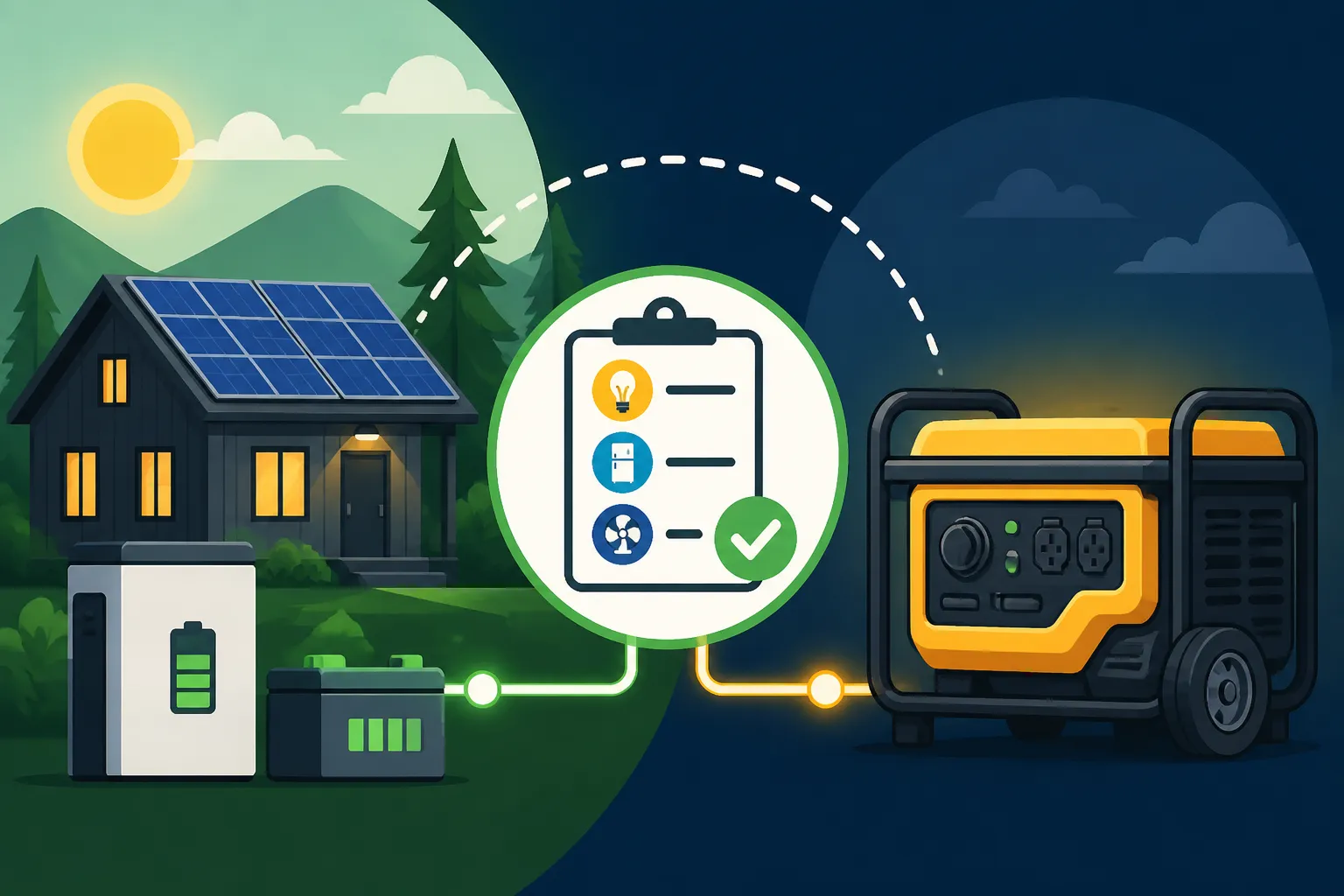
Living off-grid is a dream for many, but the reality is that relying solely on solar power can sometimes leave you in the dark, especially during prolonged cloudy spells, heavy winter snows, or when a critical appliance demands more power than your battery bank can deliver. It’s frustrating to have invested so much in independence, only to find yourself rationing electricity or scrambling for solutions when the sun decides to take a vacation. This comprehensive guide is here to walk you through the often-overlooked but crucial process of how to size a backup generator for your off-grid solar system, ensuring you maintain a reliable power supply no matter what nature throws your way.
Why a Backup Generator is Essential for Off-Grid Living
While the allure of pure solar independence is strong, any seasoned off-gridder will tell you that a reliable backup generator isn't a luxury; it's a necessity. It’s the insurance policy that guarantees your lights stay on, your fridge keeps humming, and your well pump continues to draw water, even when your solar panels are taking a break.
Bridging the Gaps in Solar Production
Think about those stretches of dreary, overcast days that can last for a week or more in places like the Pacific Northwest or the snowy mountains. Your solar panels, no matter how robust, just won't produce enough energy to fully charge your batteries. You might have sized your battery bank for a few days of autonomy, but Mother Nature has a way of testing those limits. This is precisely where a backup generator shines. It kicks in to provide that much-needed energy input, charging your batteries and directly powering your home or cabin when solar yield is insufficient. This prevents deep discharge of your expensive batteries, extending their lifespan significantly. Without it, you’d be constantly worried about conserving power, potentially sacrificing comfort or, worse, critical functions during those lean solar periods.
Moreover, if you're exploring Off-Grid Solar Cost in Cold Climates, you know that lower sun angles and shorter days mean less solar harvest. A generator provides a reliable way to supplement this reduced output, keeping your system topped up and your home warm and lit.
Peace of Mind for Critical Loads
Consider your critical loads: a refrigerator, a well pump, medical equipment like a CPAP machine, or even just the ability to charge your phone and laptop for communication. In an off-grid scenario, these aren't just conveniences; they're often necessities for health and safety. If your solar array and battery bank can't handle the surge demand of a well pump starting up or the continuous draw of a freezer, a generator becomes your fail-safe. It ensures that essential appliances can run without interruption, providing unparalleled peace of mind. Many off-grid homeowners realize the importance of this during a winter storm when temperatures drop, and they need reliable heat or water. The generator provides that crucial safety net, allowing your How to Design for Year-Round Off-Grid Power plan to truly hold up against all challenges.
Understanding Your Power Needs: The Foundation of Sizing
Before you even begin looking at generator models, you absolutely must have a crystal-clear understanding of your specific power consumption. This isn't just about what you think you'll use; it's about what you will use when your solar system needs a helping hand.
Re-evaluating Your Off-Grid Load Analysis
You probably already did a load analysis when you were planning your initial off-grid solar system. If not, now is the time to do a thorough one. This involves listing every single appliance and device you intend to run, noting its wattage, and estimating how many hours per day it will operate. For generators, though, we’re focusing on the maximum instantaneous demand you might place on the system, specifically when solar is low.
Start by listing your critical loads – those items you must have running, even if the sun isn't shining. This might include your refrigerator, well pump, lights, water heater, a fan, or charging stations. Then, add in your "comfort" loads that you'd ideally like to run, such as a microwave, TV, or perhaps a small air conditioner or mini-split in warmer months. The goal isn't necessarily to run everything simultaneously on generator power, but to know the combined wattage of the most demanding combination you expect to have on at any given time. This initial step is vital for How to Calculate Off-Grid Solar Needs and equally for generator sizing. You can find excellent watt meters and calculators on sites like Amazon to help you measure actual appliance usage.
Identifying Surge vs. Running Watts
This distinction is perhaps the most critical factor when sizing a generator for your off-grid system, especially if you have motors involved.
- Running Watts (or Rated Watts): This is the continuous power an appliance needs to operate once it's started. For example, a refrigerator might continuously draw 150-200 watts. A microwave might draw 1000 watts while cooking.
- Starting Watts (or Surge Watts): Many appliances, particularly those with electric motors (like refrigerators, well pumps, air conditioners, and power tools), require a significantly higher burst of power for a brief moment when they first kick on. This "surge" can be 2-6 times their running wattage. For instance, a well pump that runs at 1,500 watts might require 4,500 watts or even more for a second or two to start up.
Your generator must be able to handle the highest surge demand you anticipate, even if it's only for a split second. If the generator can't provide that instantaneous power, the appliance simply won't start, or the generator might overload and trip its breaker. This is a common pitfall for those trying to get by with an undersized generator. Take the time to identify the surge wattage for your most demanding appliances. Often, this information can be found in the appliance manual or online. If not, a clamp meter can help you measure it.
Generator Types and Their Suitability for Off-Grid Solar
The world of generators offers a wide array of choices, and selecting the right type is crucial for efficient and reliable integration with your off-grid solar setup. It's not just about power output; it's about fuel, noise, efficiency, and how well it communicates with your inverter-charger.
Portable vs. Standby Generators
The first major decision often comes down to portability versus a permanent installation.
- Portable Generators: These are typically smaller, more affordable, and as the name suggests, can be moved. They usually run on gasoline or propane and come in a range of sizes from a few hundred watts to 10,000+ watts. They are great for occasional use, providing power directly to appliances via extension cords or to a transfer switch (more on this later). For an off-grid solar system, a portable generator might be sufficient for a small cabin or RV, where the generator's primary role is to occasionally top off batteries during cloudy periods or provide temporary power for high-draw tools. Brands like Generac and Champion offer popular portable options readily available on Amazon or at local hardware stores. However, they generally require manual starting and refueling, can be quite noisy, and are not designed for continuous, long-term operation.
- Standby Generators: These are larger, permanently installed units, similar to what you might find backing up a grid-tied home. They often run on propane or natural gas (if available) and are designed to automatically detect a power outage or a low battery state in an off-grid system. They start themselves, run for as long as needed, and shut down once power is restored or batteries are charged. They are significantly more expensive but offer unparalleled convenience, reliability, and quiet operation compared to portable units. They're built for heavy-duty, long-term use and integrate seamlessly with advanced inverter-chargers. If you're building a Cost to Go Off-Grid for a Family Home, a standby generator is usually the preferred choice.
Fuel Types and Considerations
The type of fuel your generator uses has significant implications for cost, storage, and availability.
- Gasoline Generators: These are common and generally the most affordable upfront. Gasoline is widely available. However, it has a relatively short shelf life (even with stabilizers), is highly flammable, and requires careful storage. You'll need substantial storage for long periods of backup, which can be a safety concern. Fuel efficiency can also be lower than other options.
- Propane (LP) Generators: A popular choice for off-grid living, propane generators offer several advantages. Propane stores indefinitely, burns cleaner than gasoline (meaning less engine maintenance), and can be stored in large, stationary tanks, which is safer than storing large quantities of gasoline. They can be slightly less fuel-efficient than gasoline and the fuel itself can be more expensive per gallon, but the convenience and clean burn often outweigh this for many off-gridders. Many portable generators are dual-fuel, allowing you to switch between gasoline and propane, offering flexibility.
- Diesel Generators: Diesel generators are renowned for their durability, fuel efficiency, and ability to run for extended periods under heavy loads. Diesel fuel is relatively stable for storage, and diesel engines are generally long-lasting. However, diesel generators are typically more expensive, heavier, and noisier than gasoline or propane equivalents. They are often favored for very large off-grid systems or commercial applications where continuous, heavy-duty power is paramount. Fuel can also "gel" in extreme cold, requiring special additives or heated storage.
When considering fuel type, always think about local availability, cost fluctuations, and your personal storage capabilities and safety preferences.
Inverter Generators vs. Conventional Generators
This is a crucial distinction, especially when connecting a generator to charge sensitive electronics and batteries in your off-grid system.
- Conventional Generators: These operate at a constant engine speed (usually 3600 RPM for 60Hz power) to produce AC electricity. This constant speed means they are loud and consume a consistent amount of fuel, regardless of the load. The power output can be "dirty" (less stable waveform), which can sometimes be hard on sensitive electronics or less efficient for charging batteries through an inverter-charger. While effective for basic tools or resistive loads, they are not always ideal for sophisticated off-grid battery charging.
- Inverter Generators: These modern marvels use advanced electronics to produce clean, stable AC power, often referred to as "pure sine wave" output. Crucially, their engines can vary their speed to match the load demand. This means they run quieter, are far more fuel-efficient, and are much better for charging sensitive batteries and running electronics. For off-grid solar systems, an inverter generator is almost always the preferred choice because it provides cleaner power that your inverter-charger can process more efficiently, leading to faster and safer battery charging. While they are generally more expensive than conventional generators of comparable wattage, the benefits in terms of noise, fuel efficiency, and power quality are well worth the investment for an off-grid setup. Many popular brands, including Honda and Yamaha, offer excellent inverter generators.
| Generator Type | Fuel Type | Pros | Cons | Best For |
|---|---|---|---|---|
| Portable | Gasoline, Propane | Lower upfront cost, mobile, widely available | Noisier, manual operation, less efficient, shorter lifespan | Small cabins, RVs, occasional backup, tool power |
| Standby | Propane, Diesel | Automatic, quiet, fuel-efficient, long-lasting | High upfront cost, permanent installation | Full-time off-grid homes, critical continuous backup |
| Conventional | Gasoline, Propane | Cheaper for a given wattage | Loud, constant speed, less fuel-efficient, "dirty" power | Basic power tools, resistive loads, less sensitive equipment |
| Inverter | Gasoline, Propane | Quiet, fuel-efficient, clean power (pure sine wave) | Higher upfront cost, can be less raw power for surge | Battery charging, sensitive electronics, quiet operation |
The Step-by-Step Process for Sizing Your Generator
Now that you understand the different types and the importance of load analysis, let's walk through the actual sizing process. This isn't guesswork; it’s a calculated approach to ensure you have enough power without overspending on an oversized unit.
Calculating Your Maximum Load Demand
The first step is to accurately determine the absolute maximum power you expect to draw from the generator at any given moment. This is a critical step, often overlooked, leading to frustration.
-
List All Potential Loads: Go back to your load analysis. List everything you might possibly want to run simultaneously when the generator is on. For instance, if you're thinking of running the well pump, a few lights, the refrigerator, and the microwave all at once, list them.
-
Determine Running Watts: For each item, note its continuous running wattage.
-
Identify the Highest Starting Wattage: Find the appliance with the highest starting (surge) wattage on your list. This is often an electric motor, like your well pump or air conditioner.
-
Calculate Total Running Watts: Add up the running watts of all the appliances you'd run simultaneously, excluding the highest surge appliance.
-
Add in the Highest Surge: Take that total running wattage and add the starting wattage (not the running wattage) of your single highest surge appliance.
Example:
- Refrigerator: 200 running watts, 1000 starting watts
- Lights: 200 running watts
- Well Pump: 1500 running watts, 4500 starting watts (this is our highest surge)
- Microwave: 1200 running watts
- Laptop/phone charging: 100 running watts
If you want to run the Fridge, Lights, Microwave, and charge devices, and then the Well Pump kicks on:
- Total running watts (Fridge + Lights + Microwave + Charging): 200 + 200 + 1200 + 100 = 1700 watts
- Highest surge (Well Pump): 4500 watts
- Total Generator Size Needed (Minimum): 1700 running watts + 4500 starting watts = 6200 watts (or 6.2 kW).
It’s advisable to add a buffer, say 10-20%, to this calculation to account for measurement inaccuracies or unexpected loads. So, for this example, you might look for a generator in the 6.5 kW to 7.5 kW range. This ensures that even when your inverter-charger is pulling significant current to charge your batteries, your critical appliances still have the juice they need. When planning your Off-Grid Solar Load Calculation Explained, remember to factor in both AC and DC loads for a holistic view.
Accounting for Battery Charging Capabilities
Your generator's primary role in an off-grid solar system isn't just to power loads directly; it's often to charge your battery bank when solar production is low. This means your generator needs to be sized appropriately for your inverter-charger's capabilities.
Most modern off-grid inverters (like those from Victron Energy, Sol-Ark, or even some advanced Renogy models) have integrated battery chargers. These chargers can draw a substantial amount of power from a generator. For example, a 5,000-watt inverter might have a battery charger capable of drawing 3,000-4,000 watts from an AC source (like a generator) to rapidly charge a large battery bank. If your generator is only sized for your direct loads and not this additional battery charging capacity, it will quickly become overloaded.
- Check Your Inverter-Charger's AC Input/Charging Capacity: Look up the specifications for your inverter-charger. It will state the maximum AC input current or wattage it can draw for charging.
- Add Charger Load to Your Peak Demand: Incorporate this charger wattage into your total load calculation. For example, if your peak direct load is 2 kW and your inverter-charger can pull another 3 kW for battery charging, your generator needs to handle at least 5 kW, plus any surge requirements.
- Consider Charging Strategy: Do you want to "bulk charge" your batteries quickly, or are you okay with a slower charge? A larger generator will allow for faster charging, reducing generator run time and fuel consumption in the long run. If your How to Size an Off-Grid Battery Bank is quite large, a more powerful generator will be crucial for efficient recharging. Some systems also allow you to configure the inverter to limit the AC input draw, which can be useful if you have a smaller generator and need to prioritize direct loads over fast battery charging.
Factoring in Future Expansion and Contingencies
It's easy to size for today, but what about tomorrow? Off-grid needs often grow over time. You might add a new workshop, decide to get a chest freezer, or incorporate an electric vehicle charging station down the line. It's almost always a good idea to build in a little headroom into your generator sizing.
- Anticipate Growth: Think about any planned additions to your off-grid setup within the next 3-5 years. Do you plan to add more solar panels? Increase your battery bank? Install a larger well pump? While you can always Add Panels to an Existing System, upgrading a generator can be a more significant undertaking.
- Buffer for "What Ifs": Beyond planned expansion, a small buffer (10-20% above your calculated maximum demand) provides a safety net for unexpected situations or appliances that might draw slightly more than their spec sheet suggests. This small over-sizing can save you a lot of headaches and potential generator damage down the road. It's often better to have a little too much capacity than not enough when it comes to critical off-grid power.
Integrating Your Generator with Your Off-Grid Solar System
Once you've sized your generator, the next step is to understand how it will actually connect and interact with your off-grid solar system. This isn't just about plugging it in; it's about safe and efficient energy management.
Automatic vs. Manual Transfer Switches
The transfer switch is the bridge between your primary power source (your off-grid inverter) and your backup power source (your generator). It ensures that you're never feeding generator power back into the solar system or vice-versa, which could be dangerous and damaging.
- Manual Transfer Switch: This is a physical switch that you operate by hand. When your batteries get low, or solar production dwindles, you'd go out, start your generator, and then manually flip the transfer switch to connect the generator to your home's electrical panel (or the inverter's AC input). Once batteries are charged and/or solar production resumes, you'd manually flip it back and shut off the generator. This is a simpler, more affordable option and often suitable for smaller off-grid cabins or RVs where you're present to manage the system. You can find various manual transfer switches on Amazon.
- Automatic Transfer Switch (ATS): An ATS detects when your primary power source (your solar system, as managed by your inverter-charger) drops below a certain voltage or current threshold. It then automatically signals your generator to start, switches your loads over to generator power, and automatically switches back to solar and shuts down the generator once the batteries are sufficiently charged. This provides seamless, hands-off operation, crucial for full-time off-grid homes or situations where you might be away for extended periods. Most high-end inverter-chargers have built-in ATS functionality or can integrate with external ATS units. When considering Off-Grid Solar System Design Basics, the ATS is a critical component for true autonomy.
Generator Auto-Start Features and Inverter-Charger Compatibility
For truly automated backup, you'll want a generator with an auto-start feature that can communicate with your inverter-charger.
- Generator with Auto-Start: Many larger portable and almost all standby generators come with a "two-wire auto-start" capability. This means they have terminals that can receive a signal (a simple contact closure) from another device to start and stop the engine.
- Inverter-Charger Communication: Most advanced off-grid inverter-chargers (such as those offered by Victron, Sol-Ark, or Outback Power) have programmable relays or dedicated generator control outputs. You can program these inverters to send a start signal to your generator when your battery bank drops to a specific state of charge (e.g., 50% SOC) or when the battery voltage falls below a certain threshold. Conversely, they can send a stop signal once the batteries reach a desired charge level (e.g., 90% SOC). This is how you Add a Generator to Your Design for fully automatic operation. The inverter acts as the "brain," monitoring your system and dictating when generator assistance is needed. When learning How to Wire a Generator to an Inverter Charger, it’s crucial to follow both the generator and inverter manuals carefully.
This seamless communication is what elevates your off-grid system from a manual chore to a highly efficient and self-managing power plant. Always verify that your chosen generator and inverter-charger are compatible for auto-start functionality before making a purchase.
Common Sizing Mistakes and How to Avoid Them
Even with all the calculations, it's easy to fall into common traps that lead to an improperly sized or inefficient generator setup. Being aware of these can save you a lot of frustration and money.
Underestimating Peak Loads
This is by far the most frequent mistake off-gridders make. They calculate their average daily usage or only factor in their continuous loads, completely forgetting about those momentary surges. Imagine you've got your laptop charging, the fridge running, and some lights on, drawing a comfortable 1000 watts. You think a 2000-watt generator is plenty. But then, your well pump (which needs 4000 watts to start) kicks on, and suddenly your generator sputters, overloads, and shuts down.
The consequence? You're without water, your generator might be damaged, and you're left frustrated. To avoid this, always default to the highest anticipated starting wattage of your most demanding motor-driven appliance, and add that to the running wattage of all other simultaneous loads. It's better to slightly oversize for surge than to constantly battle an overloaded generator. For comprehensive insights into this, check out our guide on How to Calculate Daily Energy Usage and apply the same diligence to your generator sizing.
Ignoring Fuel Consumption and Storage
While sizing for power is critical, overlooking fuel consumption and storage planning can quickly make your backup solution unsustainable or prohibitively expensive. A generator, especially a larger one, can be a gas guzzler.
- Fuel Efficiency: Different generators and fuel types have varying efficiencies. An inverter generator running at a partial load will be significantly more fuel-efficient than a conventional generator running at a constant high RPM. Diesel generators are generally very fuel-efficient. Factor in how long you anticipate needing generator run time (e.g., to fully charge a depleted battery bank or get through several cloudy days). This will give you an idea of daily fuel consumption.
- Storage Capacity: If you're relying on a generator for extended periods, where will you store enough fuel? Gasoline has storage limitations, while propane or diesel require more robust, permanent storage solutions. Consider local regulations for fuel storage and safety. Running out of fuel during a critical power outage is just as bad as not having a generator in the first place. You need to budget not just for the generator itself, but also for its ongoing Off-Grid Solar Maintenance Costs and, crucially, for its fuel. Comparing Off-Grid Solar vs Generator Fuel Cost can help you understand the long-term implications.
A proper off-grid setup is about balance. A well-sized backup generator, meticulously integrated and fueled, provides that indispensable balance, ensuring your path to energy independence is truly resilient.
Disclaimer
This article is intended for informational purposes only and does not constitute professional electrical or engineering advice. Off-grid solar system design and generator integration can be complex and involve significant electrical hazards. Always consult with qualified and licensed professionals for specific system design, installation, and compliance with all local codes and regulations. Working with electricity can be dangerous, and improper installation can lead to injury, death, or property damage.