Off-Grid Solar Cost vs Extending Power Lines
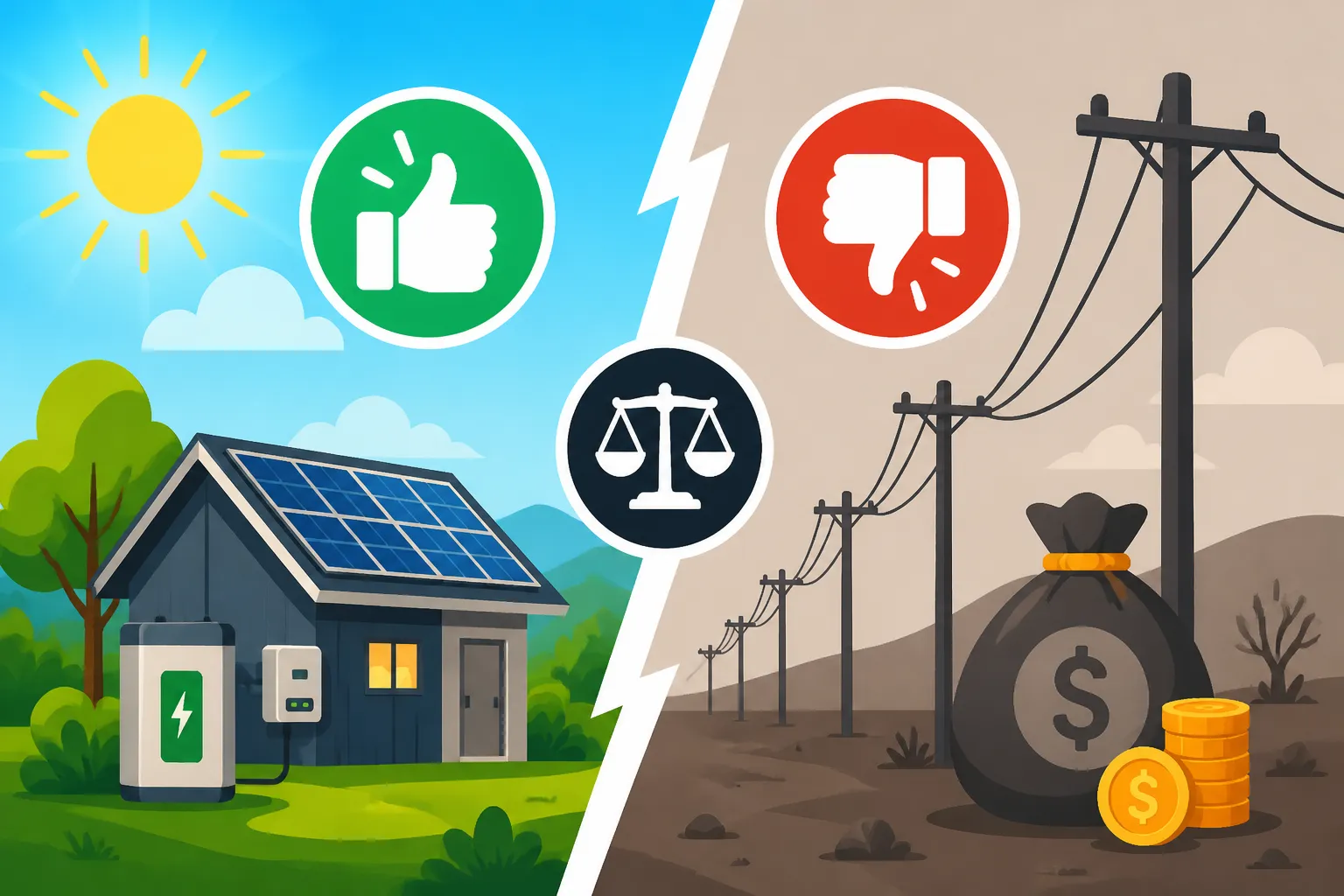
Oh, the dream of a secluded cabin in the woods, a quiet homestead far from the bustle, or even just a hunting camp where you can truly escape. It’s a beautiful vision, isn’t it? Until reality hits, and you start looking into getting power to that little slice of heaven. Many folks immediately think of extending the existing utility lines, only to be met with truly eye-watering quotes that can quickly turn that dream into a financial nightmare. This guide is all about navigating that challenging decision, helping you compare the very real costs of bringing grid power versus embracing the freedom and financial sense of an off-grid solar system.
The Frustrating Reality of Utility Line Extensions
You’ve found the perfect remote property, perhaps a few acres outside of town, or a beautiful spot a mile or two down a gravel road. The property description might even optimistically say "power available at road." Sounds great, right? Then you call the utility company, and that's when the sticker shock truly sets in. It’s a common frustration, and one that often sends people scrambling for alternatives.
Understanding Utility Extension Costs
Utility companies, whether it's a giant like Pacific Gas and Electric (PG&E) in California or a smaller rural cooperative in the Midwest, aren't just sending a guy out with a bucket truck and a coil of wire. Oh no. Extending power lines involves a complex and costly infrastructure build-out. You're looking at more than just the copper wire itself.
First, there are the poles. Each pole needs to be dug in, set, and securely braced, often across varying terrain that might include rocky ground, wetlands, or dense forest. Then comes the actual wire, which isn't cheap, especially for the high-voltage lines. But it doesn't stop there. For every certain distance or load requirement, they might need to install new transformers to step down the voltage, which are substantial pieces of equipment and add thousands to the bill. Labor costs, naturally, are a huge factor, as skilled linemen and equipment operators are needed for days or even weeks. And let's not forget the "soft costs": engineering studies to determine the route and load, environmental assessments if crossing sensitive areas, and local permitting fees. These aren't just a few hundred bucks; they can easily be several thousand dollars each.
The charges are typically calculated per linear foot or per mile, and they can vary wildly depending on your region and the specific utility. We're talking anywhere from $25 to over $100 per linear foot. So, if your property is even a quarter-mile (1,320 feet) from the nearest existing power pole, you could be looking at an extension cost of $33,000 to $132,000 or more, before any major transformer upgrades or difficult terrain challenges. If it's a full mile, easily multiply those figures by four. These are staggering upfront costs that often come with little to no negotiation, as the utility company dictates the terms.
The Hidden Drawbacks Beyond the Price Tag
Beyond the immediate, jaw-dropping quote, there are several other significant drawbacks to extending utility lines that many people don't consider until it's too late. First off, even after paying tens of thousands of dollars to bring power to your property, you're still on the hook for monthly utility bills. You're not gaining energy independence; you're simply paying a massive fee for the privilege of paying a monthly bill. These bills will fluctuate, and more importantly, they will almost certainly increase over time due to rising energy costs, infrastructure upgrades, and environmental regulations. You’ll forever be subject to the whims of the utility company and energy market.
Then there's the issue of reliability. Even with a new line, you're still connected to a centralized grid that is vulnerable to outages. Storms, equipment failures, wildfires, or even just a car hitting a pole can knock out your power. If you’re living remotely, an outage can mean being without electricity for hours or even days, often longer than those in more populated areas. You’ve invested heavily, yet you still lack true control over your power supply. This reliance on an external system, coupled with the lack of financial future-proofing, makes many people rethink their initial approach to powering their remote property.
Diving into Off-Grid Solar System Costs
When you start to seriously consider alternatives to extending power lines, off-grid solar quickly rises to the top of the list. It’s not just a trend; it's a viable, robust solution for energy independence. But just like anything worthwhile, it comes with its own set of costs and considerations. The beauty is, these costs are largely within your control, and the long-term benefits are substantial.
Key Components and Their Cost Impact
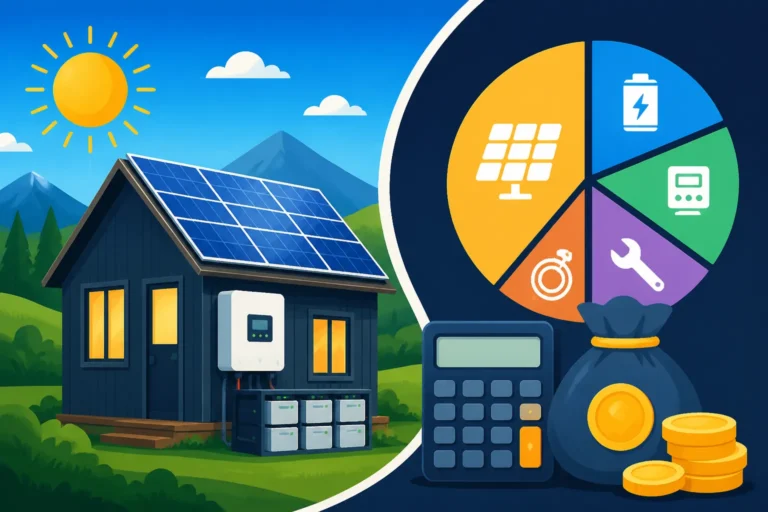
An off-grid solar system isn't just a panel and a light bulb. It's a carefully designed assembly of components, each playing a critical role in providing reliable power. Understanding what these components are and what they typically cost is the first step in creating a realistic budget. If you're wondering how much does an off-grid solar system cost, we've broken it down in detail.
- Solar Panels (PV Panels): These are the workhorses that capture sunlight and convert it into electricity. Their cost is usually quoted per watt. Modern monocrystalline panels are efficient and durable. You can expect to pay anywhere from $0.70 to $1.50 per watt for panels themselves, depending on the brand, efficiency, and quantity. For a system needing 3,000 watts (3 kW) of panels, that's roughly $2,100 to $4,500.
- Batteries: This is often the most significant investment in an off-grid system, and for good reason. Batteries store the energy generated by your panels so you have power at night or on cloudy days. The choice between LiFePO4 (lithium iron phosphate) and lead-acid batteries dramatically impacts both upfront cost and longevity. LiFePO4 batteries are more expensive initially but offer far greater lifespan, depth of discharge, and efficiency. You might spend anywhere from $0.50 to $1.00 per watt-hour for lithium, or significantly less per watt-hour for lead-acid, but lead-acid will need replacing much sooner. For many, the long-term value of lithium outweighs the higher upfront cost. We have a whole article on how battery choice affects off-grid cost. A typical off-grid home might need 20 kWh of usable battery storage, which could cost $10,000 to $20,000 for quality LiFePO4.
- Inverter: This device converts the direct current (DC) electricity from your batteries into alternating current (AC) that your household appliances use. Pure sine wave inverters are essential for sensitive electronics. The size and quality of your inverter will dictate its price, ranging from $1,000 for a modest 3kW inverter to $5,000 or more for a high-capacity 12kW unit with advanced features like surge handling and generator integration.
- Charge Controller: This manages the power flow from your solar panels to your batteries, preventing overcharging and optimizing efficiency. MPPT (Maximum Power Point Tracking) controllers are more efficient and generally recommended for most systems, though PWM (Pulse Width Modulation) controllers are cheaper for smaller, simpler setups. A good MPPT charge controller can range from $200 to $1,000+.
- Mounting Equipment: This includes the racking systems that secure your solar panels to your roof or to a ground mount. Costs vary based on the type of mount (fixed, adjustable, pole mount, ground mount) and the number of panels. Budget $500 to $2,000 for a decent mounting system.
- Wiring, Fuses, Breakers, and Balance of System Components: These are the essential, yet often overlooked, items that ensure your system is safe and functional. High-quality copper wire, appropriate fuses and breakers, disconnect switches, and combiner boxes all add up. This category can easily total $1,000 to $3,000 or more, depending on the complexity and size of your system.
Factors Influencing Your Total Off-Grid Investment
The overall cost of an off-grid solar system isn't a fixed price; it's highly variable and depends on several key factors. The most important is your energy needs. A small cabin running only lights and a refrigerator will require a much smaller, less expensive system than a full-time family home with air conditioning, a well pump, and a workshop. Take the time to conduct a thorough load analysis to determine your daily watt-hour requirements.
Another crucial factor is system size. This goes hand-in-hand with your energy needs. A 1,000W (1kW) system designed for basic power in a shed will naturally cost far less than a 5,000W (5kW) system for a tiny home. We delve into Off-Grid Solar Cost by System Size in another article if you're curious about specific breakdowns.
Your location also plays a role. How many peak sun hours does your property receive annually? A sun-drenched desert location might need fewer panels than a cloudy Pacific Northwest locale to generate the same amount of power, impacting panel quantity and cost.
Finally, the installation method significantly affects the price. Are you tackling a DIY off-grid solar installation step by step, or are you hiring professionals? DIY can save you thousands in labor costs, but requires electrical knowledge, specialized tools, and a significant time investment. Professional installation ensures code compliance and proper setup but adds 10-20% or more to your total bill. We have a detailed guide on Off-Grid Solar Installation Cost that covers this. Many people start small, perhaps with a portable Jackery power station to get a feel for solar, and then scale up, purchasing components like panels and inverters from online retailers like Amazon. This allows you to gain experience and spread out the financial commitment.
Direct Cost Comparison: Solar vs. Power Lines
This is where the rubber meets the road. Let’s put some hypothetical numbers to the test and see how off-grid solar stacks up against the often-exorbitant cost of utility line extensions. It’s not just about the upfront price; it’s about the long-term value and the true cost of power.
Scenario-Based Cost Analysis
To illustrate this, let's consider three common scenarios for remote properties. Please remember these are general estimates, as actual costs can vary significantly by region, utility, and specific property challenges.
Scenario 1: Short Distance from the Grid (500 feet)
-
Utility Line Extension: At an average of $35 per linear foot, 500 feet would be $17,500. Add in potential transformer upgrades, engineering, and permitting, and you're realistically looking at $20,000 to $30,000.
-
Off-Grid Solar System: For a modest cabin or small home with essential appliances (refrigerator, lights, electronics, well pump), you might need a 3-5kW system with 10-15 kWh of LiFePO4 battery storage. The cost for panels, batteries, inverter, charge controller, mounting, and wiring could range from $15,000 to $25,000 for quality components, potentially more for professional installation.
- Analysis: In this scenario, the initial upfront costs are somewhat comparable. The grid extension might even seem slightly cheaper initially, especially if you plan to use minimal power.
Scenario 2: Medium Distance from the Grid (1 mile / 5,280 feet)
-
Utility Line Extension: At $35 per linear foot, one mile would cost $184,800. This distance almost guarantees multiple new poles, transformers, and significant labor. Factoring in all other fees, you're easily looking at $200,000 to $300,000, if not more, depending on terrain and access.
-
Off-Grid Solar System: For a full-time residence requiring 5-8kW of solar and 20-30 kWh of LiFePO4 battery storage, you might budget between $25,000 and $45,000 for components. Add professional installation, and you might reach $35,000 to $60,000.
- Analysis: Here, off-grid solar becomes the undisputed winner on initial cost alone. The difference is stark, with the solar option being a fraction of the utility extension. If you're planning to power a cabin with solar, this becomes a much more sensible investment.
Scenario 3: Remote Location from the Grid (3 miles / 15,840 feet)
-
Utility Line Extension: This distance is almost prohibitive. At $35 per linear foot, three miles would be $554,400. With multiple transformers, easements, significant construction, and potential road improvements, the cost could easily soar into the $700,000 to $1,000,000+ range. Many utilities won't even entertain such an extension without the landowner paying the full, astronomical sum upfront.
-
Off-Grid Solar System: For a large homestead or a full-sized home requiring substantial power (8-15kW solar, 30-50+ kWh battery storage), your budget for a robust system could be $40,000 to $70,000 for components, possibly $50,000 to $100,000+ for a professionally installed, top-tier system.
- Analysis: For truly remote locations, off-grid solar isn't just a cost-effective option; it's often the only realistic option. The grid extension costs are simply too high to justify for most private landowners.
Here’s a quick summary table comparing the estimated upfront costs for a typical residence:
| Distance from Grid | Estimated Utility Extension Cost | Estimated Off-Grid Solar System Cost |
|---|---|---|
| 500 feet | $20,000 – $30,000 | $15,000 – $25,000 |
| 1 mile | $200,000 – $300,000 | $25,000 – $45,000 |
| 3 miles | $700,000 – $1,000,000+ | $40,000 – $70,000 |
Note: Off-grid solar costs are for components, DIY installation. Add 10-30% for professional installation.
Beyond the Initial Price Tag: Long-Term Value and Savings
While the upfront cost comparison in the scenarios above is often enough to make the decision for many, it’s crucial to look at the long-term financial picture. Extending power lines means that after your massive initial investment, you continue to pay monthly for every kilowatt-hour you consume, year after year. These rates only tend to go up, eating into your budget indefinitely. Imagine having paid $200,000 to get power, only to then face a $300 or $400 monthly electric bill for the next 30 years. That’s an additional $108,000 to $144,000 over three decades, not even accounting for rate increases!
With off-grid solar, once your system is paid for, your "fuel" (sunlight) is absolutely free. Your ongoing costs are primarily maintenance (which is generally low for quality systems) and eventual battery replacement, which might happen every 10-20 years for LiFePO4 batteries. The long-term savings of off-grid solar for remote properties are immense. You gain genuine energy independence and predictable costs. Your "Off-Grid Solar Payback Period Explained" will depend on how much you would have paid the utility, but for many remote installations, it's far shorter than you might imagine.
Furthermore, there are often financial incentives that can help offset the initial cost of solar. While specific state and local incentives vary, the federal government offers the Investment Tax Credit (ITC), which can cover a significant percentage of your solar system's cost. This is why understanding the 2026 Solar Tax Credit and Off-Grid Systems is so important for budgeting. This credit directly reduces the amount you owe in federal taxes, effectively making your system considerably cheaper. Such incentives simply don't exist for extending power lines.
Making the Smart Decision for Your Property
So, after all this, what's the ultimate takeaway? When does one option truly shine over the other, and how can you make the most informed decision for your unique situation? It boils down to a careful evaluation of your distance from the grid, your budget, your desire for independence, and your long-term vision.
When Extending Power Lines Might Make Sense
Let's be realistic: there are a few very specific situations where extending utility lines could be the more practical choice, primarily if you're very close to existing infrastructure. If your property boundary is literally a stone's throw (say, less than 200 feet) from an existing power pole and transformer, and the utility offers a reasonable hookup fee without exorbitant per-foot charges, it might make sense. This is especially true if your energy needs are minimal, or if you have a complete aversion to the idea of managing your own power system. For someone who simply wants grid power without any DIY hassle or maintenance, and where the costs are genuinely low, extending lines might fit the bill. However, for most remote property owners, these ideal conditions are a rare luxury.
Why Off-Grid Solar is Often the Superior Choice
For the vast majority of remote property owners, off-grid solar is not just a viable alternative; it's often the superior choice in terms of both financial prudence and lifestyle benefits.
First and foremost, the long-term cost savings are undeniable. Once your system is installed and paid for, your daily energy costs plummet to near zero. You're effectively pre-paying for decades of electricity. This offers an incredible sense of financial security and freedom from ever-increasing utility bills.
Beyond the money, there's the invaluable benefit of energy independence and resilience. You control your power. No more worrying about distant storms knocking out your electricity for days, or about regional grid failures. Your power is generated and stored right on your property, giving you peace of mind. This kind of self-reliance is a huge draw for many, especially those looking for a truly sustainable lifestyle.
Off-grid solar systems are also incredibly flexible and scalable. You can start with a smaller system for essential loads and expand it as your needs grow or your budget allows. Many folks start with a basic setup and add more panels or batteries over time. We often get questions about how to size an off-grid solar system to meet growing needs, and it's a very common approach. This modularity means you're not locked into a one-time, all-or-nothing investment.
Finally, embracing off-grid solar often increases your property value in a way that simply connecting to the grid doesn't. A property with a fully functional, reliable off-grid power system is a huge asset, particularly in remote areas where utility extensions are prohibitively expensive. It makes the property instantly more attractive and livable. So, when people ask, "Is Off-Grid Solar Worth the Cost?", for remote properties, the answer is almost always a resounding yes. It provides not just electricity, but also freedom, security, and a smart financial investment for the future.
Disclaimer
Please remember that the information provided in this article is for general guidance only and does not constitute professional financial, electrical, or legal advice. Costs and regulations for off-grid solar systems and utility extensions can vary widely based on your specific location, local utility company policies, state and federal incentives, and individual energy needs. Always consult with qualified professionals, including licensed electricians and solar installers, and your local utility company, before making any significant decisions regarding your power supply.