Cost to Run A Water Heater on Off-Grid Solar
One of the biggest anxieties for folks considering going off-grid, or even just adding solar to their RV or cabin, is the thought of giving up reliable hot water. That steamy shower or hot water for dishes feels like a fundamental comfort, and the idea of figuring out how to power it with solar can seem incredibly daunting and expensive. This guide is here to demystify the cost of running a water heater on off-grid solar, helping you understand the real expenses, the energy demands involved, and smart ways to make it happen without breaking the bank.
The Hidden Power Hunger of Your Hot Water
Before we can even talk about costs, we need to get real about how much energy a water heater truly devours. It's often one of the single largest energy consumers in any home, on or off-grid, and misunderstanding its appetite is where many off-grid solar budgets go sideways.
Understanding Different Water Heater Types and Their Demands
Not all water heaters are created equal, especially when you're relying on the sun. The type you choose will dramatically impact the size and, therefore, the cost of your off-grid solar system.
Let's break down the common options:
- Electric Resistance Tank Water Heaters: These are the most common type found in grid-tied homes, and they are, frankly, off-grid solar killers if not carefully managed. They typically have two heating elements, each drawing between 1,500 to 5,500 watts, with 4,500W being very common. When both elements kick on, you're looking at a huge power draw. While they don't run constantly, they'll cycle on and off throughout the day to maintain temperature, and then work overtime during peak usage (like morning showers). A typical 40-gallon electric tank heater can easily consume 10-15 kWh (kilowatt-hours) per day, sometimes more, depending on usage and insulation. This translates to needing a massive solar array and battery bank, significantly driving up your Off-Grid Solar Cost: Complete Breakdown.
- Electric Tankless (On-Demand) Water Heaters: These units only heat water as you need it, which sounds efficient, but they require even more instantaneous power than tank heaters. To heat water quickly, they often have multiple heating elements that can collectively draw anywhere from 13,000 to 27,000 watts! That's an enormous surge load, requiring an absolutely massive inverter, often 10kW or more, which adds a substantial chunk to your Cost of an Off-Grid Solar Inverter. While their daily kWh consumption might be lower if usage is sparse, the sheer instantaneous power draw makes them extremely challenging and expensive for most off-grid solar systems.
- Propane or Natural Gas Tankless Water Heaters: Ah, now we're talking about off-grid friendly options. These units use propane or natural gas to heat water on demand. Their electrical draw is minimal, usually just a few watts for the ignition, fan, and control board. We're talking less than 100 watts total, and only when hot water is actually running. The bulk of their energy comes from the fuel, not electricity. This drastically reduces the demands on your solar system, though you'll still need to factor in the cost and logistics of propane delivery.
- Propane or Natural Gas Tank Water Heaters: Similar to their electric counterparts but fueled by gas. They maintain a tank of hot water using a gas burner. Their electrical draw is also minimal, often just a small pilot light or electronic ignition, and possibly a tiny fan or control board. Again, the main energy cost is in the fuel, not electricity.
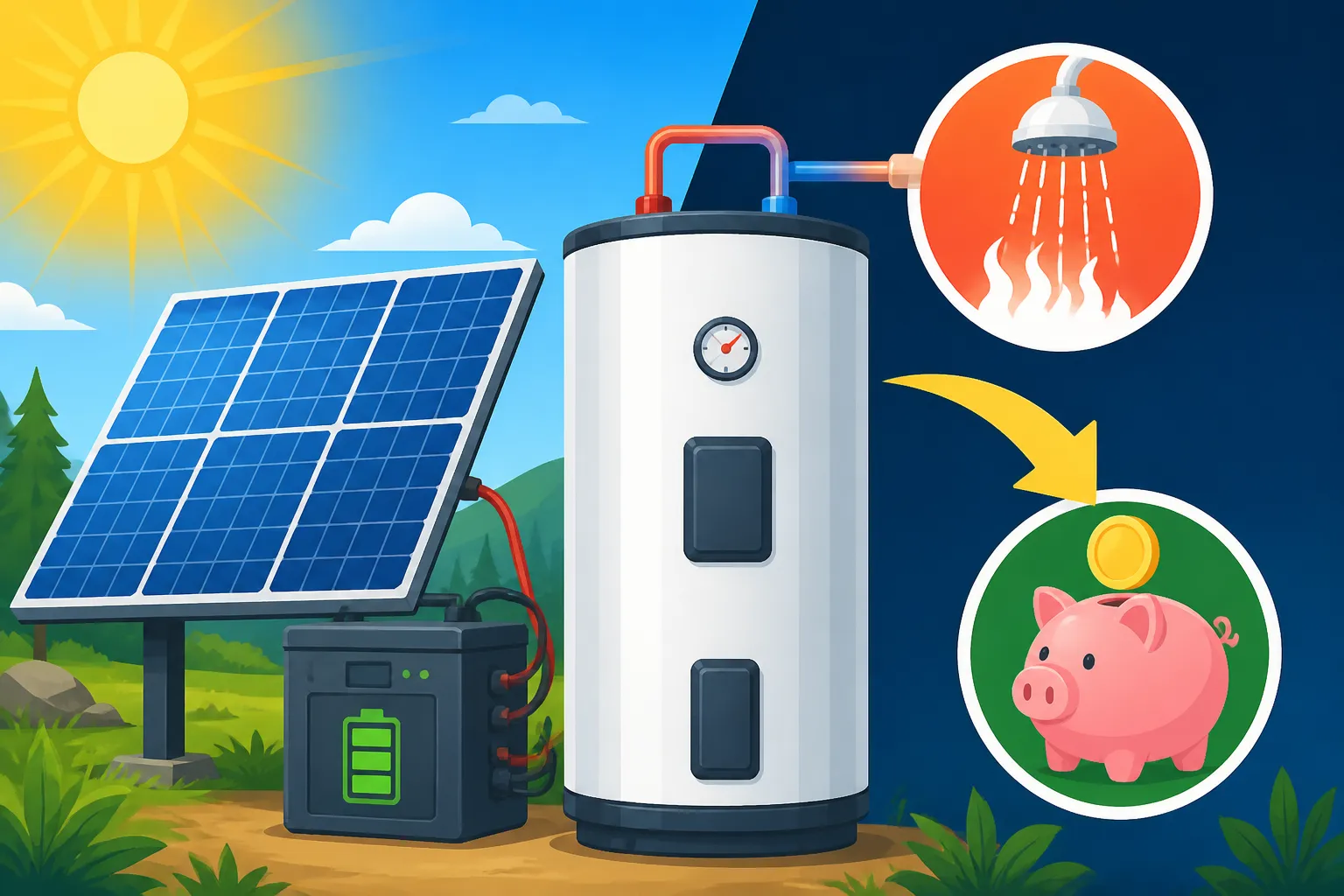
- Solar Thermal Water Heaters: These are fantastic for off-grid living because they use the sun's heat directly, not electricity, to warm water. Flat plate collectors or evacuated tubes absorb sunlight and transfer that heat to water, which is then stored in an insulated tank. They often have a small electrical backup element for cloudy days or peak demand, or they can be paired with a propane or wood-fired booster. The electrical load is minimal, usually just a small pump to circulate water through the collectors. This is often the most cost-effective way to get abundant hot water off-grid from a purely electrical perspective.
Calculating Your Actual Hot Water Usage
It's easy to underestimate how much hot water you actually use. Guessing will lead to either an undersized, frustrating system or an oversized, overpriced one. You need to do a thorough Off-Grid Solar Load Calculation Explained.
Here’s how to get realistic numbers:
- Showers: This is often the biggest culprit. A typical showerhead uses about 2.5 gallons per minute (GPM). If you take a 10-minute shower, that’s 25 gallons of hot water. If there are two people, that’s 50 gallons. Multiply by how many showers per day and the hot water temperature rise needed (e.g., from 50°F incoming to 105°F output). This can be a huge daily demand.
- Dishes: Handwashing dishes might use 5-10 gallons. A dishwasher can use 4-6 gallons per cycle, though modern ones often have internal heaters, reducing the demand on your main water heater.
- Laundry: A washing machine can use anywhere from 10-25 gallons of hot water per load, depending on the setting and machine efficiency. Consider if you really need hot water for every load; cold water washing is often sufficient for many clothes.
- Other Uses: Handwashing, cooking, cleaning – these add up, too, though typically in smaller increments.
To get truly accurate, consider installing an inexpensive watt-hour meter (if using electric) on your current water heater for a week or two. You can find simple plug-in models on Amazon that will track consumption. This real-world data is gold. Without it, you're just guessing, and off-grid solar planning doesn't do well with guesswork.
Sizing Your Off-Grid System to Meet Hot Water Needs
Once you know your actual hot water demands and have chosen your water heater type, you can start to size your solar system components. This is where the rubber meets the road on determining the actual "cost to run a water heater on off-grid solar."
Determining Solar Panel Requirements for Water Heating
If you're going with an electric resistance water heater, even a modestly sized one, your solar array will need to be substantial. Let's say your electric tank heater uses 12 kWh per day. To generate that much power, you'll need to consider your location's "peak sun hours."
- Example: In a sunny location like Arizona, you might get 5-6 peak sun hours per day. In a cloudier region like the Pacific Northwest, it could be 2-3 hours.
- Calculation: If you need 12,000 Wh (12 kWh) and get 4 peak sun hours: 12,000 Wh / 4 hours = 3,000 watts of solar panels.
- Real-world: This 3,000-watt figure is the minimum ideal scenario. You'll need to factor in losses from wiring, inverter efficiency, temperature, and shading. So, you'd likely need to oversize your array by 20-30%, bringing it closer to 3,600-3,900 watts. If a typical panel is 400 watts, you're looking at 9-10 panels just for your water heater! That's a significant portion of your How Many Solar Panels for Off-Grid Living.
For propane or solar thermal options, the electrical panel requirement specifically for the water heater might be negligible – perhaps just one or two small panels to cover the control board or circulation pump. This is why many off-gridders choose these non-electric options; they dramatically reduce the solar array size needed.
Matching Battery Bank Capacity to Your Water Heater
Batteries are the heart of any off-grid system and often the most expensive component. For an electric water heater, this will be particularly true. Your battery bank needs to store enough energy to run the water heater when the sun isn't shining (night, cloudy days). You also need to consider "days of autonomy" – how many days of power you want to have without any sun.
- Example (continued): If your water heater uses 12 kWh per day and you want 2 days of autonomy, you need 24 kWh of usable battery storage.
- Battery Chemistry Matters:
- LiFePO4 (Lithium Iron Phosphate) batteries are fantastic because you can use nearly 100% of their rated capacity without damaging them. If you need 24 kWh usable, you buy roughly 24 kWh rated. These are more expensive upfront but have a much longer lifespan. Check out LiFePO4 vs Lead-Acid Battery Cost for a detailed comparison.
- Lead-acid batteries (AGM, Flooded) are cheaper upfront but you can only safely use about 50% of their capacity. So, for 24 kWh usable, you'd need about 48 kWh rated capacity, which means double the batteries, double the weight, and a shorter lifespan.
- Putting it into perspective: A single 100Ah 12V LiFePO4 battery holds about 1.28 kWh of energy. To get 24 kWh, you'd need approximately nineteen 100Ah batteries. The Cost of an Off-Grid Solar Battery Bank for this many batteries will be substantial, easily running into many thousands of dollars. Again, this highlights why electric resistance water heating is a tough nut to crack with off-grid solar.
If you opt for a propane or solar thermal heater, your battery bank needs for hot water are minuscule, potentially saving you thousands on battery costs. You can then focus your battery capacity on essential loads like lights, fridge, and electronics.
Selecting the Right Inverter and Charge Controller
The inverter converts DC power from your batteries into AC power for your appliances, and the charge controller manages the flow of power from your solar panels to your batteries.
- Inverter Size: If you're running an electric resistance water heater, remember those huge wattage numbers? A 4,500W element will require an inverter that can handle at least that much continuous power, plus a little buffer. If your heater has two elements, you'd need an inverter capable of 9,000W continuous, potentially even more if it has a higher surge capacity for initial startup. This immediately puts you into the realm of larger, more expensive inverters. A quality 8kW to 12kW inverter can cost several thousand dollars. Understanding How to Size an Off-Grid Inverter for such a load is critical to avoid costly mistakes.
- Charge Controller: This device ensures your batteries are charged safely and efficiently. The size depends on your solar array's total wattage and voltage. For a 3,600W array feeding a 48V battery bank, you'd need a robust MPPT charge controller that can handle the current. High-quality Best MPPT Charge Controllers are essential for maximizing the power harvest from your panels, especially if you have a large array dedicated to hot water.
For non-electric water heating, your inverter and charge controller sizing would be based on your other household loads, significantly reducing their required size and cost.
Breaking Down the Costs: What You’ll Actually Pay
The "cost to run a water heater on off-grid solar" isn't just about the initial component purchase; it's a blend of upfront investment, installation, and long-term considerations.
Component Costs for an Off-Grid Water Heater System
Let's assume you're considering a full electric resistance water heater, as that’s the most impactful on solar costs. Here’s a rough breakdown of what you'd be looking at for a robust system designed to handle significant hot water demand (e.g., 10-15 kWh/day):
- Solar Panels: For 3.6kW of panels (about nine 400W panels), expect to pay $0.70 – $1.20 per watt. That's roughly $2,500 – $4,300. You can often find good deals on larger quantities on Amazon or specialized solar retailers.
- Batteries: For 24 kWh of usable LiFePO4 storage (e.g., nineteen 100Ah 12V batteries or a few larger 48V server rack batteries), prices can range from $500-$800 per 100Ah 12V equivalent, or more for higher quality integrated units. So, expect $9,500 – $15,000+.
- Inverter: A high-quality 8-12kW pure sine wave inverter capable of handling resistive loads will run $2,000 – $5,000. Brands like Victron, Sol-Ark, and Outback are popular choices for their reliability and features.
- Charge Controller: A large MPPT charge controller (e.g., 80A-100A for a 48V system) would be in the range of $500 – $1,500.
- Mounting Hardware: Roof or ground mounts, rails, and clamps can add $500 – $1,500, depending on complexity and material.
- Wiring, Fuses, Breakers, Disconnects: Don't forget these essential safety components. They can easily add another $500 – $1,000.
- Electric Water Heater: The heater itself might be $400 – $1,000, but remember, its energy demand drives all the other costs up.
Total Estimated Component Cost (Electric Resistance Water Heater Scenario): $16,400 – $28,800+
Compare this to a propane tankless system:
- Propane Tankless Water Heater: $400 – $1,200
- Propane Tank (leased or purchased): $300 – $1,000 (plus fuel costs)
- Minimal impact on solar panels, batteries, inverter, and charge controller costs (as they would primarily serve other loads).
Total Estimated Component Cost (Propane Tankless Scenario for Hot Water): $700 – $2,200 (plus fuel)
This dramatic difference clearly illustrates why many off-gridders opt for propane or solar thermal solutions for hot water.
Installation and Ancillary Expenses
The physical installation of an off-grid solar system is a significant part of the cost, whether you do it yourself or hire professionals.
- DIY Installation: If you're handy and comfortable with electrical work, you can save substantially on labor costs. However, you'll still need to factor in tools, potential rental equipment (like lifts for roof mounting), and your time. A common misconception is that DIY is "free" labor – it's not, your time has value! You'll also need to be meticulous about safety and adhering to best practices to avoid hazards. You can find excellent guides on DIY Off-Grid Solar Installation Step by Step.
- Professional Installation: Hiring a certified solar installer and electrician can range from $1.00 – $3.00 per watt for installation alone, on top of component costs. For a system of the size needed for an electric water heater (e.g., 3.6kW array), this could add $3,600 – $10,800 to your total cost. They handle permits, inspections, and ensure everything meets code, which can be a huge peace of mind.
- Permitting and Inspections: Depending on your location, you might need permits for a permanent off-grid solar installation. These can range from a few hundred to over a thousand dollars. Inspections ensure safety but also add to the timeline.
- Site Preparation: Clearing land for ground mounts, trenching for cables, or reinforcing a roof can add costs.
So, for an electric water heater, a professional installation might push your total cost well over $20,000 to $40,000.
Long-Term Savings and Return on Investment
While the upfront cost of off-grid solar for an electric water heater can be substantial, it's important to look at the long-term picture.
- Fuel Savings: If you're replacing propane or diesel generators for hot water, the savings on fuel can be significant over time. Propane prices fluctuate, and relying on it for all your hot water can be a recurring expense.
- No Utility Bills: The biggest financial benefit of any off-grid system is eliminating monthly utility bills. For large consumers like electric water heaters, this saving becomes more pronounced.
- Increased Property Value: A well-designed off-grid solar system can increase the value of your property, especially in remote areas where grid extension is prohibitively expensive.
- Payback Period: While specific to your system size, usage, and local energy costs, off-grid solar systems generally have a "payback period" where the savings equal the initial investment. For a system heavily weighted by an electric water heater, this period might be longer than for a more modest system, but it's still a finite time. Learn more about Off-Grid Solar Payback Period Explained.
- Tax Credits and Incentives: While federal tax credits like the Investment Tax Credit (ITC) primarily apply to grid-tied systems or specific components, some off-grid components may qualify if they meet certain criteria or are part of a primary residence. Always check current regulations.
Ultimately, the choice comes down to weighing the upfront investment against the desire for energy independence and the long-term savings on fuel and utility costs.
| Water Heater Type | Typical Electrical Demand (Watts) | Daily kWh (Est.) | Impact on Solar System Cost (Relative) | Fuel Source | Pros | Cons |
|---|---|---|---|---|---|---|
| Electric Tank | 1,500 – 5,500 | 10-15+ | Very High | Electricity | No fossil fuels at point of use; familiar | Requires massive solar array & battery bank; high continuous power draw; long payback period for solar-dedicated systems. |
| Electric Tankless | 13,000 – 27,000 | 5-10+ | Extremely High | Electricity | Endless hot water on demand; compact size | Insane instantaneous power draw requires huge inverter (10kW+); often impractical for most off-grid systems without extreme oversizing; significantly increases Off-Grid Solar Cost by System Size. |
| Propane Tankless | < 100 (for ignition/controls) | Minimal | Very Low | Propane | Instant hot water; compact; minimal electrical draw on solar system; reliable | Requires propane fuel (cost, delivery, storage); produces combustion byproducts; higher running cost due to fuel, but lower solar infrastructure cost. |
| Propane Tank | < 100 (for pilot/controls) | Minimal | Very Low | Propane | Reliable hot water storage; minimal electrical draw on solar system; familiar operation | Requires propane fuel (cost, delivery, storage); produces combustion byproducts; takes up space; standing heat loss from tank. |
| Solar Thermal | < 100 (for pump, backup element) | Minimal | Very Low | Sun (primary), Electric/Propane (backup) |
Uses sun's heat directly; very energy efficient; low electrical demand; environmentally friendly; long lifespan for collectors. | High upfront installation cost for collectors/tank; requires backup heat source for cloudy periods/winter; plumbing complexity; requires sun exposure; can freeze if not properly designed for cold climates; might still need some solar PV for backup element or pump. |
Smart Strategies for Affordable Off-Grid Hot Water
Knowing the costs is one thing; finding ways to make it work for your budget is another. Here are some actionable strategies to make off-grid hot water more attainable.
Embracing Energy-Efficient Water Heating Options
The type of water heater you choose is, without a doubt, the single biggest factor in the cost of providing hot water off-grid. Prioritize efficiency and alternative energy sources.
- Solar Thermal with Electric/Propane Backup: This is, in my opinion, the gold standard for abundant and cost-effective off-grid hot water. The sun provides most of the heat directly, sidestepping the massive electrical conversion losses and component sizing of PV-only systems. You'd typically have a small electric element or a propane booster for those days the sun doesn't cooperate. The minimal electrical draw on your main solar system makes this a fantastic choice.
- Propane Tankless Water Heaters: As discussed, these are a popular and reliable option. Brands like Rinnai or Eccotemp offer excellent on-demand propane water heaters that require very little electricity. The trade-off is the ongoing cost and logistics of propane, but the initial solar system investment is much lower. Many off-gridders find this to be a practical and affordable compromise.
- Heat Pump Water Heaters (HPWH): These are extremely efficient electric water heaters that use refrigeration technology to move heat from the surrounding air into the water, rather than generating heat directly. They can be 2-3 times more efficient than traditional electric resistance heaters, consuming significantly less kWh per day. However, they are still electric, so they still require a decent solar setup, just a smaller one. They also need to be installed in a space with sufficient ambient air (like a basement or garage) and don't perform as well in very cold environments. If you're designing for Off-Grid Solar Cost in Cold Climates, they might not be the best primary choice unless well-insulated.
Optimizing Usage and Reducing Consumption
Even with the most efficient water heater, modifying your habits can dramatically reduce your hot water needs and, by extension, the size and cost of your solar system.
- Low-Flow Fixtures: Install low-flow showerheads (1.5-2.0 GPM) and aerators on faucets. These are inexpensive upgrades found at any hardware store or online via Amazon that significantly cut down on hot water usage without sacrificing comfort too much.
- Shorter Showers: This is the most obvious, but often overlooked, change. Even shaving a couple of minutes off your daily shower can save gallons of hot water.
- Strategic Laundry/Dishes: Use cold water for laundry whenever possible. Only run dishwashers when full. Consider handwashing dishes with minimal hot water.
- Insulate Your Tank and Pipes: If you have any kind of tank water heater, ensure it's well-insulated. Even insulating the first few feet of hot water pipe from the tank can reduce heat loss. This applies to both electric and propane tank heaters.
- Pre-Heat with Sunlight: For small tasks like washing hands or a quick rinse, consider a small, dark-colored solar bag or container left in the sun. This provides lukewarm water without touching your main system. It might sound basic, but these small savings add up.
Phasing Your System and Budgeting Smartly
Going fully off-grid can be a big financial leap. Sometimes, phasing your build can make it more manageable.
- Start with Essentials: Initially, build your off-grid solar system to cover your absolute essentials: lights, refrigeration, water pump, and basic electronics. For hot water, rely on a portable propane tankless heater, or even a simple camp shower, while you save up.
- Add Hot Water Later: Once your base system is stable, you can then plan to expand it specifically for a more robust hot water solution. This might mean adding more solar panels (see Cost of Expanding an Off-Grid System), more batteries, or installing that solar thermal system. This approach allows you to spread out the How Much Does an Off-Grid Solar System Cost over time.
- Consider a Portable Power Station for Small Needs: For very light hot water needs, such as running a small, low-wattage kettle for tea or heating a small amount of water for a quick wash-up, a powerful solar generator like a Jackery or EcoFlow unit can be a convenient, albeit limited, solution. They won't power a full-sized electric water heater, but they can handle intermittent, smaller loads without needing to integrate directly into your main system.
- Budgeting: Create a detailed budget for your off-grid project, itemizing every component and potential installation cost. This can help you see where you might be able to cut back or where an investment will yield the most benefit. Having a clear plan is key to managing How to Budget for an Off-Grid Solar System.
Running a water heater on off-grid solar is entirely possible, but for electric resistance types, it comes with a significant price tag due to the immense power requirements. By understanding the energy demands, carefully selecting the right water heating technology, and optimizing your usage, you can achieve the comfort of hot water in your off-grid life without draining your finances.
Disclaimer
Please remember that the information provided in this guide is for general informational purposes only and should not be considered professional advice. Off-grid solar system design and installation can be complex and involve significant safety considerations. Always consult with certified electricians and solar professionals, and adhere to all local codes and regulations before designing or installing any solar power system. Individual costs and performance will vary based on location, usage, equipment choices, and installation methods.