Best Off-Grid Solar with Lithium Batteries
Living off the grid, whether it's in a remote cabin, an RV, or a homestead, presents a unique challenge: generating and storing your own reliable power. The thought of losing power or constantly battling with an inefficient, high-maintenance system can be incredibly frustrating. This comprehensive guide is designed to walk you through everything you need to know about building the best off-grid solar system utilizing cutting-edge lithium batteries, helping you achieve true energy independence and peace of mind.
Why Lithium Batteries are a Game Changer for Off-Grid Solar
For years, lead-acid batteries were the standard for off-grid energy storage, and honestly, they were often a headache. They were heavy, required constant maintenance, and you couldn't use all their stored power without damaging them. Enter lithium batteries, specifically Lithium Iron Phosphate (LiFePO4). These batteries have absolutely revolutionized off-grid living, making solar power not just viable but genuinely robust and user-friendly.
Superior Lifespan and Cycle Count
One of the biggest frustrations with traditional lead-acid batteries is their short lifespan. You'd typically get a few years, maybe five if you were meticulous with maintenance, before you had to shell out for a whole new bank. This ongoing replacement cost can quickly add up and really dampen the dream of long-term off-grid sustainability.
LiFePO4 batteries, however, offer a dramatically longer cycle life. While a good lead-acid battery might give you 500-1000 cycles at a 50% depth of discharge, lithium batteries can easily provide 3,000 to 7,000 cycles or more, even at 80% to 100% depth of discharge. What does this mean in real terms? It means you might buy one set of lithium batteries and have them last for 10, 15, or even 20 years, depending on your usage. Think about the peace of mind knowing you won't be replacing your expensive battery bank every few years. This longevity significantly impacts the overall Off-Grid Solar Payback Period Explained, making your initial investment truly pay off over time.
Deeper Depth of Discharge and Usable Capacity
Imagine having a full tank of gas, but only being able to use half of it before it's "empty" to avoid damaging your engine. That's essentially what it's like with lead-acid batteries. To prolong their life, you're often advised not to discharge them below 50% of their capacity. So, a 100 amp-hour lead-acid battery only gives you about 50 amp-hours of usable energy. This forces you to buy a much larger battery bank than you actually need, simply to have enough usable power, which, of course, adds to the Cost of an Off-Grid Solar Battery Bank.
Lithium batteries, particularly LiFePO4, are different. You can regularly discharge them to 80%, 90%, or even 100% of their capacity without significantly impacting their lifespan. This means a 100 amp-hour LiFePO4 battery provides almost 100 amp-hours of usable power. You need fewer batteries to store the same amount of usable energy, saving you space, weight, and often, money in the long run. This efficiency is a huge boon for understanding How Much Battery Capacity You Need for your system.
Lighter Weight and Compact Size
If you've ever tried to move a couple of 6V golf cart batteries, you know how incredibly heavy and bulky lead-acid batteries can be. They require substantial space and often specialized ventilation, especially if they're flooded lead-acid. This makes them less than ideal for mobile applications like RVs, vans, or even smaller cabins where space is at a premium.
Lithium batteries are remarkably lighter and more compact for their usable energy capacity. This is a game-changer for anyone doing van life, RV full-timing, or setting up a tiny home. A 100Ah LiFePO4 battery might weigh a third of what a comparable usable capacity lead-acid battery does, and take up less space. This weight saving directly translates to better fuel economy for vehicles and easier installation in confined areas. Portable power solutions like the Jackery 2000 Plus for Off-Grid: Specs and Review capitalize on this by offering significant power in a relatively compact, movable unit, demonstrating how lithium technology makes power truly portable.
Faster Charging Efficiency
Another common frustration with lead-acid batteries is their slow charging rate, especially when they get closer to full. They have a long absorption phase where they accept less and less current, meaning it takes a long time to top them off, even on a sunny day.
LiFePO4 batteries, on the other hand, can accept a much higher charge current throughout most of their charging cycle. This "bulk charge" phase is much longer, allowing them to replenish their stored energy much faster. This is incredibly valuable in off-grid scenarios, particularly if you have limited sunlight hours or need to quickly harvest energy when the sun is strong. You can make the most of those precious peak sun hours, ensuring your batteries are topped up and ready for nighttime or cloudy weather much more efficiently. This efficiency also impacts your How Much Solar to Charge Your Batteries Daily calculations significantly.
Key Components of an Off-Grid Solar System with Lithium Batteries
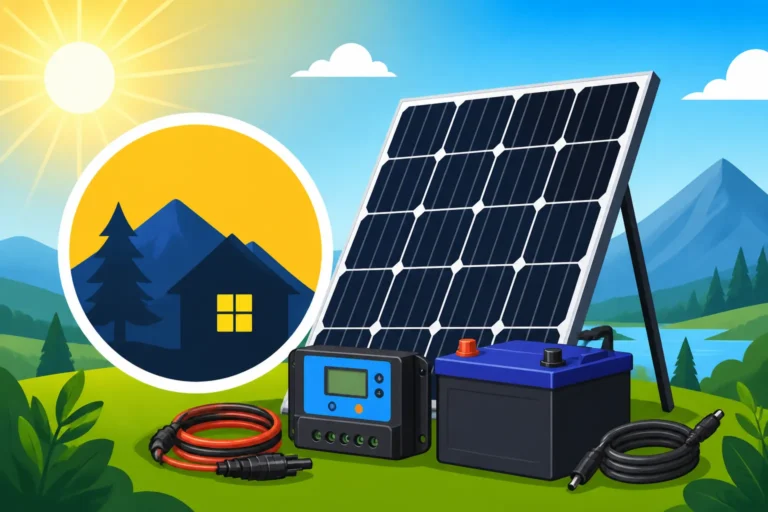
While lithium batteries are the star, they're part of a finely tuned orchestra. An off-grid solar system is a collection of essential components working together to harvest, store, and deliver power. Understanding each part is crucial for building a reliable and efficient setup.
Solar Panels: The Power Harvesters
These are your eyes to the sun, the frontline of your off-grid power generation. Solar panels capture sunlight and convert it into direct current (DC) electricity. For off-grid systems, you'll primarily be looking at rigid monocrystalline panels, known for their high efficiency and durability. Polycrystalline panels are an older technology, less efficient, and generally not recommended for the significant investment of a lithium-based system.
When selecting panels, consider factors like their wattage (e.g., 100W, 200W, 400W panels), physical size, and voltage characteristics (Voc, Vmp). You'll need enough total wattage to meet your daily energy demands and efficiently charge your lithium battery bank, especially when accounting for less-than-ideal conditions like cloudy days or winter months. The way you arrange them—whether series, parallel, or a combination—will also impact system voltage and performance, which is vital for understanding How to Wire Solar Panels in Series vs Parallel.
Charge Controller: Protecting Your Investment
The charge controller is the unsung hero of your off-grid system. It acts as the brain between your solar panels and your batteries, regulating the voltage and current coming from the panels to ensure your batteries are charged safely and efficiently. For lithium batteries, choosing the right charge controller is absolutely paramount.
You'll primarily encounter two types: PWM (Pulse Width Modulation) and MPPT (Maximum Power Point Tracking). For any serious off-grid solar system, especially one with lithium batteries, an MPPT charge controller is the only way to go. MPPT controllers are significantly more efficient, converting excess voltage from your panels into additional current for your batteries. This means you harvest 20-30% more power from your panels compared to a PWM controller, which is a massive gain that directly impacts your battery charging speed and overall system performance. A high-quality MPPT controller like those from Victron or Renogy can automatically detect battery voltage and adapt its charging profile, which is critical for the specific needs of LiFePO4 batteries.
Inverter: Converting DC to AC Power
Most of the appliances and electronics we use in our daily lives run on alternating current (AC) power, just like in a grid-tied home. Your solar panels and batteries, however, produce and store direct current (DC) power. The inverter's job is to convert that DC power from your battery bank into usable AC power for your devices.
There are two main types of inverters: modified sine wave and pure sine wave. A modified sine wave inverter is cheaper, but it produces a "choppy" waveform that can damage sensitive electronics (like laptops, medical devices, and many modern appliances) and cause motors to run less efficiently or hum loudly. For a reliable, modern off-grid system with lithium batteries, you must choose a pure sine wave inverter. It produces a clean, smooth waveform identical to grid power, ensuring your electronics are safe and function optimally. Sizing your inverter correctly is also critical, as it needs to handle the continuous running watts of all your simultaneous loads, plus the surge (starting) watts of motors and compressors. This is where topics like How to Size an Off-Grid Inverter become incredibly important.
The Lithium Battery Bank: The Heart of the System
This is where all that solar energy gets stored for when the sun isn't shining. As we've discussed, LiFePO4 batteries are the preferred choice for their longevity, depth of discharge, and overall efficiency. When building your battery bank, you'll need to consider several factors:
- Voltage: Common off-grid system voltages are 12V, 24V, and 48V. While 12V might be fine for small RV setups, larger systems for cabins or homes will benefit greatly from 24V or, even better, 48V. Higher voltage systems allow for thinner wires, less voltage drop, and often more efficient inverter operation, saving on cabling costs and improving performance. This choice is critical to understand when deciding 12V vs 24V vs 48V: Which to Choose.
- Capacity (Ah/kWh): This dictates how much energy your battery bank can store. It's measured in amp-hours (Ah) or kilowatt-hours (kWh). Your capacity needs will depend directly on your daily energy consumption and how many "days of autonomy" (how long your system can run without sun) you desire.
- Battery Management System (BMS): This is absolutely essential for lithium batteries. A good BMS protects the battery from overcharging, over-discharging, over-current, and extreme temperatures. It also balances the cells within the battery pack, ensuring optimal performance and longevity. Many modern LiFePO4 batteries come with an integrated BMS. For those building larger, custom systems, external BMS units or intelligent inverter-chargers (like some offerings from Victron Energy or Sol-Ark) provide comprehensive protection and monitoring. The BMS is what makes lithium batteries so safe and reliable, preventing the kind of issues that can arise from improper handling or charging.
Designing Your Optimal Off-Grid Solar System with Lithium
Alright, now that you know the components, how do you put them all together in a way that actually works for your specific needs? This is where good design comes in. Skipping these steps is a surefire way to end up with a system that's either undersized, overpriced, or constantly leaving you in the dark.
Performing a Comprehensive Load Analysis
This is arguably the most critical first step. You cannot design an effective off-grid solar system without knowing exactly how much power you actually use. It’s like trying to build a house without knowing how many rooms you need.
Here’s how to do it:
- List every single electrical device: Go through your typical day (or week, if it's a seasonal cabin) and list every appliance, light, and electronic device you plan to use. Don't forget the obscure things like phone chargers, electric toothbrushes, or power tools you might use occasionally.
- Find the wattage: For each item, look for a label indicating its wattage (W). If it only lists amps (A) and voltage (V), multiply them (A x V = W). If you can't find it, a Kill-A-Watt meter is a fantastic, inexpensive tool for measuring real-time consumption.
- Estimate daily usage hours: For each item, estimate how many hours per day (or week, then convert to daily average) you will run it. Be realistic!
- Calculate daily Watt-hours (Wh): Multiply the wattage by the estimated daily usage hours (W x hours = Wh). Do this for every item.
- Sum it up: Add all the daily Wh figures together. This gives you your total estimated daily energy consumption in Watt-hours.
- Identify peak loads: Note which appliances draw a lot of power simultaneously. This helps determine your inverter size. For example, a microwave and a well pump might both be used, but rarely at the exact same moment. However, a refrigerator and lights will be on continuously. Understanding your Off-Grid Solar Load Calculation Explained is fundamental.
Sizing Your Solar Array for Lithium Batteries
Once you know your daily energy consumption, you can determine how many solar panels you need. This isn't just about matching watts; it's about considering how much sunlight you actually get.
- Determine Peak Sun Hours: This is the equivalent number of hours per day when the sun's intensity averages 1,000 watts per square meter. This varies significantly by location and season. You can find average peak sun hour data for your specific area online or through solar calculators. For instance, in winter, a northern location might only get 2-3 peak sun hours, while a desert location in summer might get 6-7.
- Account for System Losses: No system is 100% efficient. You'll lose power due to wiring, temperature, dust on panels, and inverter efficiency. A typical estimate is 20-30% total system loss.
- Calculate Required Panel Wattage:
- Take your total daily Watt-hours (from your load analysis).
- Divide by your peak sun hours.
- Divide by your overall system efficiency (e.g., 0.75 for 25% loss).
- Add a buffer (e.g., 10-20%) for cloudy days or future expansion.
- The formula looks something like: (Daily Wh / Peak Sun Hours / System Efficiency) * Buffer = Total Panel Watts Needed.
For example, if you use 5000 Wh per day, have 4 peak sun hours, and factor in 25% losses (0.75 efficiency), you'd need roughly (5000 / 4 / 0.75) = 1667W of solar panels. Add a 15% buffer: 1667 * 1.15 = ~1917W. So, you might need five 400W panels. This kind of careful calculation is key for avoiding the common pitfalls detailed in Common Off-Grid Sizing Mistakes.
Determining the Right Lithium Battery Bank Capacity
With lithium batteries, you don't need to double your capacity to get usable power like with lead-acid, but you still need enough to carry you through periods of low solar input.
- Days of Autonomy: Decide how many days you want your system to run purely on battery power without any sun (e.g., 2-3 days for typical living, more for critical loads or very cloudy regions).
- Calculate Required Battery Wh/Ah:
- Multiply your daily Watt-hours by your desired days of autonomy.
- Divide by the maximum depth of discharge for your chosen lithium battery (e.g., 0.9 for 90%).
- Add a buffer.
- Example: 5000 Wh/day * 3 days = 15,000 Wh. If you use 48V batteries and 90% DoD, 15,000 Wh / 48V = 312.5 Ah. 312.5 Ah / 0.9 DoD = ~347 Ah total at 48V. You could achieve this with three 48V 100Ah LiFePO4 batteries (300Ah total, slightly undersized) or four (400Ah total, a good buffer).
- This is where understanding How Many Batteries for an Off-Grid System truly comes into play.
Matching Inverters and Charge Controllers
Finally, ensure your electronics can handle your design.
- Inverter Sizing: Your inverter's continuous wattage rating must be greater than the sum of all appliances you anticipate running simultaneously. Its surge rating must be able to handle the highest starting load (like a well pump, refrigerator, or microwave). Always err on the side of oversizing your inverter slightly. Many off-grid setups opt for robust pure sine wave inverter-chargers from brands like Victron or Sol-Ark, which combine the inverter, battery charger (for generator input), and transfer switch into one unit.
- Charge Controller Sizing: Your MPPT charge controller needs to be able to handle the total current coming from your solar array at its maximum output, and its voltage range must be compatible with your panel array's voltage (Voc) and your battery bank's voltage. If you have a 48V battery bank, you'll need a charge controller designed for 48V systems. This is an essential step in learning How to Size a Charge Controller.
Installation and Maintenance Considerations for Lithium Systems
Once you've designed your perfect system, the next phase is installation and then ensuring it runs smoothly for years to come. While a DIY approach is possible for smaller systems, larger setups often benefit from professional help, especially with the high voltage DC aspects.
Wiring and Safety Best Practices
Proper wiring is non-negotiable for safety and efficiency. Using undersized wires can lead to voltage drop (power loss), overheating, and even fire hazards.
- Cable Sizing: Always use appropriately sized wire gauge for the current (amps) it will carry and the distance it will travel, to minimize voltage drop. Larger gauge (smaller number) wires are needed for higher currents or longer runs.
- Fuses and Breakers: Every major component (solar array, battery bank, inverter) must be protected by fuses or circuit breakers. These are critical safety devices that prevent damage from short circuits or overloads.
- Disconnects: Install manual disconnect switches for your solar array and battery bank. This allows you to safely isolate components for maintenance or in an emergency.
- Grounding: Properly grounding your entire system (panels, mounts, inverter, battery box) to an earth ground rod is crucial to protect against electrical surges and lightning. Off-Grid Solar Safety and Grounding is not an area to cut corners.
Environmental Factors and Protection
Lithium batteries, while robust, have specific environmental needs that differ from lead-acid.
- Temperature: LiFePO4 batteries perform optimally within a wide temperature range, typically from 32°F to 130°F (0°C to 55°C) for charging and -4°F to 140°F (-20°C to 60°C) for discharging. Crucially, charging below freezing can permanently damage lithium batteries. If you live in a cold climate, you'll need to consider insulated battery boxes, internal heaters (many modern LiFePO4 batteries include these), or keeping your batteries in a conditioned space.
- Ventilation: While LiFePO4 batteries don't off-gas like lead-acid, proper ventilation is still important, especially for inverters and charge controllers, to dissipate heat and ensure optimal performance.
Monitoring and System Optimization
One of the greatest advantages of modern off-grid systems, especially those with lithium batteries, is the ability to monitor their performance in real-time.
- Battery Monitors: A dedicated battery monitor (like a Victron SmartShunt or a system integrated into your inverter-charger) provides crucial information: state of charge (%), current flowing in/out, voltage, and sometimes even temperature. This allows you to understand your power consumption and generation at a glance, helping you conserve power when needed.
- Smart BMS Features: Many advanced LiFePO4 batteries and integrated systems offer Bluetooth connectivity or display screens that provide detailed battery health, cycle count, and individual cell voltage monitoring.
- Routine Checks: Even with smart monitoring, regular visual inspections are essential. Check for loose connections, corrosion, damaged wiring, or excessive dust on panels. Keeping your solar panels clean is a simple yet effective maintenance task that directly impacts their output. For larger systems, consider how often you'll need to perform Off-Grid Solar Maintenance Costs.
Systems like the EcoFlow Power Kit for Off-Grid: Specs and Review, or a comprehensive Victron MultiPlus Review, demonstrate how integrated components with robust monitoring capabilities can simplify the complexity of managing an off-grid setup, making it more user-friendly and reliable.
Lithium vs. Lead-Acid for Off-Grid Solar
To quickly summarize the advantages that make lithium batteries the superior choice for most modern off-grid solar systems, here's a comparison table:
| Feature | Lead-Acid Batteries (e.g., AGM, Flooded) | LiFePO4 Lithium Batteries |
|---|---|---|
| Initial Cost | Lower | Higher |
| Usable Capacity (DoD) | ~50% (to extend lifespan) | 80-100% |
| Lifespan / Cycle Count | 500-1,500 cycles | 3,000-7,000+ cycles |
| Weight | Very heavy | Significantly lighter |
| Size | Bulky | More compact for same usable capacity |
| Maintenance | High (watering for flooded, equalizing charges) | Low to none (BMS handles most issues) |
| Charging Efficiency | Slower, especially at higher SOC (longer absorption phase) | Faster, accepts high current throughout most of charge cycle |
| Temperature Sensitivity | Susceptible to cold (reduced capacity, damage if frozen when discharged) | Charging below freezing causes permanent damage (some have heaters) |
| Voltage Drop | More significant under load | Very stable voltage under load |
| Safety | Off-gassing (H2) requires ventilation, spill risk for flooded | Safe with proper BMS, no off-gassing, no spill risk |
| Overall Value (Long-Term) | Often higher due to replacements, lower efficiency | Superior due to longevity, high efficiency, and low maintenance |
It's clear why anyone serious about a long-term, reliable off-grid solution is looking at lithium. The initial cost might be higher, but the long-term savings in replacements, maintenance, and the sheer peace of mind of having a more robust, efficient system are undeniable.
Disclaimer
The information provided in this guide is for general informational purposes only and does not constitute professional advice. Off-grid solar system design and installation involve electrical work that can be dangerous if not performed correctly. Always consult with qualified professionals and adhere to all local codes and regulations when planning and installing your system. We are not responsible for any actions taken based on the information presented herein.