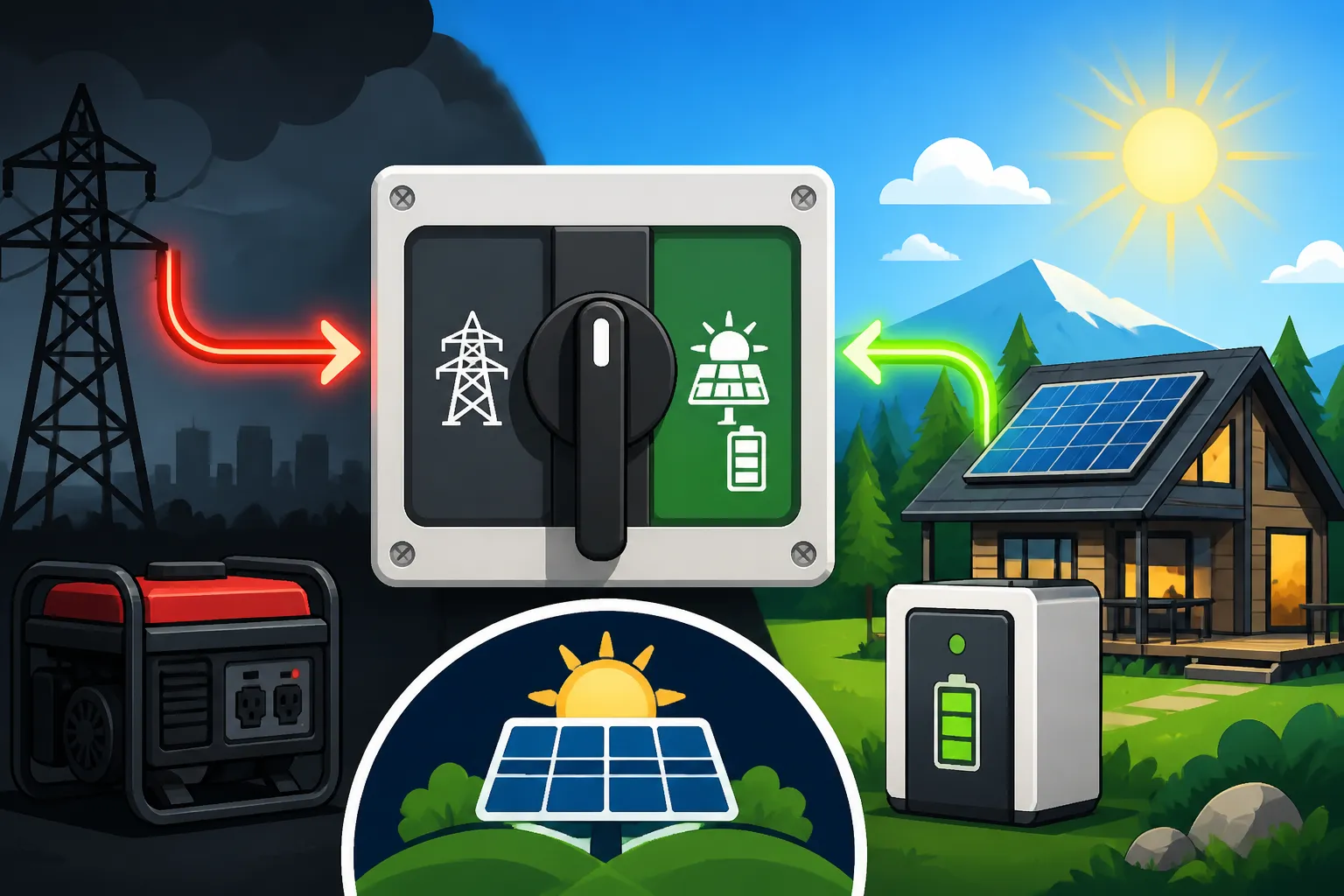
Best Transfer Switches for Off-Grid
There's nothing quite like the feeling of having your off-grid solar system humming along, providing clean, independent power. But what happens when the sun dips below the horizon for a few cloudy days, or your batteries are running low, and you need to fire up that trusty generator? The challenge many off-gridders face is how to safely and efficiently switch between these different power sources without risking damage to their system, or worse, creating a dangerous backfeed situation. This guide will walk you through everything you need to know about off-grid transfer switches, helping you choose the best one for your unique setup and ensure your power transitions are smooth and secure.
Understanding Off-Grid Transfer Switches
When you're living off the grid, your electrical system is a bit different from a typical grid-tied home. You're often juggling power from solar panels, a battery bank, and sometimes a backup generator. This complexity is exactly why a transfer switch isn't just a convenience; it's a vital safety component.
Why You Need a Transfer Switch in an Off-Grid System
Imagine a scenario where your solar batteries are depleted, and you need to bring your generator online to recharge them or power your home. Without a proper transfer switch, you'd be looking at a manual, potentially risky process of unplugging loads, starting the generator, and hoping you don't accidentally send generator power back into your inverter or, even worse, the solar array. This is known as "backfeeding," and it's incredibly dangerous.
Backfeeding can damage your inverter, overload your solar charge controller, and poses a serious electrocution risk to anyone working on your electrical system or even utility workers if your system somehow connects to a grid that you're supposed to be isolated from. A transfer switch provides a clear, safe, and code-compliant way to isolate your off-grid system from one power source before connecting it to another. It ensures that your house electrical panel is connected to only one power source at any given time – either your solar inverter output or your backup generator. This isolation is crucial for protecting your equipment, complying with electrical codes, and, most importantly, ensuring the safety of your home and family. For those planning their full setup, understanding the role of each component is key, and our guide on Off-Grid Solar System Components Explained] dives deeper into how everything fits together.
Types of Transfer Switches for Off-Grid Applications
When it comes to transfer switches for off-grid living, you'll generally encounter two main types: Manual Transfer Switches (MTS) and Automatic Transfer Switches (ATS). Each has its own set of advantages and is suited for different off-grid lifestyles and system sizes.
A Manual Transfer Switch (MTS), as the name suggests, requires you to physically flip a switch to change power sources. It's a hands-on approach where you monitor your battery levels or weather conditions and decide when it's time to bring the generator online. Think of it like shifting gears in a manual car – you're in direct control. These are often simpler devices, offering a straightforward mechanical means of disconnecting one power source and connecting another.
An Automatic Transfer Switch (ATS), on the other hand, operates autonomously. It continuously monitors your primary power source (usually your solar inverter/battery bank) and, when voltage drops below a certain threshold or goes out of range, it automatically starts your backup generator, transfers the load, and then shuts down the generator and transfers back to solar when conditions normalize. This is like an automatic transmission – the system handles the power shifts for you. These switches are more complex, often incorporating control circuits to communicate with your generator and manage the switching process. For larger setups, especially those aiming for full home power, knowing How to Wire an Off-Grid Solar System] properly with an ATS can make a huge difference in convenience.
Key Features to Look for in an Off-Grid Transfer Switch
Choosing the right transfer switch involves more than just picking between manual and automatic. You need to consider several technical specifications to ensure it's compatible with your system and meets your needs.
First, amperage and voltage ratings are paramount. The switch must be rated for the maximum current (amperage) and voltage that will pass through it. This means matching it to your main inverter's output or your subpanel's capacity. For instance, if your inverter can output 50 amps at 240V, your transfer switch needs to handle at least that much. Undersized switches can overheat, trip breakers, or even fail catastrophically. You should also consider the number of poles, which refers to the number of electrical lines it can switch. Most residential systems will need a two-pole (120/240V split-phase) or single-pole (120V) switch, depending on your setup.
Next, consider surge protection. While not a primary function of the transfer switch itself, some higher-end models or integrated panels may include surge suppression. This can offer an extra layer of protection for your sensitive off-grid electronics, safeguarding them from transient voltage spikes, whether they come from your generator or another source.
Finally, the enclosure rating is crucial, especially if the switch will be exposed to the elements. NEMA (National Electrical Manufacturers Association) ratings indicate how well the enclosure protects against dust, water, and other environmental factors. A NEMA 3R enclosure, for example, is suitable for outdoor use and provides protection against rain, sleet, and external ice formation. A NEMA 1 enclosure is typically for indoor, dry environments. Always check the required rating for your specific installation location to ensure long-term reliability and safety. If you're pondering a DIY installation, understanding How to Install an Off-Grid Solar System] means paying close attention to these details.
Manual Transfer Switches Explained
For many off-gridders, especially those just starting out or with smaller, simpler setups, a manual transfer switch (MTS) is the go-to solution. It's often favored for its simplicity, reliability, and lower initial cost.
Pros and Cons of Manual Transfer Switches
The biggest draw of a manual transfer switch is its simplicity and reliability. There are fewer moving parts and no complex electronics to worry about, meaning less to break down. This simplicity also translates to a lower cost, making MTS units an attractive option for budget-conscious projects, like a small cabin or an RV. When you manually operate the switch, you have complete control over when power sources are switched. You can decide exactly when to run your generator, perhaps waiting for optimal charging conditions or specific load demands, rather than relying on automatic thresholds. This hands-on control is something many off-gridders appreciate, feeling more connected to their system's operation.
However, the manual nature also comes with inconveniences. You have to be physically present to flip the switch and often to start the generator. This isn't ideal if you're away from your property or during an emergency when you might not be able to get to the switch immediately. There's also the potential for human error. Forgetting to shut down one source before connecting another, or simply not performing the switch promptly, can lead to brief power interruptions or, in worst-case scenarios, safety hazards. While generally reliable, an MTS doesn't offer the seamless power transfer of an ATS, meaning a brief blackout during the switchover is inevitable.
Ideal Scenarios for Manual Transfer Switches
Manual transfer switches are perfect for specific off-grid applications where simplicity and cost-effectiveness are priorities. If you have a smaller cabin or a recreational vehicle (RV), where your power needs are moderate and you're typically present to manage the system, an MTS can be an excellent choice. Many RV owners, for example, use an MTS to switch between their shore power connection, their onboard generator, and their inverter output.
They're also well-suited for occasional generator use. If your generator is primarily for backup during extended cloudy periods or for powering heavy loads only a few times a month, the manual operation isn't a significant burden. For those on a tight budget for their off-grid system, an MTS helps keep initial costs down without sacrificing essential safety. It allows you to invest more in other critical components like Best Off-Grid Solar Batteries] or Best Off-Grid Solar Panels]. Even if you plan to expand your system later, starting with a robust MTS can provide a solid foundation.
Installation Considerations for Manual Transfer Switches
Installing a manual transfer switch requires careful planning and adherence to electrical codes. The switch typically needs to be placed between your off-grid inverter's output and your main electrical panel or a dedicated subpanel that serves your off-grid loads. It effectively becomes the gatekeeper for your home's power.
You'll need to run appropriate wiring from your inverter's AC output to one side of the transfer switch, and wiring from your generator's output (or a generator inlet box) to the other side. The output of the transfer switch then connects to your home's electrical panel. It's crucial to use the correct gauge wire and appropriate circuit breakers to protect all components. Many off-grid guides, including How to Install a Transfer Switch], detail these steps. Given the electrical work involved, if you're not an experienced electrician, consulting or hiring a professional is highly recommended to ensure everything is wired correctly and safely.
Here's a quick comparison of Manual vs. Automatic Transfer Switches:
| Feature | Manual Transfer Switch (MTS) | Automatic Transfer Switch (ATS) |
|---|---|---|
| Operation | Manual lever/switch | Automatic, sensor-driven |
| Cost | Generally lower | Significantly higher |
| Complexity | Simple mechanics, minimal electronics | Complex controls, integrated logic |
| Power Interruption | Brief momentary outage during switchover | Typically seamless or very brief interruption |
| Generator Start | Manual start required | Automatically starts/stops generator |
| Ideal For | RVs, small cabins, occasional backup, budget-conscious | Whole homes, critical loads, remote properties, convenience |
| Maintenance | Minimal | More complex, may require periodic checks |
| User Interaction | High | Low |
Automatic Transfer Switches Explored
For those seeking the pinnacle of convenience and seamless power management in their off-grid setup, an Automatic Transfer Switch (ATS) is often the preferred choice. While more complex and expensive, the benefits can be substantial, especially for larger or more critical applications.
Benefits and Drawbacks of Automatic Transfer Switches
The primary benefit of an ATS is seamless power transfer. When your primary power source (your solar battery bank and inverter) falters, the ATS detects the issue and automatically switches to your backup generator, often initiating the generator start sequence itself. This means no manual intervention, no fumbling in the dark, and minimal interruption to your appliances. This automation is invaluable for busy households, those with critical medical equipment, or remote properties where you can't always be on-site to manage power. Imagine running an off-grid business from your home office; an ATS ensures your computers stay running even when the sun isn't shining.
However, this sophistication comes at a cost. ATS units are significantly more expensive than their manual counterparts due to their internal electronics, sensors, and control logic. They are also more complex to install and troubleshoot, often requiring a professional electrician or a seasoned off-grid system integrator. This complexity can also mean a higher likelihood of needing maintenance or repairs over the system's lifetime compared to a simple mechanical switch. You're trading simplicity for advanced functionality. Despite the added upfront cost, some off-gridders find that the peace of mind and convenience an ATS offers make it well Is Off-Grid Solar Worth the Cost].
When an Automatic Transfer Switch is the Best Choice
An automatic transfer switch shines brightest in specific off-grid scenarios where reliability, convenience, and continuous power are non-negotiable. For whole-home off-grid systems, especially those designed for full-time living, an ATS is almost a necessity. It ensures that essential appliances like refrigerators, well pumps, and heating systems remain operational without constant monitoring.
Consider situations where critical medical devices are in use, such as CPAP machines or oxygen concentrators. A momentary power interruption, let alone a prolonged one, could be life-threatening. An ATS minimizes this risk by swiftly transitioning to backup power. Similarly, if you have a remote property that's often unattended, or if you travel frequently, an ATS provides unparalleled peace of mind. You don't have to worry about your food spoiling or pipes freezing because the system will manage power transfers even when you're not there. Businesses operating off-grid also benefit greatly from an ATS, preventing costly downtime. When designing such a system, you'll need to carefully consider How to Size an Off-Grid Solar System] to ensure your ATS can handle peak loads.
Advanced Features and Integration
Modern automatic transfer switches offer a range of advanced features that integrate seamlessly into a sophisticated off-grid lifestyle. Many ATS units are designed for generator auto-start, sending a signal to your backup generator to fire up when battery voltage drops. Some even monitor battery state of charge directly or can be programmed with specific thresholds. Once the batteries are sufficiently recharged and solar production is stable, the ATS will gracefully shut down the generator and switch back to solar power.
Beyond basic switching, some advanced ATS models offer smart home compatibility and remote monitoring. This allows you to check your power status, receive alerts, and even initiate transfers from your smartphone or computer, no matter where you are. Brands like Victron Energy or Sol-Ark offer inverter-chargers with integrated transfer switch functionalities or dedicated ATS units that can be part of a larger, interconnected smart energy system. This level of integration can be particularly useful for maximizing your system's efficiency and reducing generator run time, ultimately saving on fuel and maintenance. Understanding how to integrate a generator into your design is crucial, and you can learn more about How to Add a Generator to Your Design].
Top Considerations for Selecting Your Off-Grid Transfer Switch
Choosing the right transfer switch isn't a one-size-fits-all decision. It involves carefully evaluating your specific off-grid needs, existing equipment, and future expansion plans. Taking the time to consider these factors upfront will save you headaches and expenses down the line.
System Size and Load Requirements
One of the most critical aspects of selecting a transfer switch is ensuring it's appropriately sized for your off-grid system. You need to consider the maximum continuous current and voltage it will handle. This means looking at the output capacity of your main inverter. If you have a 5000-watt inverter that can push, say, 40 amps at 120V (or 20 amps at 240V for split phase), your transfer switch needs to be rated for at least that amperage. Going too small will lead to nuisance tripping, overheating, and potential failure, while going unnecessarily large can add to the cost without much benefit. Our guide on How to Size an Off-Grid Inverter] can help you determine your power needs.
You should also factor in your total expected household load. Do you plan to run an entire house, including a well pump, air conditioning, and multiple heavy appliances, or are you just powering basic lights and electronics in a small cabin? The more significant your combined loads, the higher the amperage rating your transfer switch will require. It's often wise to slightly oversize your transfer switch from your initial calculations to allow for future expansion or unexpected surge loads, which are common when starting motors in appliances.
Generator Compatibility and Integration
Your backup generator is a critical part of your off-grid safety net, and your transfer switch needs to work seamlessly with it. If you're going with an Automatic Transfer Switch (ATS), ensure it has the necessary control wiring and logic to communicate with your specific generator model. Many ATS units come with a multi-pin connector specifically designed to integrate with generators that have auto-start capabilities. You'll want to check if the ATS can monitor generator status, battery voltage, and provide programmable run times. For instance, some ATS units can be programmed to run the generator only when batteries are below 50% state of charge and stop when they reach 90%, optimizing fuel consumption.
For Manual Transfer Switches (MTS), compatibility is simpler, but you still need to ensure the generator's output matches the switch's input voltage and phase. You'll typically connect your generator to a dedicated generator inlet box, which then wires into the MTS. Always ensure your generator has proper ground fault circuit interrupter (GFCI) protection, especially if you're using portable units, and that the entire setup respects Off-Grid Solar Safety and Grounding] protocols. Don't forget to account for How to Size a Backup Generator] in your overall system design to avoid overloading issues.
Environmental Factors and Enclosure Ratings
Where you install your transfer switch dictates the type of enclosure you'll need. This is where NEMA (National Electrical Manufacturers Association) ratings come into play.
- Indoor Installation: If your transfer switch will be housed in a dry, protected indoor space like a utility room or garage, a NEMA 1 rated enclosure might suffice. These provide basic protection against dust and accidental contact.
- Outdoor Installation: For switches installed outdoors, you'll need a robust, weather-resistant enclosure. A NEMA 3R rating is typically the minimum requirement for outdoor use, offering protection against rain, sleet, and external ice formation. For more severe conditions or areas prone to high dust, a NEMA 4 or NEMA 4X (which adds corrosion resistance) might be necessary.
Always prioritize the appropriate NEMA rating for your installation environment. An incorrectly rated enclosure can expose electrical components to moisture, dust, or physical damage, leading to system failure, short circuits, or even fires. It's not just about protecting your investment; it's about electrical safety. Checking these details is part of adhering to Off-Grid Solar Wiring Best Practices].
Recommended Brands and Where to Find Them
Navigating the market for transfer switches can feel a bit overwhelming with so many options. Knowing which brands are trusted and where to reliably purchase your equipment is half the battle.
Reputable Manufacturers for Off-Grid Transfer Switches
When it comes to off-grid electrical components, reliability and durability are paramount. Several manufacturers have built strong reputations for producing high-quality transfer switches that stand up to the demands of off-grid living.
For robust, industrial-grade solutions, brands like Generac and Cummins Onan are well-known, especially for their automatic transfer switches designed to integrate seamlessly with their respective generator lines. These are often chosen for larger, permanent off-grid homes where reliability and integration are top priorities.
For more modular and versatile off-grid systems, brands like MidNite Solar and OutBack Power offer transfer switch solutions, often integrated into their power panels or inverter systems. These brands are highly respected in the off-grid community for their durable components and flexible configurations. For simpler, manual transfer switches, you'll find reliable options from companies like Reliance Controls and Connecticut Electric, which specialize in residential and portable generator transfer solutions.
Even solar component manufacturers like Renogy have started offering various components, including manual transfer switches or combined inverter-chargers with built-in transfer capabilities, catering to a range of off-grid needs, from RVs to small cabins. When you're looking to integrate an Off-Grid Solar Kit Price Ranges], choosing components from a reputable brand like Renogy can simplify the process.
Buying Your Transfer Switch
Once you know what kind of transfer switch you need, the next step is finding where to buy it. You have a few main avenues, each with its own pros and cons.
Online Retailers are a popular choice due to convenience and often competitive pricing. Large marketplaces like Amazon offer a vast selection of manual and smaller automatic transfer switches from various brands. You can find everything from basic Reliance Controls manual switches perfect for a cabin to more specialized Renogy power distribution components. When purchasing from Amazon or similar sites, always check seller reviews, product specifications, and return policies carefully. Specialty online solar retailers, like altE Store or Northern Arizona Wind & Sun, also carry a wide range of off-grid specific transfer switches and power panels, often with knowledgeable customer support.
Local Electrical Supply Houses can be an excellent resource, especially for larger, more complex automatic transfer switches or if you need expert advice. They often stock commercial-grade units from brands like Generac or Eaton. While prices might be slightly higher than online, the ability to see the product, get immediate assistance, and support a local business can be invaluable.
Finally, Dedicated Solar System Providers or Installers can not only supply the transfer switch but also ensure it's the right fit for your entire system and properly installed. If you're considering a professional installation for your off-grid home, they will typically source all components, including the transfer switch, ensuring compatibility and compliance with electrical codes. While DIY vs Professional Off-Grid Solar Cost] is a consideration, for critical components like transfer switches, professional guidance can be well worth it.
Ultimately, whether you opt for a simple manual switch or a sophisticated automatic one, investing in a quality transfer switch is a foundational step toward a safe, reliable, and truly independent off-grid power system.
Disclaimer
The information provided in this guide is for general informational purposes only and does not constitute professional electrical or engineering advice. Off-grid solar system design and installation involve inherent risks and should only be undertaken by qualified individuals or with the supervision of certified professionals. Always consult local electrical codes and obtain necessary permits before installing any electrical system.