How Much Does an Off-Grid Solar System Cost
Trying to figure out how much it really costs to go off-grid with solar can feel like deciphering an ancient scroll. You see numbers flung around everywhere, from a few hundred dollars to tens of thousands, and it leaves you more confused than enlightened. This comprehensive guide is here to cut through the noise, give you a realistic breakdown of off-grid solar system costs, and help you understand what truly influences your investment.
Understanding the Core Components of Off-Grid Solar Cost
When you're dreaming of energy independence, it's easy to get caught up in the big picture. But to truly understand the cost, we need to break down your off-grid solar system into its individual pieces, much like building a house brick by brick. Each component plays a vital role, and its quality, size, and type directly impact the overall price tag. Forget just thinking about "solar panels" – it's so much more nuanced than that.
Solar Panels: The Sun-Catchers
These are often the first thing people think of when they hear "solar," and for good reason! Solar panels are your primary means of harvesting energy from the sun. The cost of solar panels themselves can vary quite a bit based on their wattage, efficiency, brand, and type (monocrystalline vs. polycrystalline, rigid vs. flexible). You might find a single 100-watt panel for as little as $100-$150, but a high-efficiency 400-watt panel from a reputable brand could easily be $300-$500 or more.
The crucial factor here isn't just the price per panel, but the total wattage you need. A small shed might only need a couple of 100-watt panels, whereas a full-time off-grid home will require a substantial array, often consisting of 10 to 20 large panels. The larger your energy demand, the more panels you'll need, and naturally, your upfront investment in the array will increase. Don't forget that mounting hardware, such as roof mounts or ground mounts, adds to this cost as well. You can learn more about the specific costs in our guide on the Cost of Off-Grid Solar Panels.
Batteries: Your Energy Bank
This is arguably the most significant cost driver in any off-grid solar system, and often where beginners underestimate the investment. Unlike grid-tied systems that can simply send excess power back to the utility, an off-grid system must store all its energy for use when the sun isn't shining. Batteries are the heart of your system, holding that precious power for nights, cloudy days, and emergencies.
The market offers several battery chemistries, with lead-acid (flooded, AGM, Gel) and lithium-ion (specifically LiFePO4) being the most common for off-grid applications. Lead-acid batteries are typically cheaper upfront, with a 100Ah 12V AGM battery costing around $200-$400. However, they have a shorter lifespan, require more maintenance, and can only be discharged to about 50% without damaging them. On the other hand, LiFePO4 batteries are a more substantial initial investment, with a 100Ah 12V LiFePO4 battery often running $500-$1,000 or more, depending on the brand and features. But they offer a much longer cycle life (often 10+ years), can be discharged deeper (80-100%), and are virtually maintenance-free. Understanding the differences is key, which is why we have a dedicated comparison for LiFePO4 vs Lead-Acid Battery Cost. For most serious off-grid setups, the long-term value and performance of LiFePO4 often outweigh the higher initial cost. Your total battery bank cost will depend heavily on your desired days of autonomy – how many days you want to be able to power your home without any new solar input. A detailed dive into this component can be found in our article on the Cost of an Off-Grid Solar Battery Bank.
Inverter: The Power Converter
Your inverter is the unsung hero of your off-grid system. Solar panels generate direct current (DC) power, and batteries store DC power. However, most of the appliances and electronics in your home run on alternating current (AC) power, just like in a standard grid-tied house. The inverter's job is to convert that stored DC power into usable AC power.
Inverters come in various sizes (wattage) and types. A small, basic 1000-watt pure sine wave inverter for an RV might cost $150-$300. But if you're looking to power an entire home with appliances like refrigerators, microwaves, and power tools, you'll need a much larger and more robust inverter, often in the 3000-watt to 8000-watt range, sometimes even higher. These higher-capacity units, especially those with integrated charge controllers (inverter-chargers) or advanced features like generator auto-start capabilities, can easily cost anywhere from $1,000 to $5,000, or even more for industrial-grade systems. Brands like Victron Energy or Sol-Ark offer high-quality, feature-rich inverters that are popular in the off-grid community but come at a premium. The inverter's capacity must match or exceed your peak instantaneous power demand – meaning if you turn on the microwave and a well pump at the same time, the inverter needs to handle that combined surge. Check out our guide on the Cost of an Off-Grid Solar Inverter for more details.
Charge Controller: The Brain of the System
While often smaller and less flashy than the inverter or battery bank, the charge controller is absolutely essential. Its primary function is to regulate the voltage and current coming from your solar panels to your battery bank, preventing overcharging and maximizing charging efficiency. Overcharging can severely damage and shorten the life of your expensive batteries, so this component is critical for safeguarding your investment.
There are two main types: Pulse Width Modulation (PWM) and Maximum Power Point Tracking (MPPT). PWM controllers are simpler and cheaper, typically ranging from $50-$150, but are less efficient, especially in certain temperature conditions or when the panel voltage is significantly higher than the battery voltage. MPPT controllers, on the other hand, are much more efficient at converting the panel's output into usable battery charging current, often increasing efficiency by 10-30%. This extra efficiency means you can get more power from your panels, potentially reducing the number of panels you need. MPPT controllers usually cost more, ranging from $100 for smaller units to $500-$1,000 or more for larger, advanced models from brands like Victron. For any serious off-grid system, the investment in an MPPT controller is almost always worth it for the improved performance and battery longevity.
Balance of System BOS Components
Beyond the four main components, there's a host of "Balance of System" (BOS) components that are absolutely necessary for a safe, functional, and compliant off-grid solar setup. These are often overlooked in initial budget estimates but can add up quickly.
This category includes things like wiring (copper is expensive!), fuses, circuit breakers, disconnect switches (AC and DC), combiner boxes, monitoring equipment (like battery monitors), conduit to protect wiring, and mounting hardware for your panels. Even small items like MC4 connectors, cable glands, and zip ties contribute to the cost. For a robust system, you might also need lightning arrestors, ground fault protection, and specialized tools. For a moderate-sized cabin system, these BOS components can easily add $1,000 to $3,000 or more to your total cost. Neglecting quality components here can lead to safety hazards, system inefficiencies, or costly repairs down the line. It's truly a scenario where cutting corners can cost you more in the long run.
Factors Dramatically Influencing Off-Grid Solar System Cost
The reason "How Much Does an Off-Grid Solar System Cost" often yields such a wide range of answers is because there are so many variables at play. It's not a one-size-fits-all product like buying a car; it's a bespoke energy solution tailored to specific needs and circumstances. Understanding these factors is crucial for accurately budgeting your project.
Your Daily Energy Needs and Lifestyle
This is perhaps the single most impactful factor on your overall system cost. What do you actually want to power? Are you looking for a minimalist setup to run a few lights, charge a laptop, and maybe a small fridge in an RV or tiny cabin? Or are you aiming for a full-fledged off-grid homestead with a washing machine, a well pump, air conditioning, and multiple entertainment systems?
Think about your daily watt-hour (Wh) consumption. A small, weekend-use cabin that only powers LED lights, a phone charger, and a small radio might consume just 500-1000 Wh per day. This requires a much smaller solar array and battery bank. In contrast, a family living full-time in an off-grid home, using standard appliances, could easily consume 10-30 kilowatt-hours (kWh) per day – that's 10,000 to 30,000 Wh! Every additional appliance, especially high-draw ones like air conditioners, electric water heaters, or well pumps, dramatically increases the required solar panel wattage and battery capacity, thereby escalating the cost significantly. It’s essential to do a thorough load analysis; our guide on How to Calculate Daily Energy Usage can walk you through it.
System Size and Capacity
Directly tied to your energy needs, the overall size and capacity of your system will be the most obvious cost determinant. A 500-watt system designed for minimal power needs is vastly different in cost from a 5,000-watt or 10,000-watt system designed for a whole home. The "size" refers to the combined wattage of your solar panels and the total capacity (Amp-hours or Kilowatt-hours) of your battery bank, as well as the power rating of your inverter.
For instance, a tiny off-grid setup for a camper van might be a 400W system with 200Ah of battery storage, costing a few thousand dollars. But if you want to power a full-sized house, you could be looking at a 10kW (10,000W) solar array and a 40-60 kWh battery bank, pushing the cost well into the tens of thousands. Larger systems demand more panels, more batteries, larger inverters, higher gauge wiring, and more robust safety components, all of which contribute to a higher overall price tag. This is why accurately assessing your needs is paramount for understanding what you'll actually spend.
Location and Installation Complexity
Where you install your off-grid system can surprisingly impact the cost. Remote locations, for example, might incur higher shipping fees for equipment or increased labor costs if professionals need to travel significant distances. The type of mounting structure also matters. A simple ground mount in an open field might be straightforward, but a complex roof mount on a multi-story house with steep pitches and many obstructions will be more labor-intensive and require specialized racking.
Climate conditions are another factor. If you're in a region with long periods of cloudy weather or short winter days, you'll need a larger solar array and a bigger battery bank to compensate, increasing your costs. Similarly, extreme temperatures can dictate specific equipment choices, such as batteries rated for cold weather or inverters with advanced cooling, adding to the expense. Permitting and inspection requirements, which vary widely by county and state, can also add administrative and sometimes engineering costs. For a deep dive into installation specifics, you might find our guide on How to Install an Off-Grid Solar System helpful.
Component Quality and Brand Choice
Just like with anything else, there's a spectrum of quality and brand recognition in the off-grid solar world. You can find budget-friendly panels and inverters on platforms like Amazon, and while these might work for very basic setups, they may not offer the longevity, efficiency, or reliability of premium brands. For example, a budget inverter might generate a modified sine wave, which can harm sensitive electronics, while a pure sine wave inverter is essential for modern appliances.
Established, reputable brands like Victron Energy, Outback Power, or EG4 (for batteries) generally come with higher price tags but also offer superior performance, robust warranties, excellent customer support, and often more advanced features and monitoring capabilities. While a lower upfront cost might be tempting, investing in higher-quality components often leads to greater efficiency, longer lifespan, fewer maintenance issues, and better overall peace of mind in the long run. The choice between budget and premium depends heavily on your application, desired reliability, and how long you expect the system to last.
Cost Breakdown by System Size and Application
One of the most common questions is, "Okay, but how much does it cost for my situation?" Since off-grid solar isn't a one-size-fits-all solution, breaking down costs by typical applications helps paint a clearer picture. Remember, these are general estimates, and individual prices will fluctuate based on component choice, installation methods, and regional factors.
Small Systems e.g., RVs, Vans, Tiny Cabins
For those looking to power a mobile lifestyle or a minimalist retreat, smaller off-grid solar systems are the go-to. Think about RVs, camper vans, small fishing cabins, or even a shed that needs a bit of light and charging capabilities. These systems typically range from 200 watts to 1000 watts of solar panels and anywhere from 100 Ah to 400 Ah of 12V lithium (LiFePO4) battery storage.
A basic 200-watt system, enough to charge phones, run LED lights, and perhaps a small 12V fridge intermittently, could cost between $1,500 and $4,000 for components if you're doing a DIY installation. This would likely include two 100W panels, a small MPPT charge controller, a 100Ah LiFePO4 battery, a 1000W pure sine wave inverter, and basic wiring. For a more robust setup, like a 600-watt system with 200-300Ah of battery capacity, capable of running more consistent loads for longer periods in a tiny cabin, you're probably looking at $4,000 to $8,000 for components. These systems prioritize efficiency and often rely on 12V DC appliances to minimize inverter losses. Many folks start with a portable power station, like a Jackery Explorer series, combined with a couple of portable panels, which can be an excellent entry point into small-scale off-grid power for around $1,000-$3,000, depending on capacity. If you're outfitting a vehicle, you might consider our guide on Off-Grid Solar Cost for a Van or Off-Grid Solar Cost for an RV.
Medium Systems e.g., Remote Cabins, Workshops
Moving up a notch, medium-sized off-grid systems are designed for more substantial energy needs. These are perfect for remote cabins where you spend extended periods, workshops where you might run power tools, or even small accessory dwelling units (ADUs) that aren't tied to the main grid. These systems typically feature solar arrays from 1000 watts to 3000 watts and battery banks ranging from 400 Ah to 800 Ah (often at 24V or 48V for efficiency).
For a system powering a remote cabin with a refrigerator, some lighting, a small water pump, and occasional electronics, you might budget between $8,000 and $20,000 for components. This would include 4-8 large solar panels, a substantial MPPT charge controller, a 24V or 48V LiFePO4 battery bank totaling 10-20 kWh, and a 3000W-5000W pure sine wave inverter. At this level, component quality becomes even more critical for reliability. You'll also likely need a more comprehensive wiring and safety setup, possibly including a sub-panel for AC loads. The system needs to be robust enough to handle consistent daily use, including powering larger appliances and weathering periods of lower solar production.
Large Systems e.g., Whole-House Off-Grid
This is the pinnacle of off-grid living: powering an entire family home completely independent of the utility grid. These systems are designed to handle everything a conventional home would, including multiple refrigerators, washing machines, dryers (sometimes propane for efficiency), air conditioning, well pumps, and all standard household electronics. These are complex setups requiring significant investment and careful planning.
For a whole-house off-grid system, you're looking at a solar array anywhere from 5000 watts (5kW) up to 20,000 watts (20kW) or more. The battery bank will be massive, often 20 kWh to 60 kWh or higher, typically configured at 48V or even higher voltages for maximum efficiency and reduced current. The inverter will be a high-capacity, robust unit, often an inverter-charger, in the 5000W to 15000W range. The component cost for such a system typically starts around $25,000 and can easily climb to $70,000 or even $100,000+, especially if you opt for top-tier components and professional installation in a challenging location. This also includes significant costs for balance-of-system components, advanced monitoring, and possibly a backup generator with an auto-start feature. Investing in a robust Off-Grid Solar System Design Basics is paramount here.
Here's a simplified table illustrating general component cost ranges for different system sizes:
| System Size/Application | Solar Panels (Watts) | Battery Bank (kWh LiFePO4) | Inverter (Watts) | Est. Component Cost (DIY) | Est. Component Cost (Professional) |
|---|---|---|---|---|---|
| Small (RV/Van/Tiny) | 200W – 1000W | 2.4 – 4.8 kWh | 1000W – 2000W | $2,500 – $8,000 | $4,000 – $12,000 |
| Medium (Cabin/Shop) | 1000W – 3000W | 4.8 – 14.4 kWh | 3000W – 5000W | $8,000 – $25,000 | $12,000 – $40,000 |
| Large (Whole Home) | 5000W – 20000W+ | 24 – 60+ kWh | 5000W – 15000W+ | $25,000 – $70,000+ | $40,000 – $120,000+ |
Note: These ranges are estimates for quality components and assume standard installation challenges. Actual costs can vary widely. Professional installation costs include labor, permitting, and potential markup on components.
DIY vs Professional Off-Grid Solar Installation Costs
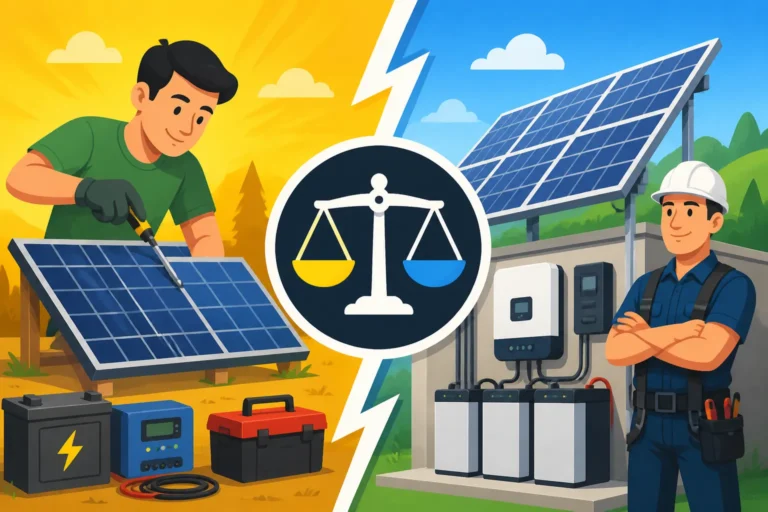
One of the biggest decisions you'll face when planning your off-grid solar system is whether to tackle the installation yourself or hire professionals. Both approaches have their distinct cost implications, benefits, and potential pitfalls. It's not just about saving money; it's also about your time, skills, and comfort with electrical work.
The Appeal and Reality of DIY Savings
The allure of building your own off-grid solar system is strong, especially for those who are handy and enjoy a good project. Doing it yourself can indeed save you a significant amount on labor costs, which often accounts for 10-30% of a professional installation's total price. For a mid-sized system, this could translate to savings of several thousand dollars. Platforms like Amazon make it easier than ever to purchase individual components, from solar panels to wiring and mounting hardware, giving you complete control over your budget and component selection.
However, the "savings" come with a substantial time investment for research, learning, planning, and the physical installation itself. You'll need to understand how to size an off-grid solar system, how to wire solar panels in series or parallel, properly size your battery bank, and ensure all components are compatible. This requires a solid understanding of electrical principles, safety protocols, and often local building codes. If mistakes are made, they can be costly, leading to damaged equipment, system inefficiencies, or even dangerous electrical hazards. Furthermore, some warranties may be voided if a system isn't installed by a certified professional. It’s definitely not a task for the faint of heart or those without a strong mechanical aptitude and a willingness to learn deeply. Our guide on How Much Cheaper Is DIY Off-Grid Solar delves into this further.
When Professional Installation is Worth the Investment
For many, hiring a professional solar installer is the preferred route, despite the higher upfront cost. Professionals bring expertise, experience, and efficiency to the table. They can accurately assess your energy needs, design an optimized system, procure components, handle all the complex wiring, ensure the system meets local electrical codes, and manage any permitting requirements. This expertise translates to peace of mind, knowing your system is safely and correctly installed, often backed by warranties on both equipment and workmanship.
While you'll pay for labor, which can range from $3,000 for a small system to $15,000+ for a large whole-house setup, this investment can prevent costly errors, maximize system performance, and ensure longevity. For complex systems, especially those requiring high voltages or integrating with existing home electrical panels, a licensed electrician or solar professional is almost always recommended for safety and compliance. This is particularly true if you're not comfortable with advanced electrical work or if your local regulations require licensed installers for specific projects. The cost of an off-grid solar installation by professionals often includes all the hidden costs like permits, inspections, and detailed system design, saving you time and potential headaches.
Hidden Costs in Both Approaches
Regardless of whether you go DIY or professional, be aware of potential hidden costs that can creep up. For DIYers, these might include specialized tools you need to buy (crimpers, multimeters, conduit benders), unexpected trips to hardware stores, and the cost of rectifying mistakes. You might also underestimate the actual time commitment, leading to project delays.
For professional installations, ensure your quote is comprehensive. Does it include permitting fees? Site surveys? Any necessary trenching for ground mounts? Ongoing maintenance contracts? Some installers might give a low initial quote but then add on "change orders" for things not explicitly listed. Always get a detailed breakdown. Both approaches also need to factor in potential costs for system expansion down the line, or for replacing components, especially batteries, which have a finite lifespan. Consider our detailed article on Hidden Costs of Going Off-Grid to prepare for all eventualities.
Long-Term Costs and Financial Considerations
The initial investment in an off-grid solar system is just one part of the financial picture. To truly understand the value and feasibility of going off-grid, you need to consider the long-term operational costs, potential savings, and any available financial incentives. It's a journey, not just a destination, and budgeting accordingly for the entire lifespan of your system is crucial.
Maintenance and Replacement Costs
While solar panels themselves are incredibly durable and require minimal maintenance (mostly just cleaning), other components of an off-grid system do have specific maintenance needs and finite lifespans. Batteries, as mentioned, are the biggest consideration. Lead-acid batteries require regular watering (for flooded types) and equalization charges, and typically need replacement every 3-7 years. LiFePO4 batteries are largely maintenance-free but will still need replacement after 10-20 years, depending on usage. Replacing a substantial battery bank can be a significant expense, easily running into thousands or tens of thousands of dollars. Our article on the Cost to Replace Off-Grid Solar Batteries dives into this detail.
Inverters typically last 10-15 years, while charge controllers can last 15-20 years or more. Wires and fuses generally last the lifetime of the system unless there's a fault. You should also budget for periodic inspections, especially for connections and grounding, to ensure everything remains safe and efficient. Some proactive maintenance, like checking for loose connections or wear and tear, can prevent larger issues. While these aren't annual costs like a utility bill, they are crucial to factor into your long-term financial planning.
Potential for System Expansion
One of the great advantages of modular solar systems is the ability to expand them over time. Many people start with a smaller system to meet basic needs and then add more panels and batteries as their energy consumption grows or their budget allows. This phased approach can make the initial investment more manageable. However, it's vital to design your initial system with expansion in mind.
This means choosing an inverter and charge controller that can handle additional capacity, as well as leaving space for more panels on your roof or ground mount. If you don't plan ahead, expanding your system could involve replacing major components prematurely, which is a costly mistake. For example, if you buy a charge controller that can only handle 1000 watts of solar and later decide you need 2000 watts, you'll have to buy a new, larger charge controller. Thinking about the Cost of Expanding an Off-Grid System from the outset can save you significant money and headaches down the road.
Off-Grid Solar Payback Period and Savings
One of the most compelling financial arguments for off-grid solar is the long-term savings. While the initial investment is substantial, once your system is paid off, your "fuel" (sunlight) is free! This eliminates monthly utility bills, which can be a huge relief, especially with rising electricity rates. For those in remote locations, the alternative might be extending utility lines, which can cost anywhere from $20,000 to $100,000 per mile or more, making off-grid solar a far more cost-effective choice.
The "payback period" refers to how long it takes for the savings on utility bills (or the avoided cost of grid extension) to equal your initial investment. This period varies wildly depending on your system cost, your previous or alternative energy costs, and how efficiently you use your power. For some, especially those avoiding costly grid extensions, the payback can be relatively quick, perhaps 5-10 years. For others, it might be 15-20 years. After the payback period, every day is essentially "free" energy, offering significant financial independence and a strong return on investment. Our article on Off-Grid Solar Payback Period Explained offers a detailed analysis.
Government Incentives and Tax Credits
It’s worth investigating whether any government incentives or tax credits apply to off-grid solar systems. In the United States, the federal solar tax credit (Investment Tax Credit or ITC) has historically offered a percentage credit on the cost of qualifying solar installations. While primarily aimed at grid-tied systems, certain components of an off-grid system that generate electricity and are stored for use in a residence may qualify. It's always best to consult with a tax professional, but generally, the components directly related to solar electricity generation and storage (panels, inverters, batteries) are often eligible.
Beyond federal incentives, some states or even local municipalities offer their own rebates, grants, or property tax exemptions for solar installations. These can vary widely, so it's crucial to research what's available in your specific area. For example, some states might offer incentives for rural energy development. These incentives can significantly reduce your net cost and make off-grid solar more accessible. For current information, consider looking into resources like the Database of State Incentives for Renewables & Efficiency (DSIRE). Our article on the 2026 Solar Tax Credit and Off-Grid Systems can provide more specific guidance.
Real-World Examples and Budgeting for Your Off-Grid Dream
Let's ground these abstract costs in some tangible scenarios. Understanding what real people spend on different types of off-grid systems can help you visualize your own project and begin to outline a realistic budget. Remember, these are examples, and your specific costs will depend on your unique needs and choices.
Sample System Costs for Different Scenarios
-
The Weekend Warrior Camper Van:
- Goal: Power lights, charge devices, run a small 12V fridge, maybe a small fan.
- Components: Two 100W flexible solar panels, a 30A MPPT charge controller, one 100Ah LiFePO4 battery, a 1000W pure sine wave inverter (for occasional AC use).
- Estimated DIY Component Cost: $1,800 – $3,000.
- Real-world Note: Many van lifers start with a portable power station like a Jackery Explorer 1000 and one or two portable solar panels, which could be purchased for around $1,000 to $1,500 on Amazon, offering a quick and easy solution for basic needs. This is often an excellent way to dip your toes into off-grid living before committing to a full build.
-
The Remote Cabin Retreat (Seasonal Use):
- Goal: Lights, TV, microwave, small refrigerator, small well pump (intermittent), laptop charging.
- Components: Four 300W rigid solar panels (1200W total), a 60A MPPT charge controller, two 200Ah 12V LiFePO4 batteries (wired for 24V, 400Ah total), a 3000W 24V pure sine wave inverter. Comprehensive wiring, disconnects, and ground mounts.
- Estimated DIY Component Cost: $7,000 – $12,000.
- Estimated Professional Installation Cost: $12,000 – $18,000.
- Real-world Note: For seasonal use, careful sizing of the battery bank to bridge cloudy periods is crucial, but less critical than for year-round living. This often allows for a slightly smaller overall system.
-
The Full-Time Off-Grid Homestead (Family Home):
- Goal: All standard household appliances (refrigerator, washing machine, oven, well pump, AC/heating via mini-split), robust power for daily living.
- Components: Twenty 400W solar panels (8000W total), two 80A 48V MPPT charge controllers, eight 200Ah 48V LiFePO4 server rack batteries (19.2 kWh total), a 8000W 48V inverter-charger, dedicated sub-panel, extensive safety gear, possibly a backup generator with auto-start.
- Estimated DIY Component Cost: $35,000 – $60,000.
- Estimated Professional Installation Cost: $50,000 – $90,000+.
- Real-world Note: This level of system requires meticulous planning, often involving an energy audit and professional design. The battery bank and inverter are the most expensive components here, and quality cannot be compromised for reliability. Our guide on How Much Does an Off-Grid Solar System Cost provides an even broader look at overall expenses.
Tips for Saving Money Without Compromising Quality
Going off-grid can be expensive, but there are smart ways to save without sacrificing system integrity or safety.
- Prioritize Energy Efficiency: This is your biggest lever! Before you even size your system, reduce your energy demand. Switch to LED lighting, use energy-efficient appliances (look for Energy Star ratings), consider propane for cooking and water heating, and insulate your home well. Every watt-hour you don't use is a watt-hour you don't need to generate or store, directly reducing the size (and cost) of your solar array and battery bank.
- Shop Around for Components: Don't just buy the first thing you see. Compare prices from different reputable suppliers. Online retailers like Amazon often have competitive pricing on smaller components, while specialized solar distributors might offer better deals on larger items like panels and batteries, especially for bulk purchases. Look for sales and end-of-season discounts.
- Consider Used or Refurbished Equipment (Cautiously): You can sometimes find good deals on used solar panels or even inverters, but proceed with extreme caution. Always verify the condition, test the equipment if possible, and ensure the seller offers some kind of warranty or return policy. Batteries, especially lead-acid, are generally not recommended to buy used due to their limited lifespan.
- Phase Your Build: Start with a smaller system that meets your immediate essential needs, and plan for future expansion. This allows you to spread the cost over time. For example, install enough conduit and wiring for your ultimate panel count, but only install half the panels and batteries initially. You can gradually add more panels or batteries as your budget allows. Our article on How to Phase an Off-Grid Solar Build to Spread Cost offers practical strategies for this.
- DIY Smartly: If you're confident in your skills, doing some or all of the installation can save thousands. However, know your limits. You might DIY the panel mounting and wiring to the charge controller, but hire an electrician to handle the AC wiring from the inverter to your breaker panel. Safety and proper wiring are paramount.
Avoiding Common Costly Mistakes
- Underestimating Energy Needs: This is probably the most common and expensive mistake. If you undersize your system, you'll constantly run out of power, stressing your batteries, and eventually forcing you to buy additional (expensive) components. Always conduct a thorough load analysis and factor in a buffer for cloudy days or unexpected usage.
- Skimping on Batteries: Batteries are expensive, but they are also the most critical component for reliable off-grid power. Buying cheap, low-quality batteries, or undersizing your battery bank, will lead to premature failure, frustrating power outages, and frequent, costly replacements. Invest in the best batteries you can afford for your application.
- Ignoring Balance of System (BOS) Costs: As discussed, the smaller components like wiring, fuses, and disconnects can add up. Failing to budget for these or using inadequate components can lead to safety hazards, voltage drop, and inefficient performance. These are not areas to cut corners.
- Failing to Plan for Expansion: Not accounting for future growth means you might have to replace perfectly good, but undersized, components like charge controllers or inverters if your power needs increase. Always design your system with some headroom.
- Overlooking Maintenance: While off-grid solar is relatively low maintenance, neglecting battery care (for lead-acid) or ignoring early warning signs from your monitoring system can lead to catastrophic failures and significantly shorten the lifespan of your components. Regular checks are a small price to pay for system longevity.
Disclaimer
The information provided in this article is for general informational purposes only and does not constitute professional advice. Off-grid solar system design and installation can be complex and involve electrical hazards. Always consult with qualified professionals, such as licensed electricians or certified solar installers, to assess your specific needs, ensure proper system sizing, and comply with all local codes and regulations. Prices and product availability are subject to change.