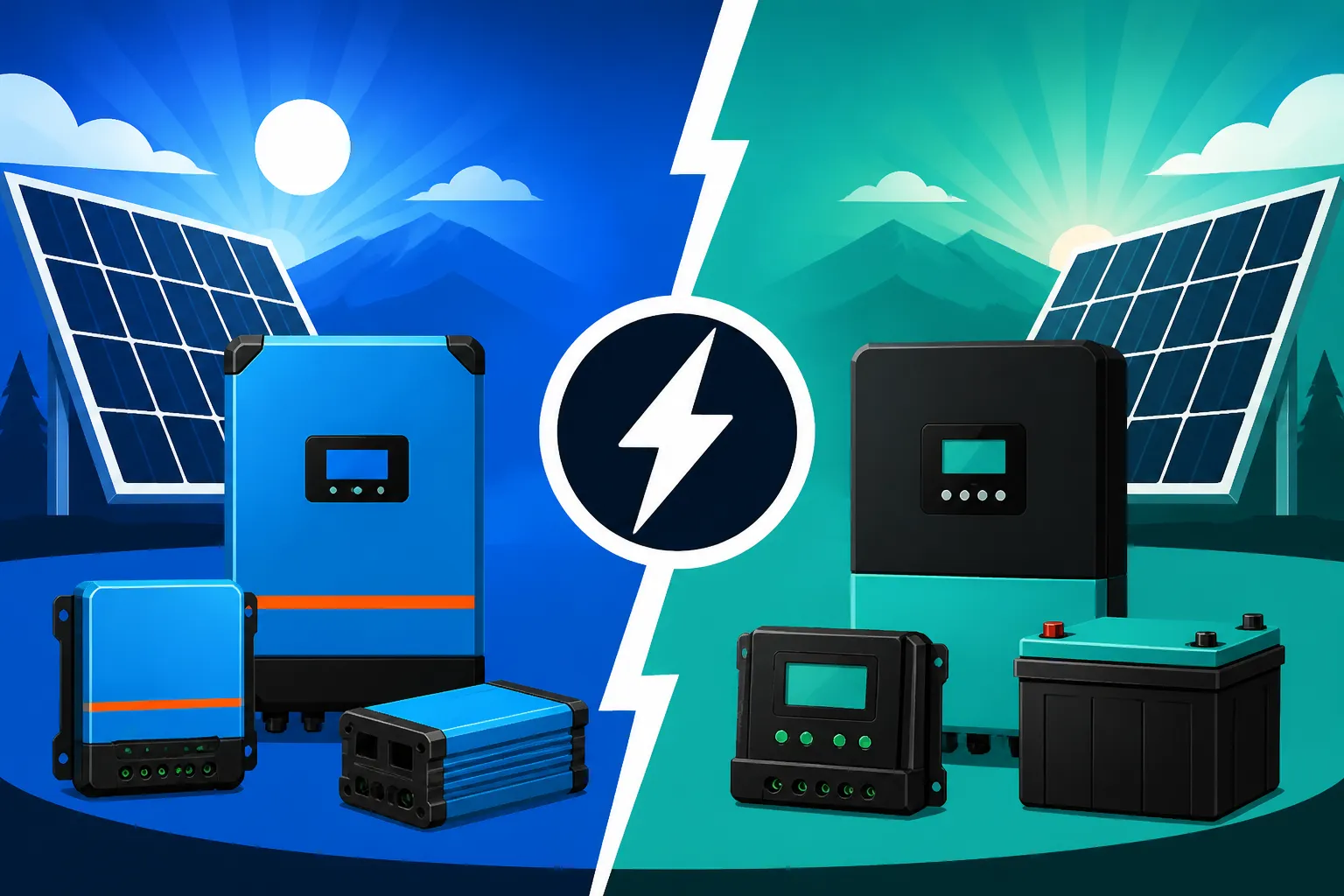
Victron vs Renogy Equipment
Picking the right components for your off-grid solar system can feel like navigating a maze, especially when you're trying to balance uncompromising quality, robust features, and a realistic budget. It's a common frustration to see fantastic systems online only to realize they're out of reach, or to worry that a more affordable option might leave you stranded. This comprehensive guide will deeply compare two prominent names in off-grid solar, Victron Energy and Renogy, helping you understand their core philosophies, product offerings, and ultimately, which brand might be the best fit for your unique off-grid adventure.
Understanding the Core Philosophies
Before we dive into the nitty-gritty of specific components, it's crucial to grasp the overarching philosophy that drives each brand. This understanding will help you see why their products are designed the way they are and who they're generally trying to serve. It’s not just about specs; it’s about the entire ecosystem and user experience.
The Victron Energy Approach: Robustness and Integration
Victron Energy has carved out a niche as a premium brand, often favored by seasoned off-gridders, marine and RV professionals, and anyone who demands ultimate reliability and sophisticated system control. Their philosophy centers on creating incredibly robust, high-performance components that integrate seamlessly into a cohesive, intelligent system. Think of them as the meticulously engineered European sports car of off-grid power – every part is designed to work in harmony, providing exceptional longevity and detailed data.
When you opt for Victron, you're not just buying an inverter or a charge controller; you're investing in a complete ecosystem. Their devices are built to communicate extensively with each other via their proprietary VE.Bus or VE.Direct protocols, managed through their powerful VictronConnect app and the ubiquitous Cerbo GX monitoring device. This allows for deep customization, remote monitoring, and complex system automation, making them ideal for mission-critical applications or advanced users who want absolute command over their power. This focus on seamless integration makes them a top contender for those wondering how to install an off-grid solar system with maximum efficiency and reliability.
The Renogy Approach: Accessibility and Value
Renogy, on the other hand, operates with a philosophy centered on making off-grid solar accessible and affordable for a wider audience. They're often the go-to brand for DIY enthusiasts, weekend warriors, and those looking to get started with a functional system without breaking the bank. Renogy aims to provide a comprehensive range of products that are relatively easy to install and operate, offering a complete solution from solar panels down to the wiring.
Many beginners find Renogy appealing because they offer numerous bundles and kits, simplifying the decision-making process for those new to solar. While their individual components might not always have the advanced features or deep integration capabilities of a Victron system, Renogy prioritizes straightforward functionality and good value for money. They provide a solid foundation for many common off-grid scenarios, whether you're powering a small cabin, an RV, or a van. You can often find their kits readily available, even on platforms like Amazon, making them easy to acquire for a DIY Off-Grid Solar build.
Inverters and Inverter Chargers
The inverter is the heart of any AC off-grid system, transforming the DC power from your batteries into usable household electricity. Inverter chargers, which combine an inverter and a battery charger, add the capability to charge your batteries from an AC source like a generator or shore power. This is one area where the philosophical differences between Victron and Renogy become very apparent.
Victron Inverters and Inverter Chargers
Victron offers a wide array of inverters and inverter chargers, most notably their MultiPlus and Quattro lines. These units are renowned for their extremely high build quality, clean pure sine wave output, and advanced features. The MultiPlus, for instance, is an inverter, a sophisticated battery charger, and a transfer switch all in one, capable of power assist (supplementing a weak AC source with battery power) and parallel/split-phase operation for larger systems. The Quattro adds a second AC input, perfect for integrating both grid and generator power simultaneously.
These devices boast exceptional surge capabilities, often double their continuous rating, which is crucial for starting high-draw appliances like well pumps or air conditioners. They are also designed for long-term reliability in harsh environments. The trade-off, of course, is the price; Victron units represent a significant investment. However, their longevity, performance, and the detailed control offered through the VictronConnect app and Cerbo GX often justify the higher initial cost for those who prioritize reliability and advanced functionality. If you're looking into the Cost of an Off-Grid Solar Inverter, Victron will typically be at the higher end, but for good reason.
Renogy Inverters and Inverter Chargers
Renogy offers a range of pure sine wave inverters and inverter chargers designed for more budget-conscious consumers and simpler setups. Their products, such as the Renogy Pure Sine Wave Inverter series or their all-in-one inverter chargers, aim to provide essential functionality without the complex features or advanced integration found in Victron systems. They are generally simpler to install and operate, making them a popular choice for beginners.
While Renogy inverters provide a reliable pure sine wave output suitable for most electronics, their surge capabilities and the depth of their programmable settings might not match Victron's top-tier offerings. They are excellent for powering common RV or cabin appliances, from laptops to microwaves, but might struggle with continuous heavy loads or specific motor-start applications where high surge is paramount. For many, the balance of cost and performance offered by Renogy is perfectly adequate, providing a solid foundation for their off-grid power needs without overcomplicating things.
Charge Controllers
The charge controller is the unsung hero of your off-grid solar system, managing the power flow from your solar panels to your battery bank. It ensures your batteries are charged efficiently and, more importantly, safely, preventing overcharging which can severely damage battery life.
Victron MPPT Charge Controllers
Victron's charge controllers are almost exclusively Maximum Power Point Tracking (MPPT) units, known for their industry-leading efficiency and advanced algorithms. Their SmartSolar MPPT controllers, like the popular SmartSolar MPPT 100/50, are renowned for extracting the maximum possible power from solar panels, especially in varying light conditions. This means more power gets to your batteries, maximizing your solar harvest throughout the day.
A key feature of Victron MPPTs is their Bluetooth connectivity, allowing users to monitor and configure settings directly from their smartphone via the VictronConnect app. This provides real-time data on solar yield, battery status, and load consumption, along with customizable charging parameters for various battery types. For complex systems, they integrate flawlessly with other Victron components, sharing data and optimizing overall system performance. This level of sophistication makes them a top choice when exploring the Best MPPT Charge Controllers for robust systems.
Renogy Charge Controllers
Renogy offers both PWM (Pulse Width Modulation) and MPPT charge controllers, catering to different budgets and system requirements. Their Wanderer and Voyager series are popular PWM controllers for smaller, more basic systems, providing an economical way to manage solar charging. For those seeking greater efficiency, Renogy's MPPT controllers, such as the Rover series, offer improved performance, especially for larger arrays.
Renogy MPPT controllers, while offering good efficiency and standard charging profiles, typically don't provide the same depth of programmable settings or advanced monitoring capabilities as Victron. They are straightforward, reliable, and get the job done for most everyday off-grid scenarios. Many Renogy MPPT controllers also include an LCD screen for direct monitoring, and some have basic Bluetooth connectivity or options for external displays. For a general purpose setup, particularly where budget is a primary consideration, Renogy's charge controllers offer excellent value and reliability.
Battery Offerings
The battery bank is your energy reservoir, storing the power generated by your solar panels for when you need it. The choice of battery technology and brand can significantly impact your system's overall performance, lifespan, and initial cost.
Victron Battery Solutions
While Victron Energy itself doesn't directly manufacture a wide range of house bank batteries under its own brand for the consumer market (they focus more on lead-acid batteries for specific marine/automotive applications, and increasingly integrate with third-party lithium battery systems), their entire system design is geared towards seamless integration with high-performance battery banks. They are often paired with premium third-party LiFePO4 (lithium iron phosphate) batteries, such as those from Battle Born or EG4, which are known for their longevity, high cycle life, and deep discharge capabilities.
Victron's Lynx Smart BMS (Battery Management System) and various battery monitors, like the BMV-712 Smart or SmartShunt, are industry standards for precisely managing and monitoring virtually any battery chemistry. These devices provide incredibly accurate state-of-charge readings, historical data, and critical protections, especially for demanding lithium battery setups. This allows users to build a truly robust and optimized battery system by combining Victron's intelligence with top-tier battery cells from specialized manufacturers. This approach gives you immense flexibility when considering how to choose an off-grid battery bank.
Renogy Battery Solutions
Renogy offers a comprehensive lineup of batteries, including both sealed lead-acid (AGM and Gel) and LiFePO4 options, making them a one-stop-shop for many off-grid needs. Their LiFePO4 batteries have become particularly popular, offering a good balance of performance, lifespan, and price. Renogy's lithium batteries often come with an integrated Battery Management System (BMS), simplifying installation and providing essential protections against overcharging, over-discharging, and temperature extremes.
For those just starting out or working with a tighter budget, Renogy's AGM batteries provide a dependable, lower-cost entry point into off-grid power, though with a shorter lifespan and shallower discharge cycles compared to lithium. Their LiFePO4 batteries are a step up, offering better efficiency, lighter weight, and a much longer cycle life, representing a significant improvement for long-term use. Renogy's emphasis on offering complete kits, often including their own batteries, makes them a convenient choice, particularly when considering the Off-Grid Solar Cost: Complete Breakdown.
| Feature/Component | Victron Energy | Renogy |
|---|---|---|
| Core Philosophy | Premium, robust, highly integrated, advanced monitoring | Accessible, value-focused, comprehensive kits, user-friendly |
| Target User | Experienced off-gridders, professionals, demanding applications, full system control | Beginners, DIYers, RV/van life, small cabins, budget-conscious |
| Inverters | MultiPlus, Quattro series. High surge, power assist, parallel ops, advanced comms. | Pure Sine Wave Inverters, Inverter Chargers. Reliable, essential functions, good value. |
| Charge Controllers | SmartSolar MPPT series. Industry-leading efficiency, advanced algorithms, deep customization, Bluetooth. | Rover MPPT, Wanderer/Voyager PWM. Good efficiency (MPPT), accessible pricing, straightforward. |
| Batteries | Focus on integration with high-quality third-party LiFePO4 (e.g., Battle Born). Victron Lynx BMS/Monitors are premium. | Comprehensive range: AGM, Gel, LiFePO4 with integrated BMS. One-stop shop for battery needs. |
| Monitoring | Cerbo GX, VictronConnect App. Remote, deep data, full system overview. | Basic LCDs, some Bluetooth for individual components. Simpler data. |
| Price Point | High-end, significant investment | Mid-range to budget-friendly |
| Expandability | Excellent, designed for modular growth and complex setups | Good for adding similar components, less advanced system-wide integration |
System Integration and Monitoring
Having all your components talking to each other and giving you a clear picture of your power situation is invaluable, especially when you're truly living off-grid. This is another area where the two brands take distinctly different paths.
Victron's Comprehensive Monitoring Ecosystem
Victron excels in system integration and monitoring, arguably offering the most comprehensive and user-friendly solution on the market. Their GX devices, such as the Cerbo GX, act as the central communication hub for all Victron components, as well as many third-party devices. This hub gathers data from your inverter, charge controllers, battery monitor, and even external sensors like tank levels or temperature.
All this data is then accessible locally via a display (like the Touch 50 or Touch 70) or remotely through the VictronConnect app and their VRM (Victron Remote Management) portal. The VRM portal is a game-changer, allowing you to monitor your system's performance, view historical data, and even make configuration changes from anywhere in the world with an internet connection. This level of remote control and detailed insight is unparalleled and provides immense peace of mind for permanent off-grid living or remote installations. It allows for a nuanced understanding of your system's performance, which is critical when you need to know How to Calculate Off-Grid Solar Needs and fine-tune your setup.
Renogy's Simpler Monitoring Options
Renogy's approach to monitoring is generally more component-specific and less integrated than Victron's. Many of their charge controllers and some inverters feature built-in LCD screens that display basic operational data like battery voltage, charging current, and load consumption. This is perfectly adequate for many users who just need to quickly check the essentials.
For more advanced monitoring, Renogy offers external meters like the BT-2 Bluetooth Module or the Renogy ONE, which provide a more centralized view, often accessible via a smartphone app. While these tools offer valuable insights, they typically don't provide the same depth of historical data, remote control capabilities, or seamless, system-wide integration that Victron's ecosystem delivers. Renogy focuses on providing clear, actionable information for individual components, which is ideal for simpler systems where extensive data logging and remote control aren't critical requirements. For those who enjoy a hands-on approach and prefer direct interaction with their system, Renogy's more localized monitoring solutions are often quite sufficient.
Support, Warranty, and Community
Beyond the hardware itself, the support infrastructure, warranty terms, and the community around a brand can significantly impact your long-term off-grid experience. When issues arise, knowing you have reliable backing can be just as important as having quality equipment.
Victron's Professional Support and Vibrate Community
Victron Energy is known for its robust support network, often delivered through a global network of certified dealers and installers. While direct end-user support from Victron isn't always as accessible as some might like, their authorized partners are typically highly knowledgeable and experienced in designing, installing, and troubleshooting complex Victron systems. This can be a huge asset for those undertaking a large or intricate off-grid project. Their warranty terms are generally strong, reflecting the premium quality of their products, often ranging from 5 to 10 years on major components.
Furthermore, Victron benefits from an incredibly active and knowledgeable online community. Their official forums, as well as numerous independent off-grid and marine forums, are brimming with users and experts willing to share advice, wiring diagrams, and troubleshooting tips. This strong community support, coupled with extensive documentation and detailed manuals, means that even if you're not going through a certified installer, you have a wealth of resources at your fingertips. This aspect is particularly valuable for anyone diving deep into topics like Off-Grid Solar System Design Basics.
Renogy's Accessible Support and Growing Community
Renogy places a strong emphasis on direct customer support, offering various channels including phone, email, and online chat. Their goal is to make off-grid solar achievable for everyone, and their support reflects that, often catering to customers who might be newer to solar technology. They also have a comprehensive FAQ section and a growing library of instructional videos and guides on their website, which are incredibly helpful for DIYers.
Renogy's warranty typically varies by product, with solar panels often carrying a 25-year power output warranty and other components like inverters and charge controllers having a shorter, but still respectable, 1-5 year warranty. As a popular brand for accessible solar, Renogy also has a substantial and active user community across various social media platforms and forums. While perhaps not as deeply technical as some Victron-focused discussions, the Renogy community is excellent for sharing installation experiences, troubleshooting common issues, and finding tips for optimizing simpler setups. Many users find their products readily available for purchase and with reliable service, which contributes to their popularity. This is especially true for those exploring options like Off-Grid Solar Kits: What to Buy.
The Cost-Benefit Analysis
Ultimately, your decision often comes down to balancing performance, features, and cost. Neither brand is inherently "better" than the other; they simply offer different value propositions tailored to different needs and budgets. It's about finding the right fit for your off-grid journey.
Investing in Victron: Long-Term Value and Control
Choosing Victron is undeniably a larger upfront investment. You're paying for cutting-edge technology, exceptional build quality, advanced features, and a seamlessly integrated ecosystem that provides unparalleled control and monitoring. This higher initial cost, however, often translates into long-term benefits: potentially fewer replacements, higher efficiency, and the peace of mind that comes with a robust, reliable system. For those contemplating Is Off-Grid Solar Worth the Cost or the Off-Grid Solar Payback Period Explained, the longevity and efficiency of Victron components can significantly influence those calculations over time.
For an off-grid home, a remote cabin for year-round living, or any application where consistent, reliable power is non-negotiable, the higher price tag for Victron often makes sense. The ability to precisely manage your system, troubleshoot remotely, and expand modularly ensures your investment is future-proof and resilient. It's the choice for those who view their off-grid power system as a critical utility and are prepared to invest in a professional-grade solution. This is particularly relevant when you're looking at things like the Lifetime Cost of an Off-Grid Solar System.
Renogy: Affordable Entry and Practical Power
Renogy offers a more budget-friendly entry point into off-grid solar, making it accessible to a wider audience. Their comprehensive kits and individual components provide a practical and effective way to generate and store solar power without the high upfront expense of premium brands. For many users, especially those with smaller power needs or those exploring off-grid living for the first time, Renogy provides an excellent balance of cost and functionality.
While Renogy systems might not offer the same depth of features or integration as Victron, they are perfectly capable of powering common appliances and providing a reliable off-grid experience for RVs, vans, small cabins, or backup power solutions. Their accessibility, ease of installation, and readily available components (often found on platforms like Amazon or directly from their website) make them a compelling choice for DIYers and those who prioritize practicality and affordability. If you're wondering How to Budget for an Off-Grid Solar System and want a reliable yet economical choice, Renogy often hits that sweet spot.
Ultimately, the choice between Victron and Renogy boils down to your specific needs, technical expertise, budget, and long-term vision for your off-grid system. If you're building a mission-critical, highly integrated system where maximum reliability and detailed control are paramount, and you have the budget, Victron is an excellent investment. If you're a DIY enthusiast, looking for an accessible entry into off-grid solar, or need a practical, cost-effective solution for a smaller setup, Renogy offers outstanding value and functionality. Both brands contribute significantly to the off-grid solar landscape, empowering people to achieve energy independence in their own way.
Disclaimer
The information provided in this guide is for general informational purposes only. While we strive to provide accurate and up-to-date content, off-grid solar systems involve electrical work that can be dangerous if not handled properly. Always consult with qualified professionals and adhere to local electrical codes and safety guidelines when designing, installing, or maintaining any solar power system. Product specifications, features, and pricing can change, so always verify current details with the manufacturers or retailers.