Is Off-Grid Solar Worth It for a Greenhouse
Oh, the dream of a lush, thriving greenhouse, brimming with life, even when it's miles from the nearest power pole! Many of us who are passionate about growing know the frustration: you’ve found the perfect spot for your greenhouse—ideal sunlight, great drainage, sheltered from harsh winds—but it’s just too far to run grid power without breaking the bank. This guide is all about diving deep into whether off-grid solar is a practical, cost-effective, and truly worthwhile solution for powering your greenhouse, no matter its size or what you’re growing.
Understanding Your Greenhouse Power Needs
Before you even start dreaming about solar panels, the absolute first step is to get a crystal-clear picture of what you actually need to power inside your greenhouse. It's like planning a road trip without knowing your destination—you're just going to wander aimlessly. Many folks jump straight to buying panels or batteries, only to find out their system is either wildly undersized for their ambitions or massively oversized and far more expensive than necessary.
Identifying Essential Equipment and Their Consumption
Your greenhouse isn't just a passive structure; it's a dynamic environment that often relies on various pieces of equipment to maintain optimal growing conditions. Think about everything you use, or plan to use, throughout the year. Are you running circulation fans to prevent fungal growth on your tomatoes? Perhaps a small heater to ward off an unexpected late frost for your delicate orchids? Or maybe you're really serious about extending your growing season with powerful LED grow lights.
Let's break down some common culprits and their typical power hungry tendencies. Ventilation fans, especially larger exhaust fans, can draw a fair amount of power, often running intermittently throughout the day to regulate temperature. Heating elements, whether electric space heaters or heat mats for seed starting, are notorious energy hogs. A single 1500-watt electric heater, if it runs for just a few hours, can deplete a significant chunk of your battery bank. Grow lights, particularly high-intensity discharge (HID) lights or even arrays of powerful LEDs, will consume consistent power for many hours each day, sometimes 12-16 hours, making them a primary driver of your system size. Don't forget smaller items like automated irrigation pumps, misters, small circulating fans, weather stations, or even a small radio for ambiance. Each of these contributes to your overall demand, and it's vital to list them all out.
The best way to determine the consumption of each item is to check its label or manufacturer specifications. Look for wattage (W) or amperage (A) and voltage (V). If you only see amps, multiply amps by volts to get watts (W = A x V). If you're dealing with AC appliances (like most standard household items), they'll typically be 120V or 240V. For DC appliances (common in RVs or smaller off-grid setups), they'll likely be 12V or 24V. Don't forget that many appliances have a "starting wattage" or "surge wattage" that is much higher than their "running wattage," especially motors like those in pumps or large fans. Your inverter needs to be able to handle these brief surges.
Calculating Daily and Seasonal Energy Loads
Once you've identified all your equipment and their individual power draws, it's time to figure out your total daily energy consumption. This is where the rubber meets the road. For each piece of equipment, estimate how many hours per day it will run. For example, a small circulation fan might run 8 hours a day, while grow lights could be on for 14 hours. A heater might only kick on for 3 hours during the coldest part of the night.
Multiply the wattage of each item by its estimated daily run time to get its daily watt-hour (Wh) consumption. Then, add all these watt-hour totals together to find your average daily watt-hour usage. This number is your golden ticket, as it directly informs how many solar panels you'll need and how large your battery bank should be. For a more detailed walkthrough, check out our guide on how to calculate daily energy usage.
What often trips people up is forgetting that greenhouse needs aren't static; they fluctuate wildly with the seasons. A greenhouse in Minnesota in January will have vastly different energy requirements than one in Arizona in July. In winter, heating and artificial lighting become paramount, potentially running for longer durations or drawing more power to compensate for shorter, colder days. This means a higher daily watt-hour demand, and critically, fewer peak sun hours to recharge your batteries. Conversely, summer might demand more power for ventilation and cooling fans, but you'll have an abundance of sunlight to produce that power. You need to plan for your worst-case scenario, typically the darkest, coldest part of winter, to ensure year-round reliability. This load calculation is the cornerstone of how to size an off-grid solar system correctly.
The Benefits and Drawbacks of Off-Grid Solar for Greenhouses
Deciding to go off-grid with your greenhouse is a big step, and it comes with its own unique set of advantages and challenges. It's not a one-size-fits-all solution, and what works beautifully for one gardener might be overkill or insufficient for another.
Advantages of Going Solar for Your Greenhouse
There's a lot to love about powering your greenhouse with the sun, especially if you're keen on self-sufficiency and a touch of eco-friendliness.
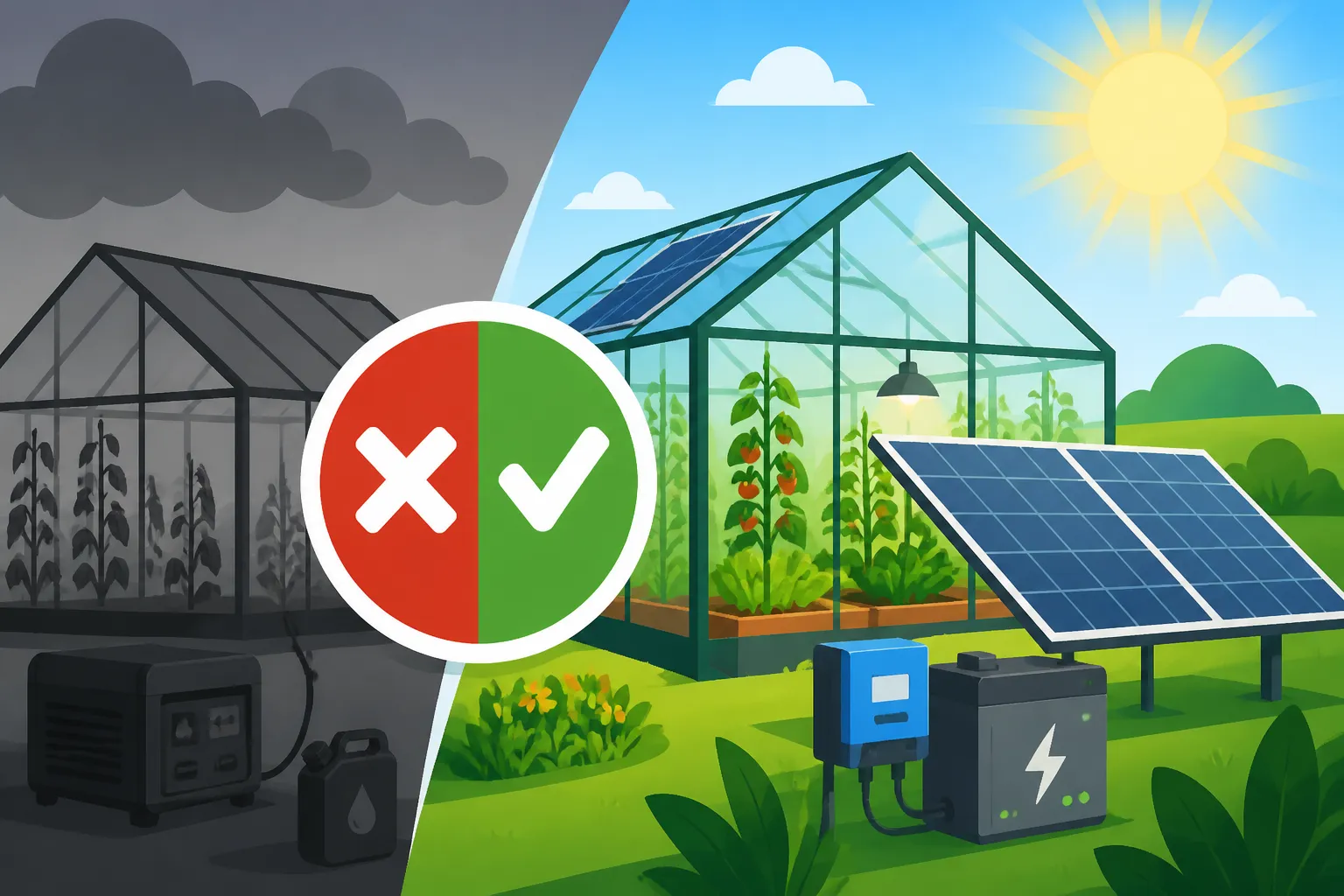
First and foremost is energy independence. Imagine never having to worry about power outages disrupting your carefully controlled growing environment. Your plants won't even notice if the neighborhood grid goes down. This resilience is a massive plus, particularly for those growing sensitive or high-value crops. You're no longer tethered to a utility company, its fluctuating rates, or its infrastructure reliability. For some remote properties, extending traditional grid power can be prohibitively expensive, costing tens of thousands of dollars just to run lines to your site. In such cases, off-grid solar can actually be the more economical choice upfront. Our article on Off-Grid Solar vs Grid-Tied Cost Comparison delves into this further.
Then there's the environmental benefit. You're harnessing clean, renewable energy, reducing your carbon footprint, and growing your plants in a truly sustainable way. This aligns perfectly with the ethos of many gardeners and homesteaders who are looking to live more harmoniously with nature.
Furthermore, off-grid solar offers incredible flexibility in placement. You can put your greenhouse in the absolute best horticultural spot on your property, regardless of how far it is from existing power lines. No more compromising on location because of power access. Whether it's nestled in a clearing in the woods or perched on a sunny hillside, if the sun hits it, you can power it. This also means you can easily move or expand your greenhouse setup in the future without needing costly electrical work.
Finally, while the initial investment can feel substantial, off-grid solar often leads to lower long-term operating costs. Once your system is paid for, your "fuel" (sunlight) is free. No more monthly utility bills for your greenhouse power consumption, which can add up significantly, especially if you're running heaters or grow lights for extended periods. Over the lifespan of your system, these savings can be quite substantial.
Potential Challenges and Considerations
Now, let's be realistic. Off-grid solar isn't without its hurdles, and it's important to go in with your eyes wide open about the potential downsides.
The most significant barrier for many is the initial upfront cost. A robust off-grid solar system capable of powering a moderately sized greenhouse, especially one with heating or serious grow lights, can be a significant investment. You're buying all the components—panels, batteries, charge controller, inverter, wiring, and mounting hardware—outright. While the cost of an off-grid solar system can vary wildly depending on its size and complexity, it's rarely a cheap endeavor, especially compared to just plugging into an existing outlet. For example, a small, basic setup for a shed or greenhouse might be a few hundred dollars, but a system powering a well-equipped growing operation could easily run into several thousands. You can read more about how Off-Grid Solar Cost by System Size is determined to get a better idea.
Next up is intermittency and battery storage. Solar panels only produce power when the sun shines. What happens on cloudy days? Or at night? This is where your battery bank comes in. You need enough battery capacity to store excess energy generated during the day to power your greenhouse when the panels aren't producing. Underestimating your battery needs is one of the most common mistakes, leading to frustrating power shortages during crucial times. The type and size of your battery bank will significantly impact your overall cost and system reliability. Our guide on how many batteries for an off-grid system provides key insights.
Maintenance is another factor. While modern solar systems are fairly low-maintenance, they're not entirely hands-off. Panels need occasional cleaning, batteries need monitoring, and components might need replacement over time. This isn't the same as just plugging into the wall and forgetting about it.
Finally, there's the complexity of design and installation. Sizing a system correctly requires careful calculations and a good understanding of electrical principles. While smaller systems can be a DIY project, larger, more complex setups might warrant professional help to ensure safety and efficiency. Making mistakes in wiring or component selection can be costly and even dangerous.
Key Components of an Off-Grid Greenhouse Solar System
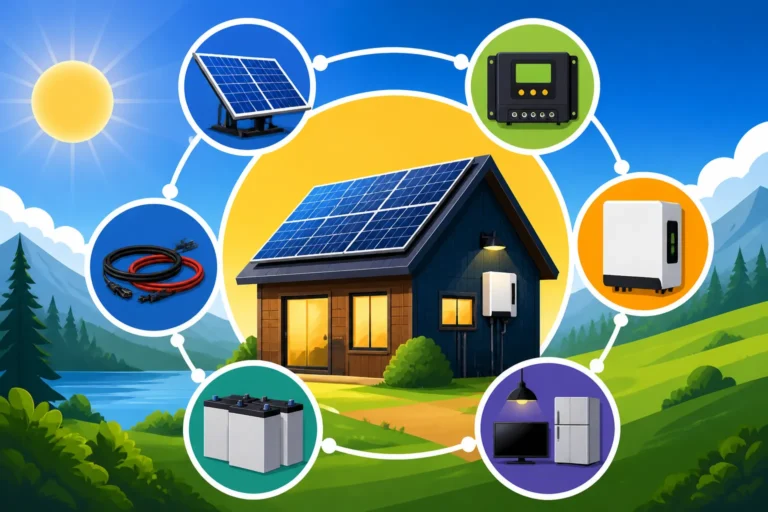
If you decide off-grid solar is the right path for your greenhouse, understanding the core components is essential. Think of it like building a house: you need a strong foundation, walls, a roof, and all the internal systems to make it livable. Your solar system is no different.
Solar Panels and Mounting Options
The solar panels themselves are the heart of your system, diligently converting sunlight into electricity. For greenhouses, you'll primarily be looking at rigid monocrystalline panels. These are the most efficient and durable, designed for long-term outdoor use, and come in various wattages, typically ranging from 100W to 400W or more per panel. While flexible panels exist, they are generally less efficient, more expensive per watt, and have a shorter lifespan, making them less ideal for a permanent greenhouse setup unless you have very specific, curved surface mounting needs.
When it comes to mounting options, you have a few practical choices for a greenhouse:
- Roof Mounts: This is often the most space-efficient option. Panels can be mounted directly onto the greenhouse roof, assuming the structure is strong enough to support the weight and handle wind loads. The main challenge here is shading the greenhouse itself, which might be counterproductive to your growing efforts. Careful placement is key to ensure you're not blocking essential light from your plants while maximizing panel exposure.
- Ground Mounts: This is usually the preferred method for greenhouses. Ground mounts allow you to position your panels independently of the greenhouse structure, typically south-facing (in the Northern Hemisphere) and at an optimal tilt angle to capture the most sunlight throughout the year. This avoids shading your plants and often provides easier access for cleaning and maintenance. You can use fixed tilt mounts or even adjustable tilt mounts to change the angle seasonally, further optimizing production. Our guide on how to install off-grid solar panels goes into more detail on these techniques.
- Pole Mounts: Similar to ground mounts but elevated on a single pole, these can be good for getting panels above minor obstructions or snow accumulation, but they require a very sturdy foundation and skilled installation.
Regardless of the mounting style, ensuring your panels are optimally angled and free from shading is critical for maximum energy production. Even a small amount of shading on one panel can significantly reduce the output of an entire series string.
Battery Storage Solutions for Continuous Power
Batteries are the unsung heroes of any off-grid system, especially for a greenhouse where consistent power is often non-negotiable. They store the energy your panels generate during sunny periods, making it available when the sun isn't shining—like at night or on heavily overcast days. This stored energy provides the "days of autonomy" you need to keep your greenhouse running smoothly.
You'll primarily encounter two main types of batteries suitable for off-grid solar:
- Lead-Acid Batteries: These are the traditional workhorses, including flooded lead-acid (FLA), absorbed glass mat (AGM), and gel batteries. FLAs are generally the most affordable upfront but require regular maintenance (checking water levels) and have a shorter lifespan and lower usable capacity (you shouldn't discharge them below 50% to maximize their life). AGMs and gels are sealed, maintenance-free, and more resilient, but still have lower usable capacity and shorter lifespans compared to lithium.
- Lithium Iron Phosphate (LiFePO4) Batteries: These are the newer, premium choice and have become incredibly popular for off-grid applications. While they have a higher upfront cost, LiFePO4 batteries offer significantly longer lifespans (often 10-15 years or more), can be discharged much deeper (typically to 80-100% without damage), are much lighter, and are virtually maintenance-free. They are a fantastic investment for serious, long-term off-grid setups. Many growers find the peace of mind and performance of LiFePO4 batteries, like those from Battle Born or EG4, to be well worth the investment for critical greenhouse operations. You can learn more about these options in our guide to the best off-grid solar batteries.
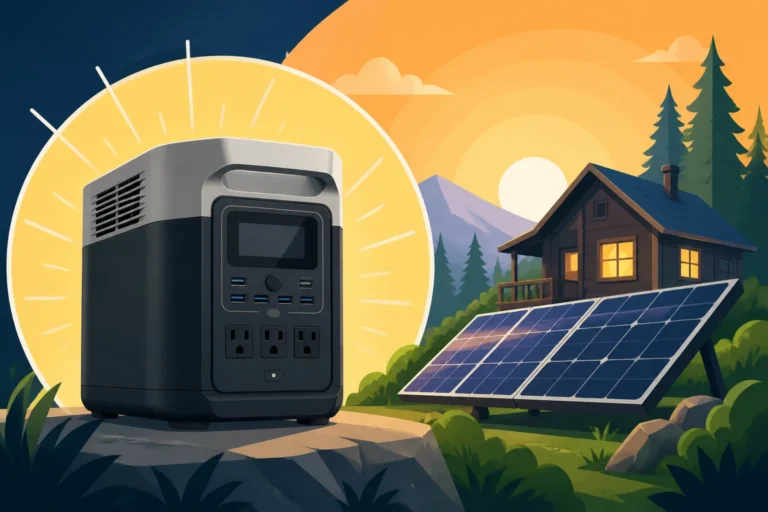
For smaller, more temporary greenhouse needs, or as a way to "test the waters" with off-grid power, portable power stations can be a fantastic entry point. Brands like Jackery offer integrated battery, inverter, and charge controller solutions that are plug-and-play. A Jackery Solar Generator can power smaller fans, LED grow lights, or even a small heat mat for several hours. This is especially useful for seasonal greenhouses or those just getting started without committing to a full-blown permanent system.
Charge Controllers and Inverters
These two components are the intelligent managers of your off-grid solar system, ensuring everything operates safely and efficiently.
The charge controller acts as the brain between your solar panels and your battery bank. Its primary job is to regulate the voltage and current coming from the solar panels to prevent overcharging your batteries, which can severely damage them. There are two main types:
- PWM (Pulse Width Modulation) Charge Controllers: These are simpler, less expensive, and generally suitable for smaller systems where the voltage of the solar panels closely matches the voltage of the battery bank (e.g., 12V panel charging a 12V battery).
- MPPT (Maximum Power Point Tracking) Charge Controllers: These are more sophisticated and efficient, especially for larger systems and when the panel voltage is significantly higher than the battery bank voltage. MPPT controllers can "step down" higher voltage from your panels more efficiently, converting excess voltage into additional current. This means you get more usable power from your solar array, which is often crucial for meeting the demands of a greenhouse. If you're serious about maximizing your energy harvest, an MPPT controller is almost always the better choice. Our piece on MPPT vs PWM Charge Controllers offers a deeper dive into their differences.
The inverter is what allows you to use standard household AC appliances (like most fans, heaters, or pumps) with your DC battery bank. Solar panels and batteries produce direct current (DC) power, but most appliances run on alternating current (AC) power. The inverter converts that DC power into AC power.
For a greenhouse, you'll almost certainly want a pure sine wave inverter. While modified sine wave inverters are cheaper, they can be inefficient and potentially damaging to sensitive electronics or anything with a motor (like pumps or many types of fans). Pure sine wave inverters produce a clean, smooth waveform identical to grid power, ensuring your greenhouse equipment runs optimally and safely. When sizing your inverter, remember that surge capacity is important. If you have a well pump or a large fan that momentarily draws a lot of power when it starts up, your inverter needs to be able to handle that brief surge, not just the continuous running wattage.
Is Off-Grid Solar a Worthwhile Investment for Your Greenhouse?
This is the million-dollar question, isn't it? After all the calculations and component choices, you want to know if this leap into off-grid independence for your greenhouse truly makes sense for your specific situation.
Cost-Benefit Analysis and Payback Period
To truly assess worth, you need to conduct a thorough cost-benefit analysis. Start by totaling up the initial investment for your entire off-grid solar system. This includes panels, batteries, charge controller, inverter, wiring, mounting hardware, and any installation costs if you hire professionals. This figure can be significant, potentially ranging from a few thousand dollars for a basic setup to well over $10,000 or more for a comprehensive system supporting heavy loads. You can get a good handle on these numbers by exploring articles like How Much Does an Off-Grid Solar System Cost or How Off-Grid Solar Saves Money Long-Term.
Now, compare that to the alternative: extending grid power, if that's even an option. If your greenhouse is far from the existing grid, the cost of trenching, poles, and electrical hookups can easily be astronomical, often surpassing the cost of a decent solar system. In such scenarios, off-grid solar isn't just worth it; it's often the only practical and affordable solution.
Next, consider your ongoing operational costs. With solar, your "fuel" is free. Compare this to the monthly electricity bills you'd incur if connected to the grid, especially during peak heating or lighting seasons. Factor in potential increases in utility rates over time. Over the lifespan of your solar system (which can be 20-25 years for panels and 10-15 years for quality lithium batteries), those monthly savings can really add up.
The "payback period" is the time it takes for your cumulative energy savings to equal your initial investment. For a greenhouse, this can vary wildly. If you're replacing very expensive grid extension costs, the payback could be almost immediate. If you're offsetting moderate electricity bills, it might be 5-10 years. Our article, Off-Grid Solar Payback Period Explained, dives deep into how to calculate this important metric. The longer you plan to use the greenhouse, the more attractive the long-term savings become.
Scenarios Where Off-Grid Solar Shines and Where It Doesn't
Let's look at some real-world situations to help you gauge if off-grid solar is a perfect fit for your greenhouse:
Where it Shines:
- Remote Locations: This is the absolute sweet spot. If your dream greenhouse spot is acres away from grid power, off-grid solar is often the most cost-effective and logical choice. The alternative of running miles of trenching and electrical lines would simply be too expensive.
- Small to Medium-Sized Seasonal Greenhouses: If you're growing seasonally and only need power for basic ventilation, circulation, a few heat mats, or supplemental lighting for a few hours, a well-sized off-grid system is perfectly manageable and highly efficient. You might even start with a portable solar generator like a robust Jackery model and expand later.
- Emergency Preparedness: For those who want to ensure their valuable plants are protected even during extended power outages, an off-grid solar setup provides unparalleled peace of mind.
- Eco-Conscious Growers: If sustainability and a minimal environmental footprint are top priorities, off-grid solar aligns perfectly with your values.
Where it Doesn't Shine as Brightly:
- Large-Scale Commercial Greenhouses with High, Constant Loads: If you're running multiple industrial-sized heaters, powerful high-bay grow lights for 18 hours a day, large exhaust fans, and intricate climate control systems across a massive commercial operation, the sheer scale of the off-grid solar system required could be prohibitively expensive and logistically challenging. The battery bank alone would be immense, and the number of panels needed would be vast. For these operations, grid-tied or hybrid systems are often more practical.
- Greenhouses with Easy, Affordable Grid Access: If your greenhouse is just steps from your house or an existing power source, and the cost to connect to the grid is minimal, then off-grid solar might be an unnecessary expense, at least initially. The convenience and lower upfront cost of grid power would likely outweigh the benefits of going off-grid unless energy independence is your absolute top priority.
- Budget-Constrained Projects with High Energy Demands: If you have a very limited budget but a greenhouse full of energy-intensive equipment that needs constant power (e.g., year-round exotic plant cultivation in a cold climate), off-grid solar might not be feasible without significant compromises in reliability or performance.
Ultimately, the "worth" is subjective and tied to your specific circumstances. Consider the cost to power a greenhouse with solar for various sizes and needs before making a final decision.
Making an Informed Decision for Your Cultivation Goals
Deciding whether off-grid solar is worth it for your greenhouse really boils down to a few key factors: your actual energy needs, your location's solar resources, your budget, and your personal priorities regarding energy independence and sustainability.
Don't skip the step of performing a detailed load analysis—it's the single most important part of sizing your system. Underestimating your needs will lead to frustrating power shortages, while overestimating can lead to unnecessary costs. Be realistic about how much power each piece of equipment truly draws and for how long. Remember to account for seasonal variations, especially those long, dark winter nights or intense summer heat waves.
Consider starting small if you're unsure. For a modest greenhouse, a basic 400W Off-Grid Solar System might be sufficient for a fan, some lights, and a few small heating pads. You could even begin with a smaller portable power station to run a few essential items and see how it handles your needs before investing in a full-blown system. A portable unit from a brand like Jackery or EcoFlow can give you a taste of off-grid living without the full commitment.
If you decide to take the plunge, take the time to budget meticulously. Our guide on how to budget for an off-grid solar system can walk you through the process. Research different components and don't be afraid to ask questions. There's a huge community of off-grid enthusiasts eager to share their knowledge. Whether you're aiming for a fully self-sufficient ecosystem for year-round exotic plants or just powering a simple fan for your summer vegetables, off-grid solar offers a pathway to making your greenhouse dreams a reality, free from the constraints of the grid.
Disclaimer
The information provided in this article is for general informational purposes only and does not constitute professional advice. While we strive to provide accurate and up-to-date information, off-grid solar system design, installation, and specific energy requirements can be complex and vary widely based on individual circumstances, local codes, and product specifications. Always consult with qualified professionals, such as certified electricians or solar installers, before making any purchasing decisions or undertaking any installation work. We are not responsible for any actions taken based on the information presented herein.