How to Choose Off-Grid Solar for a Greenhouse
Stepping into the world of off-grid solar for your greenhouse can feel a lot like trying to decipher a secret gardening manual written in an alien language. You know you want to provide your plants with the perfect environment, but figuring out how to power those critical fans, grow lights, and even a small heater without a grid connection often brings up more questions than answers. The good news is, you're not alone in feeling this way, and this guide is here to untangle the complexities, helping you choose and implement an effective, reliable off-grid solar system so your greenhouse can thrive independently.
Understanding Your Greenhouse's Unique Energy Demands
Before you even think about buying panels or batteries, the very first, and arguably most important, step is to truly understand what your greenhouse needs in terms of power. It's not just about flipping a light switch; a greenhouse is a dynamic environment with demands that shift by the season, the time of day, and even the type of plants you're nurturing.
Identifying Your Essential Loads and Usage Patterns
Think of your greenhouse as a miniature ecosystem, each component playing a vital role. What equipment keeps that ecosystem humming along? For most folks, this starts with the basics:
- Ventilation Fans: Crucial for air circulation, preventing overheating, and controlling humidity. You might have exhaust fans to push hot air out and circulation fans to move air around internally. These often run for many hours a day, especially in warmer months.
- Grow Lights: If you're extending your growing season or starting seedlings indoors, supplemental lighting is a must. These can be significant energy consumers, often running 12-18 hours daily.
- Heating/Cooling: Whether it's a small space heater to ward off a surprise frost or a pump for an evaporative cooling system, these components are highly seasonal and can draw a lot of power when active.
- Irrigation Pumps: If you're using an automated watering system, the pump will need power, though usually intermittently.
- Environmental Monitoring Sensors: Thermometers, hygrometers, and soil moisture sensors might have minimal power draws, but they often run continuously, making them important to account for.
The key here is not just what you're powering, but how long and when. A small hobby greenhouse might only need power for a circulation fan and a few LED lights for a couple of hours in the evening, while a larger, year-round operation could require continuous power for multiple systems. Take the time to make a list of every electrical device you plan to use, note its wattage (often found on the appliance label or in its manual), and estimate how many hours a day or week it will run. Don't forget those peak seasonal demands – winter heating or summer cooling could drastically change your daily energy consumption.
The Critical Role of Climate and Plant Needs
Your local climate and the specific types of plants you're growing are huge factors in determining your energy requirements. For example, a greenhouse in a sunny, mild climate like Southern California might only need power for occasional ventilation and irrigation. In contrast, a greenhouse in a cloudy, cold region like the Pacific Northwest or a high-desert area could demand substantial power for grow lights and heating for months on end. This regional difference will directly influence how much solar you need to install.
Consider the temperature and humidity ranges your plants prefer. Tropical plants, for instance, demand consistent warmth and high humidity, which might necessitate more active heating and misting systems. Cold-tolerant greens, on the other hand, can often get by with less intervention. While passive solar design and good insulation can dramatically reduce your energy footprint, active powered solutions are almost always needed to maintain ideal conditions consistently. Knowing your plants' needs will help you prioritize which loads are absolutely essential to power year-round, and which can be more intermittent or even seasonal. This initial planning, often called performing an off-grid load analysis, is the bedrock of a successful system design.
Essential Components of an Off-Grid Greenhouse Solar System
Once you have a solid grasp of your greenhouse's power appetite, it's time to look at the individual pieces that will make up your off-grid solar system. Each component plays a specific role, and understanding them is key to making informed choices.
Solar Panels: Your Energy Harvesters
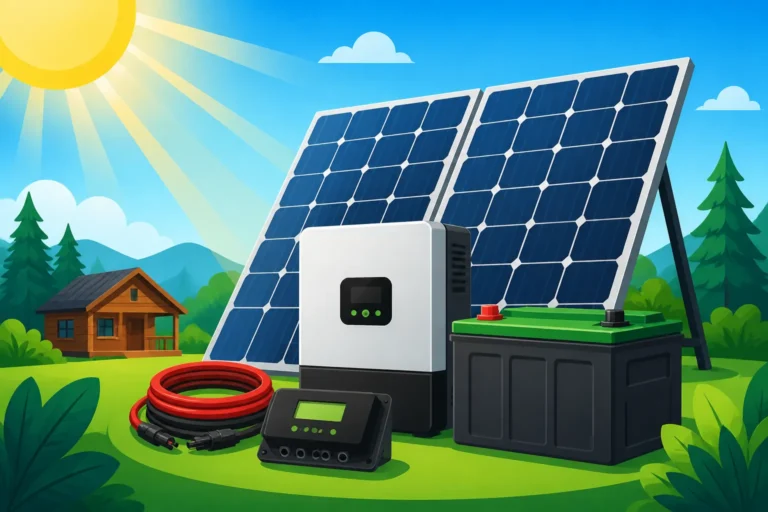
The solar panels are, quite literally, your primary source of power. They capture sunlight and convert it into usable electricity. When considering Best Off-Grid Solar Panels for your greenhouse, you'll typically encounter a few types:
- Monocrystalline Panels: These are often the most efficient, meaning they convert a higher percentage of sunlight into electricity, making them a great choice if you have limited space. They tend to perform well in lower light conditions, too.
- Polycrystalline Panels: A bit less efficient than monocrystalline, but usually more affordable. If you have plenty of roof or ground space, these can offer a good cost-per-watt value.
- Flexible Panels: While not typically ideal for large, permanent greenhouse installations due to their lower efficiency and sometimes shorter lifespan, they can be useful for small, portable setups or for unique curved greenhouse designs where rigid panels aren't an option.
When choosing panels, think about their durability. They'll be exposed to the elements year-round, so look for robust frames and tempered glass. Also, consider their physical size and how they'll fit on your greenhouse roof or on a ground mount nearby. Will they cast unwanted shade on your plants? Will they be easily accessible for cleaning? For many greenhouse owners, maximizing power output per square foot is important, especially if the greenhouse itself offers limited roof space.
Batteries: Storing Sunshine for Later
Solar panels only produce power when the sun shines. What happens at night, on cloudy days, or during those crucial early morning hours when your grow lights need to kick on? That's where your battery bank comes in. This is where you store all that beautiful sunshine for later use. Choosing the right batteries is critical for the reliability and longevity of your off-grid setup, and it's also a significant portion of your overall off-grid solar cost: complete breakdown.
The two main contenders you'll hear about are:
- LiFePO4 (Lithium Iron Phosphate) Batteries: These are the new darlings of the off-grid world. They offer a much longer cycle life (meaning they can be charged and discharged many more times), can be deeply discharged without damage, are lighter, and perform better in a wider range of temperatures than lead-acid batteries. While their upfront cost is higher, their longevity and performance often make them more cost-effective over the system's lifespan. Brands like Battle Born and EG4 are popular in this space.
- Lead-Acid Batteries (AGM, Gel, Flooded): These have been the workhorses of off-grid systems for decades. They are more affordable upfront but have a shorter lifespan, can't be discharged as deeply, and require more careful maintenance (especially flooded types). They can also be sensitive to cold temperatures, which might be a concern in an unheated battery enclosure near a greenhouse.
For a greenhouse, where consistent power is often paramount for plant health, investing in high-quality batteries is usually a wise decision. When you're figuring out how many batteries for an off-grid system, you'll need to consider how many "autonomy days" you want – essentially, how long your system can run without any sun.
Inverters and Charge Controllers: The Brains of the Operation
These two components act as the intelligence and muscle of your off-grid system, ensuring everything runs smoothly and safely.
The charge controller is like a traffic cop for electricity. It manages the power flow from your solar panels to your batteries, protecting them from overcharging, which can severely damage them. You'll typically choose between two types:
- MPPT (Maximum Power Point Tracking) Controllers: These are more efficient, especially in varying light conditions and when your panel voltage is significantly different from your battery voltage. They can extract up to 30% more power from your panels compared to PWM controllers, which often makes them worth the extra cost for any serious off-grid greenhouse.
- PWM (Pulse Width Modulation) Controllers: Simpler and less expensive, these are suitable for very small systems where the panel voltage closely matches the battery voltage. For most greenhouse setups, an MPPT controller is the way to go to maximize energy harvest.
The inverter is what allows you to use standard AC (alternating current) appliances, like your grow lights, fans, or pumps, from your DC (direct current) battery bank.
- Pure Sine Wave Inverters: These produce clean, stable electricity, just like your utility company. They are essential for sensitive electronics, motors (like those in fans and pumps), and anything with a clock or timer. For a greenhouse, this is almost always the best choice to ensure all your equipment runs correctly and without damage.
- Modified Sine Wave Inverters: Cheaper but produce a "choppier" waveform. These can damage certain appliances, cause motors to run hot or inefficiently, and interfere with electronics. Avoid these for anything critical in your greenhouse.
It's absolutely vital to match your inverter's capacity to the surge loads of your appliances. Motors, like those in well pumps or exhaust fans, can draw 3 to 7 times their running wattage for a brief moment when they start up. Your inverter needs to be able to handle this "starting wattage" without faulting. Many Best Off-Grid Solar Inverters come with built-in surge capabilities, so look closely at those specs. If you're pondering how to choose an off-grid solar system, pay special attention to the inverter's surge rating, as undersizing can lead to frustrating power interruptions.
Sizing and Designing Your Off-Grid Greenhouse System
This is where the rubber meets the road! Taking all the information about your energy needs and the components, you'll start to piece together a system that’s robust enough to keep your plants happy and healthy.
Performing a Detailed Load Calculation
Remember that list of all your greenhouse appliances and their estimated run times? Now it's time to use it to calculate your daily energy consumption in watt-hours (Wh). This is perhaps the single most crucial step in how to calculate off-grid solar needs.
Here’s a simplified breakdown:
- List all appliances: Fans, lights, pumps, heaters, sensors.
- Find the wattage: Look for the "W" or "watts" rating on each device. If it only lists amps (A) and voltage (V), multiply them (W = A x V).
- Estimate daily run time: How many hours per day will each device operate? Be realistic, considering seasonal changes.
- Calculate daily watt-hours per device: Wattage (W) x Daily Run Time (Hours) = Daily Watt-Hours (Wh).
- Sum it up: Add up the daily watt-hours for all your devices. This gives you your total daily energy consumption.
Example Scenario: Let's say your greenhouse has a 200W LED grow light running 14 hours/day (200W * 14h = 2800Wh), a 50W circulation fan running 16 hours/day (50W * 16h = 800Wh), and a 100W irrigation pump running for 30 minutes (0.5 hours) twice a day (100W * 1h = 100Wh). Your total daily consumption would be 2800 + 800 + 100 = 3700Wh.
Don't forget to account for any surge currents for motors, as mentioned earlier. Your inverter must be able to handle the highest momentary surge in your system. This detailed calculation forms the basis for everything else you buy.
| Appliance Category | Typical Wattage Range (W) | Daily Usage (Hours) | Daily Watt-Hours (Wh) | Notes for Greenhouse |
|---|---|---|---|---|
| Lighting | ||||
| LED Grow Lights | 50 – 600 | 12 – 18 | 600 – 10,800 | Essential for plant growth; varies by plant type and light intensity. |
| Supplemental LEDs | 10 – 50 | 4 – 8 | 40 – 400 | For seed starting or specific areas. |
| Climate Control | ||||
| Exhaust Fan | 50 – 500 | 4 – 12 (seasonal) | 200 – 6,000 | Critical for air circulation and humidity control. |
| Circulation Fan | 10 – 100 | 8 – 24 | 80 – 2,400 | Prevents fungal diseases, ensures even temperature. |
| Small Heater | 500 – 1500 | 2 – 8 (seasonal) | 1,000 – 12,000 | Used for frost protection or specific plant needs. Often high draw. |
| Cooling Pad Pump | 50 – 200 | 2 – 8 (seasonal) | 100 – 1,600 | For evaporative cooling systems. |
| Watering & Misc. | ||||
| Irrigation Pump | 100 – 750 | 0.5 – 2 | 50 – 1,500 | For drip systems or watering. Intermittent use. |
| Environmental Sensor | 1 – 5 | 24 | 24 – 120 | Low continuous draw, critical data. |
| Small Fan (e.g., for portable station) | 5 – 20 | 6 – 12 | 30 – 240 | Portable, temporary spot cooling. |
Matching Components to Your Energy Profile
With your load calculation in hand, you can now accurately size the different parts of your system. This is where how to size an off-grid solar system becomes a practical exercise.
- Sizing Your Solar Panels: You need enough solar panels to generate your total daily watt-hours, plus a buffer for cloudy days and system inefficiencies. You'll need to research your area's "peak sun hours" – the equivalent number of hours per day when sunlight intensity averages 1,000 watts per square meter. If your greenhouse location gets 4 peak sun hours and you need 3700Wh daily, you'd need panels capable of producing 3700Wh / 4h = 925W. Factor in some loss for wiring, temperature, and dust (typically 20-30%), so aim for about 1100-1200W of panels. This is how many solar panels for off-grid living might vary for different applications.
- Sizing Your Battery Bank: Your battery bank needs to store enough energy to last through periods without sun (your "autonomy days"). For a greenhouse, you might aim for 2-3 days of autonomy to ensure consistency. If your daily need is 3700Wh, and you want 2 days of autonomy, you need 7400Wh of usable battery capacity. Remember that lead-acid batteries can only be discharged to about 50% without shortening their life, while LiFePO4 batteries can go much deeper (80-100%). This greatly impacts how much battery capacity you actually need versus what you buy.
- Sizing Your Inverter: As discussed, the inverter's continuous rating should be higher than your total simultaneous running wattage of all AC appliances, and its surge rating must handle the highest starting load. If your grow light is 200W and a large exhaust fan is 500W (with a 1500W surge), and they might both run at the same time, your inverter needs to handle 700W continuous and at least a 1500W surge. A 2000W pure sine wave inverter is a common choice for smaller to medium greenhouses.
Designing the right system is a balancing act between capacity, cost, and reliability. This also helps in understanding the cost of an off-grid solar battery bank and the overall system. Don't be afraid to over-size slightly, especially on the panel side, to account for less-than-ideal weather. When you're ready to tackle the budget, our guide on how to budget for an off-grid solar system can be a huge help.
Considering Scalability and Future Needs
One of the smartest moves you can make is to design your off-grid system with future expansion in mind. It's incredibly common for greenhouse enthusiasts to start small and then realize they want to add more grow lights, a stronger fan, or even automate their irrigation further down the line. Trying to shoehorn new components into a system that wasn't designed for it can be a headache and more expensive in the long run.
Think about choosing a charge controller and inverter that have a bit of overhead capacity. For example, if your current panel array needs a 60A MPPT controller, consider one rated for 80A if the budget allows. This leaves room to add more solar panels later without needing to replace a major component. Similarly, opting for a slightly larger inverter than your current peak load might accommodate future additions like a powerful seed-starting mat or a small refrigerator for plant samples.
For those just starting or looking for supplemental power, portable power stations like the Jackery Explorer series offer excellent flexibility. A Jackery unit can run smaller, critical components like sensors or a low-power circulation fan, giving you peace of mind if your main system needs maintenance or for specific plant requirements in isolated sections. You could even use a Jackery power station for an additional grow light during specific growth phases without needing to immediately expand your main battery bank. It's a fantastic way to phase an off-grid solar build to spread cost, allowing you to get some off-grid capability now and build out the larger system over time.
Installation, Maintenance, and Maximizing Efficiency
Once you've meticulously planned and acquired your off-grid solar components, the next phase is bringing it all to life. Proper installation and ongoing maintenance are crucial for ensuring your system performs reliably for years to come.
Practical Installation Tips for Greenhouses
Installing solar in a greenhouse environment has its own unique considerations. While the general principles of how to install an off-grid solar system remain the same, you'll want to pay attention to specifics:
- Panel Mounting: Your greenhouse roof might be made of polycarbonate or glass, which typically isn't designed to hold the weight of solar panels. Ground mounts or pole mounts are often a more practical and structurally sound solution for greenhouses. They also offer the flexibility to adjust the panel tilt angle seasonally, optimizing power production. If you do mount on a greenhouse structure, ensure it's robust enough or reinforced.
- Wiring Protection: The interior of a greenhouse can be humid, and pests like rodents are common. All wiring must be properly protected in conduit to prevent moisture ingress, UV degradation, and critter damage. Running cables underground in sealed conduit from a ground-mounted array to a weatherproof enclosure near or inside the greenhouse is a common and safe practice.
- Enclosure and Ventilation: Your batteries and electronics (charge controller, inverter) need a safe, dry, and well-ventilated home. This could be a dedicated outdoor enclosure, a shed adjacent to the greenhouse, or a specific, protected area within the greenhouse itself. If batteries are inside, ensure they are in a sealed, vented box, especially lead-acid types which can off-gas. Keep electronics away from direct sun and high humidity.
- Safety First: Proper grounding of your solar array and electrical components is non-negotiable for safety. If you're not comfortable with electrical work, it's wise to consult or hire a qualified electrician, even for a DIY off-grid solar installation step by step. They can ensure your system meets local electrical codes and is properly grounded.
Routine Maintenance for Longevity
Off-grid solar systems, especially in an agricultural setting, benefit greatly from regular check-ups. Just like your plants, they need a little TLC to thrive!
- Clean Your Panels: Dust, pollen, bird droppings, and even general greenhouse grime can accumulate on your solar panels, reducing their efficiency. A simple rinse with water (and a soft brush if needed) a few times a year, or more often during dusty seasons, can make a significant difference.
- Battery Health: Check battery terminals periodically for corrosion and ensure connections are tight. For flooded lead-acid batteries, you'll need to check water levels and top them up with distilled water. LiFePO4 batteries are largely maintenance-free on this front, but monitoring their state of charge with a battery monitor is always a good idea. Understanding off-grid solar maintenance costs often highlights that preventative care is much cheaper than reactive repairs.
- System Monitoring: Many charge controllers and inverters come with displays or apps that let you monitor system performance. Pay attention to how much power your panels are producing, your battery's state of charge, and if any error codes pop up. Catching small issues early can prevent bigger problems.
- Seasonal Adjustments: If your panels are on adjustable mounts, consider changing their tilt angle for summer and winter. A steeper angle in winter helps catch lower sun, while a flatter angle in summer maximizes exposure during longer days.
Optimizing Energy Use in Your Greenhouse
Even with a perfectly sized and installed system, the best way to ensure reliable off-grid power is to be as energy-efficient as possible. Every watt-hour saved is a watt-hour you don't need to generate or store.
- LED Grow Lights: If you're using grow lights, make sure they are energy-efficient LEDs. They produce less heat, reducing the need for cooling, and convert electricity to light more efficiently than older HPS or MH lamps.
- Smart Controls and Timers: Use programmable thermostats for fans and heaters, and timers for your lights and irrigation pumps. Only run equipment when it's absolutely necessary. For instance, why run an exhaust fan if the greenhouse is already cool enough naturally?
- Insulation and Sealing: Just like a house, a well-insulated greenhouse will retain heat better in winter and keep cool air in during summer, significantly reducing the energy needed for climate control. Seal up any drafts or gaps.
- Natural Ventilation and Shading: Leverage nature whenever possible! Open vents and doors for natural airflow before switching on exhaust fans. Use shade cloths on sunny days to reduce heat gain and the need for active cooling.
- Strategic Use of Portable Power: For instance, you could use a Jackery Explorer 1000 or similar portable power station to run a smaller fan for specific hot spots or to power a germination mat for a few weeks without tapping into your main system's battery bank. This isolates certain loads, making your overall system more resilient. A Jackery unit is fantastic for experimental setups or temporary needs, adding a layer of flexibility to your off-grid operations without the complex wiring of a full system expansion.
By meticulously planning your loads, carefully selecting your components, and diligently maintaining and optimizing your system, you can ensure your off-grid greenhouse provides a stable, thriving environment for your plants, independent of the grid.
Disclaimer
Please remember that the information provided in this guide is for educational purposes only and should not be considered professional electrical engineering or financial advice. Off-grid solar system design and installation can be complex and involve significant safety considerations. Always consult with qualified professionals, adhere to local building codes, and prioritize safety when working with electricity.